

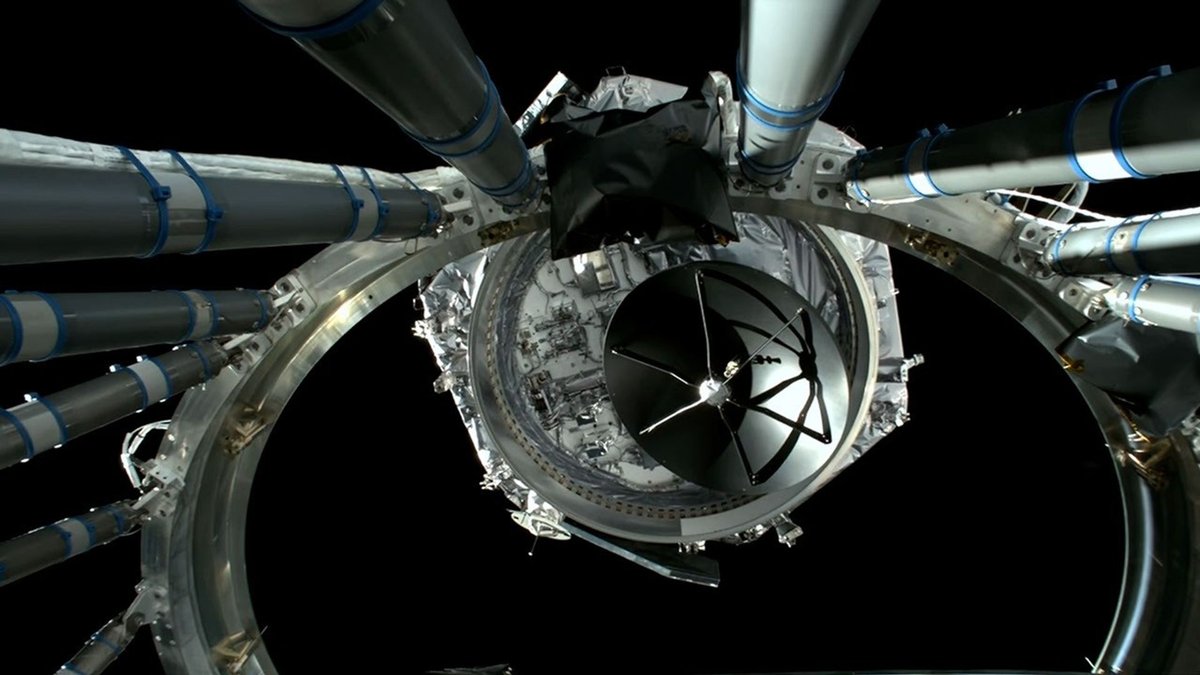
NASA’s Nancy Grace Roman Space Telescope is already exceeding expectations.
After reaching the launchpad ahead of schedule and on budget, the spy-satellite-sourced, $4-billion project pulled off a flawless launch to space on Sunday morning. At a postlaunch press conference, NASA officials noted that the performance of the rocket that took the telescope to space was so picture-perfect that Roman will likely need fewer trajectory adjustments than planned. That means Roman’s onboard fuel could instead help extend the observatory’s five-year mission to a full decade.
Lofted onboard a SpaceX Falcon Heavy rocket from NASA’s Kennedy Space Center in Florida, Roman was “exactly where it needed to be,” said Denton Gibson, launch director of NASA’s Launch Services Program, at the press event. “That’s a monumental effort because we know the more accurate the launch vehicle is, the more science we can get.”
On supporting science journalism
If you’re enjoying this article, consider supporting our award-winning journalism by subscribing. By purchasing a subscription you are helping to ensure the future of impactful stories about the discoveries and ideas shaping our world today.
“A launch is such a transition point,” said Julie McEnery, Roman’s senior project scientist at NASA’s Goddard Space Flight Center (GSFC). “It’s a transition because it’s an end point for the engineers, but it’s a starting point for the scientists.”
Roman “will contribute to world-changing science,” said NASA administrator Jared Isaacman. In addition to the agency’s Hubble Space Telescope and James Webb Space Telescope (JWST), “Roman will become a household name alongside those great instruments of discovery.”
Separating from its rocket about 30 minutes after launch, Roman successfully deployed its power-providing solar panels and spacecraft-cooling sunshield and will soon unfurl its high-gain antenna for broadband communications with Earth.
In the coming days, the observatory will perform a midcourse correction burn on its approximately three-month voyage to the second sun-Earth Lagrange point, or L2. There, situated 750,000 miles beyond the moon, Roman will begin its science mission to study dark energy, dark matter and exoplanets.
Along the way, the telescope will power up its two core science payloads: a wide-field infrared camera for panoramic views of the cosmos that will be 100 times wider than Hubble’s and an advanced coronagraph for capturing unprecedented images of exoplanets.
Nicky Fox, associate administrator for NASA’s Science Mission Directorate, summarized the sheer scale of Roman’s expected discoveries at the press conference: “Billions of galaxies will be found, tens of billions of new stars, tens of thousands of new planets, and thousands of supernovae—all wrapped up in one beautiful telescope.”
The observatory should beam back its first images before the winter holidays, said Jackie Townsend, Roman’s project manager at GSFC. And the telescope’s first year of science observations, slated to begin in January 2027, will be action-packed.
One of the mission’s top priorities will be putting the coronagraph through its paces—presumably by taking snapshots of known exoplanetary systems. “Let’s get that technology demonstration nailed so that we can think about what we might want to do next with that instrument,” McEnery said. Observations with Roman’s coronagraph could unveil Jupiter-like planets around nearby stars and will guide the development of NASA’s Habitable Worlds Observatory, which will target smaller, more Earth-like worlds.
Another early focus for the mission will involve using Roman’s wide-field camera to stare at the Milky Way’s star-packed central bulge. Those observations will constitute “a deeper, sharper view of the center of our galaxy” than ever before, McEnery said, and will ultimately deliver most of Roman’s exoplanet discoveries while initially helping mission controllers gauge the telescope’s on-sky performance.
In its first year Roman will also undertake a “pilot survey” of supernovae popping off across the sky and will separately gaze out of the galactic plane to gain a better view of the far-distant cosmos—similar to previous “deep field” images from Hubble, JWST and other telescopes.
“A year from now, we will have found thousands of new exoplanets, [and] we will have used the coronagraph to demonstrate new technologies in space for the first time,” McEnery said. “We will have conducted our pilot survey…, so we will be making new precise measurements of supernovae. Those same observations will allow us to catch the unexpected…. I’m pretty certain we’re going to find something we didn’t expect with that. And I think that that will probably be the most exciting result [of Roman’s first year of science].”
Roman’s most promising aspect, perhaps, is its synergy with Hubble, JWST and other facilities such as the U.S. Vera C. Rubin Observatory in Chile and the European Space Agency’s Euclid space telescope. Rubin and Euclid are each performing their own panoramic sky surveys, with significant areas of overlap with Roman’s. All three projects will collectively contribute to better measurements of how cosmic structure is changing over time—crucial information for clarifying the nature of dark energy and dark matter in the universe’s evolution.
And although, as a survey-style telescope, Roman boasts a wider, faster view of the sky than either Hubble or JWST, McEnery emphasized that doesn’t make these more focused missions obsolete. “There are things that Hubble [and JWST] can do that aren’t duplicated on any of our other observatories,” she said. “[With Roman] we’re redefining what it means to find a needle in a haystack—and when we find those needles, Hubble and Webb can then follow up, while Roman continues to go off and find new things.”
One of the postlaunch press conference’s most surprising moments came after Isaacman received an unexpected call midway through the briefing from President Donald J. Trump, who praised the mission’s success via speakerphone. It marks a change of heart for the administration, which had repeatedly proposed deep cuts to NASA’s science that included canceling Roman entirely. In the end, the observatory was saved by congressional intervention.
Isaacman shrugged off the shift. “The president of the United States is excited about our next great exploration asset that’s underway. I think that’s a great moment,” he said. “So I’m incredibly grateful for his support…. I do believe we’re entering a new golden age of discovery right now, and I think I’m going to have a lot to thank the president for on that.”
