


 Julie Bolthouse
Environmental campaigner Julie Bolthouse points out that Northern Virginia has the world’s largest concentration of data centres. This is not something she is thrilled about.
“We’re the Wall Street of the data centre industry,” says Ms Bolthouse, who is a director of local Virginian charity and campaign group Piedmont Environmental Council.
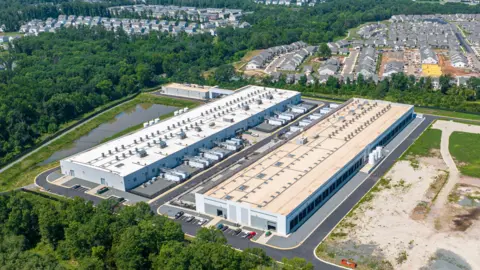
Data centres are vast warehouses that house stacks of computers that store and process data used by websites, companies and governments.
Northern Virginia, the northern region of the state of Virginia, has been a key location for data centres since the 1990s. This is thanks to its immediate proximity to Washington DC, yet with historically cheap electricity and land prices.
Centred on the city of Ashburn, which is 35 miles (56km) west of the US capital, there are more than 477 data centres in the state. This is by far the largest number in the US, with Texas in second place on 290, and California third with 283.
In fact, some studies say that 70% of the world’s internet traffic goes through Ashburn and the surrounding area, which has been dubbed “Data Centre Alley”.

 Hugh Kenny
Thanks in large part to the continuing boom in artificial intelligence (AI), which requires more computing power, demand for data centres is rocketing. As a result, global data centre capacity is expected to double over the next five years, according to a recent study by business analysis firm Moody’s.
Ms Bolthouse and other environmentalists in Northern Virginia are opposed to the continuing expansion of the data centre sector in their region, saying it is already having a major negative impact on their quality of life.
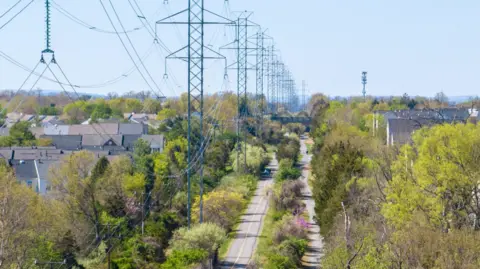
She points to new electricity cables being built over conservation land, parks and neighbourhoods, increased water demand, and the facilities’ back-up diesel generators affecting air quality.
Ms Bolthouse also cites the fact that households in Virginia and neighbouring Maryland are being expected to help pay for the electricity network upgrades that the data centres require.
She and fellow campaigners are fighting back. “We’re working directly on the ground, opposing each data centre application and working on the local zoning, and trying to educate our local planning commission and supervisors about the issues that we see. But we’re also working at the state level.”
Similar campaigns against data centres are springing up all over the world, including in the Republic of Ireland, where such facilities use 21% of the country’s electricity.
“Our main objections to data centres revolve around their potential negative impacts on our climate, their sustainability, and local infrastructure,” says Tony Lowes of Friends of the Irish Environment. “When data centres rely on fossil fuel, they potentially strain the electricity grid and can undermine national renewable energy commitments.”
The group is continuing to challenge plans for a new €1.2bn ($1.3bn; £1bn) data centre in County Clare on Ireland’s west coast.
Mr Lowes adds that while Friends of the Irish Environment would prefer to see data centre development halted altogether, there are various mitigations that might help, including sites prioritising renewable energy, and implementing energy and cooling efficiency measures.
 Hugh Kenny
The big players in the global data centre industry are trying to allay people’s concerns. This summer, for example, Microsoft launched its Data Center Community Pledge.
Microsoft is promising that by next year it will procure 100% renewable energy globally. And that by 2030 it will “achieve zero waste through a combination of waste reduction, reuse, recycling and composting”, and become “water positive”. The latter means that it aims for its data centres to return more water to the local supply than they use.
Meanwhile, Amazon Web Services (AWS) already uses recycled water for cooling in 20 of its 125 data centres around the world, and also says it will be “water positive” by 2030.
Josh Levi, president of the Data Center Coalition, which represents dozens of data centre operators including Amazon Web Services, Google, Microsoft and Meta, says that data centres are leading the way on clean energy use.
“For example, wind and solar capacity contracted to data centre providers and customers represented two-thirds of the total US corporate renewables market last year, and four of the top five purchasers of renewable energy in the US are companies that operate data centres,” he says.
“The data centre industry is also unlocking greater energy savings and efficiencies for homes, businesses, utilities, and other end users – everything from smart thermostats to grid-enhancing technologies require the digital infrastructure provided by data centres.”
The protests against data centres have also extended to South America, where campaigners say they have achieved successes.
In Uruguay, for example, Google changed the design of a new facility now under construction. It was initially due to be water cooled, but the US giant switched to an air-cooled system.
This followed protests in a country that has been experiencing droughts and a shortage of drinking water.
“Water use by Google in the initial proposal would have been equivalent to the daily consumption of drinking water by 55,000 people in our country,” says María Selva Ortiz of Friends of the Earth Uruguay.
“This threat to the right to water amidst a water crisis raised strong criticisms, leading Google to change the proposed technology to cool down its equipment, so the project was modified. Chillers will cool down with air instead of water.”
In Chile, meanwhile, Google has halted plans for a data centre over similar water use concerns.
Back in Virginia, Ms Bolthouse says the firms need to do more to boost sustainability. In the long run, she says, it will be in the industry’s own interests to improve data centres’ environmental impact.
“What’s going to happen if we continue with business as usual is that electrical prices are going to skyrocket for everybody, including the data centre industry – and that’s their biggest bill, so that’s going to impact them,” she says. “The water scarcity issue is also going to impact them.
“So I am optimistic that we’re going to see a little bit of progress, but I think it’s going to take time.”
