

Shortwave radios offer a way to connect one location on Earth to practically anywhere else with minimal infrastructure. But these radios come with some drawbacks—a significant one being that, unlike satellite communications, their transmission rates for digital data are typically measured in just hundreds of bits per second.
Peter Bloom
Peter Bloom is the founder of Rhizomatica, a nonprofit that works with remote, indigenous, and off-grid communities around the world to build shortwave and cellular-communication infrastructure.
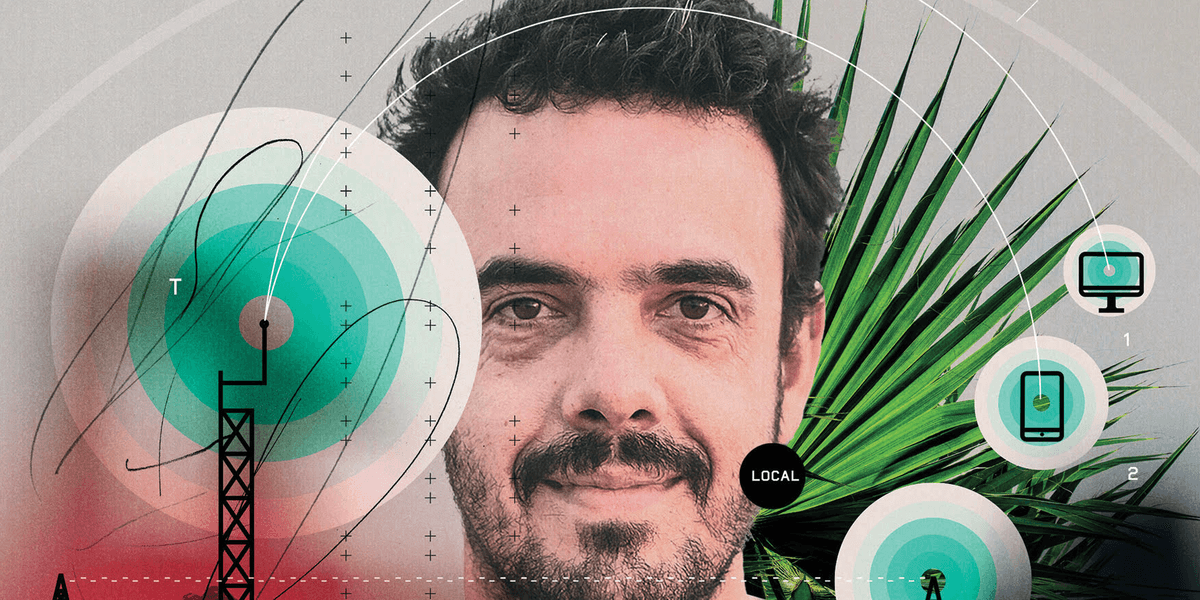
Peter Bloom is the founder of Rhizomatica, a Philadelphia-based nonprofit that has open-sourced a digital shortwave-radio set called the High-frequency Emergency and Rural Multimedia Exchange System, or HERMES. The set operates in the high-frequency (HF) band from 3 to 30 megahertz, as does Mercury, its digital modem. Rhizomatica staff travel around the globe to remote locations in countries like Bangladesh, Brazil, and Ecuador. Wherever they go, they use HERMES to help connect locals to the rest of the world.
Bloom spoke with IEEE Spectrum about how HERMES brings better data rates and encryption to shortwave radios.
How does HERMES connect remote locations?
Peter Bloom: We use the ionosphere as our satellite—or mirror—which helps us move information, voice, and data over really long distances. We’re using small radios that put out about 20 watts of power, and we can pretty reliably do 400- to 600-kilometer links between two radios. We’re talking about places that are not easy to reach, where it’s not simple to put terrestrial infrastructure.
What can HERMES send that a basic voice radio can’t?
Bloom: HERMES is a software stack—it’s a set of different programs that all work together in order to be able to send data over HF. HERMES allows you to send pretty much any file. Depending on what the file is, whether it’s a photo or an email or a voice memo, it just sends it as a file. It’s like a data pipeline over HF.
Why does sending files and data matter more than just voice?
Bloom: In emergency situations, people send their latitude and longitude over HF to say, “Hey, I’m here at this place.” People need to be able to send data over HF if there’s a manifest, a parts list, telemedicine—here’s what we have, here’s what we need. Instead of trying to read that out over the air, it’s much easier to just send the file. Same with a photo—if we need evidence that an area was logged illegally, we can just have someone send that over HF, rather than spending days getting down the river to get the photo where it needs to go.
Why did you build in encryption that amateur-radio regulations in many countries don’t allow?
Bloom: Encryption [regulations] for ham radio operators are different in each country. So it’s all optional—you turn it on, you turn it off. The reason we built the encryption is that some of the partners we work with are in very sensitive areas and don’t want to be sending out information that can be easily captured and used against them.
How has HERMES made an impact?
Bloom: We’ve been working with artisanal fishers in Bangladesh on a pilot project. There’s 10 or 11 boats that have HERMES systems on them. Pretty soon after we installed those, one of the boats had a mechanical issue in the Bay of Bengal, 100 or 200 kilometers offshore. They were able to send their GPS position and an SOS that they were having trouble. They were able to coordinate the rescue of the crew and the boat. So that was a really cool moment of HERMES in action that we’re super happy about.
This article appears in the October 2026 print issue as “Peter Bloom.”
From Your Site Articles
Related Articles Around the Web
