

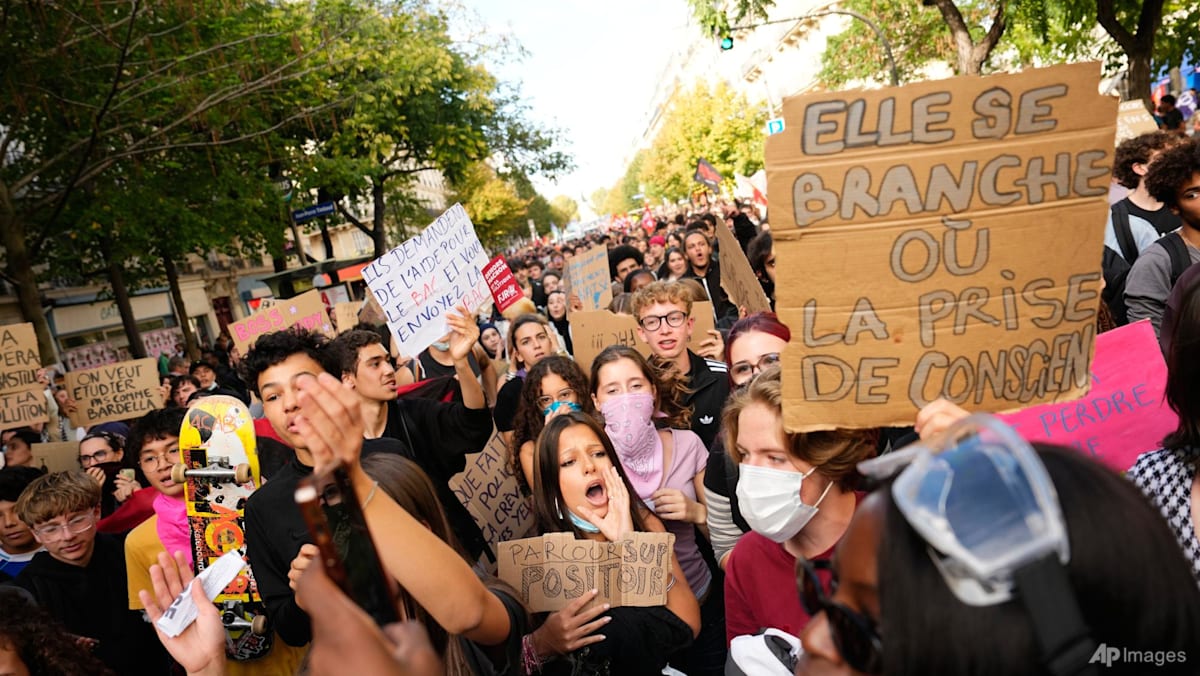
Could this become a wider anti-government movement?
US President Donald Trump, pushing his global right-wing narrative ahead of tough midterm elections at home, has sought to blame the unrest on “mass migration” and Islam.
But while the movement is already broader than a school protest, it has not yet developed into broader opposition to the government.
However, there are signs that it could expand, with high school students increasingly joined by university students, teachers, trade unions, parents and other supporters.
While the interior ministry said that 256,000 people protested nationwide, union organisers put the figure at 450,000.
The unrest also comes months ahead of a 2027 election that would determine the successor to Macron, whose government announced last week a series of unpopular spending cuts for the next year’s budget.
The education budget is set to increase by a below-inflation 1.7 per cent to 65.53 billion euros, excluding teacher pensions.
And while France ranks in the middle of OECD countries for spending on education, the average expenditure per secondary school student has barely changed over the last decade, education ministry data shows.
For now, education remains the issue holding the protests together, but grievances beyond schools are increasingly being embraced. The movement could very well evolve into a much broader outlet for government dissatisfaction.
