

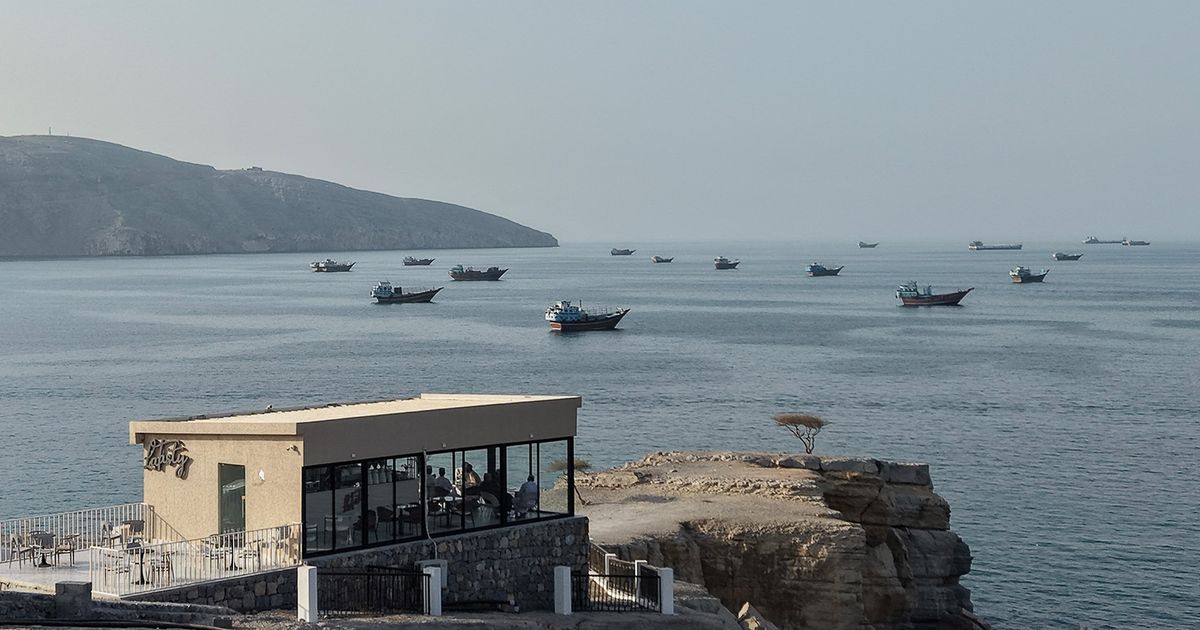
Commercial shipping traffic through the Strait of Hormuz has collapsed. Before the war with Iran, approximately 125 commercial vessels passed through each day. In late September, the 10-day average was down to about 18.
Americans who will never see the Strait of Hormuz are paying for this disruption every day. For decades, American naval power, backed by overseas bases and alliances, kept maritime disruption rare enough that businesses and consumers could largely ignore the risk. President Donald Trump’s foreign policy theory is that the United States can reduce those commitments — or shift more of its cost to others — without surrendering the prosperity, access and influence they produce. The war is testing that theory.
Modern supply chains cross oceans repeatedly. Raw materials may be refined in one country, turned into components in another and assembled into finished products in a third before reaching an American store shelf. The same networks carry American crops, energy and manufactured goods to customers abroad. Companies have developed inventories, delivery schedules and entire business models around the assumption that the parts and products they need would arrive when promised.
Over time, that reliability has come to seem almost natural. It is not.
Freedom of navigation long predated today’s global economy. Containerization and communications technology allowed companies to spread production among countries, while international agreements defined rights of navigation and commerce. After World War II, the U.S. became the principal military power protecting the sea lanes that expansion required. A legal right to navigate was essential, but rights alone could not clear a mine, intercept a missile or persuade an insurer that a threatened voyage remained safe.
American naval power provided the bulk of the security that translated those rights into reliable passage. The U.S. Navy did not escort every merchant vessel or prevent every act of piracy. Its presence in important waterways and its capacity to respond made closing a strait or attacking commercial traffic far more costly. Most shipping moved freely because governments and armed groups understood that interference could bring consequences. Maintaining that deterrent was expensive. It required a large fleet deployed far from home, supported by ports, airfields, fuel, ammunition, maintenance, intelligence and communications. Much of that support came from allies, whose territory and cooperation gave the U.S. Navy global reach.
Roughly 80% of international merchandise trade moves by sea. American investment in protecting that commerce benefited countries around the world, but that investment was hardly an act of charity. It delivered an enormous return to the U.S. through lower prices, dependable industrial inputs, accessible export markets and the influence that came from being the power behind the system. Those returns were dispersed across the economy and therefore harder to see than the budgets, bases and deployments that purchased them.
The Trump administration’s formal America First Trade Policy uses a narrower ledger. Its official report declares that the U.S. has for decades “shed jobs, innovation, wealth, and security to foreign countries” and calls the trade deficit in goods evidence of “fundamental unfairness.” Trump has described security commitments in similarly transactional terms, conditioning the defense of NATO allies on whether they “pay” and questioning why the U.S. should protect foreign shipping without compensation. That approach counts the costs the U.S. bears while omitting much of what those commitments purchase.
Trump did not begin the war with Iran to test that theory. But by creating conditions in which the U.S. could no longer ensure the free movement of commerce, he has tested it anyway.
The inability to ensure freedom of navigation has economic consequences that reach far beyond the shipping industry. Higher insurance premiums, longer routes, delayed parts and more expensive fuel spread throughout the economy. Brent crude remains above $100 a barrel, and energy prices in August were 16.3% higher than a year earlier. Maritime disruption is not responsible for every price increase, but it is making an economy built on predictable movement more expensive to operate.
Iran did not defeat the U.S. Navy in a traditional battle for control of the strait. The U.S. went to war without sufficient forces in place and without a workable plan to keep commercial traffic moving. Iran needed only to make passage dangerous enough that shipowners, insurers and governments behaved as if it controlled the waterway. The legal right to navigate remained. The confidence required to exercise it freely disappeared.
Fighting over Yemen’s Red Sea coast has placed the Bab el-Mandeb — a critical shipping and energy chokepoint connecting the Red Sea to the Indian Ocean — under renewed threat. Attacks have also damaged three pumping stations along Saudi Arabia’s East-West Pipeline, temporarily halting exports through the principal oil route around Hormuz. The danger is no longer confined to one strait. It now reaches the other waterways and infrastructure on which regional commerce depends.
American credibility is being re-priced as well. Saudi Arabia, long dependent on the U.S. for security, has asked China to press Iran to restrain the Houthis. Once allies begin seeking help elsewhere, their confidence in the U.S. will not be restored simply because tankers begin moving again.
American forces have destroyed an extraordinary number of targets in Iran, but none of that changes the strategic result. This war has failed to protect one of the United States’ most consequential interests: keeping global commerce moving.
Whether intended or not, Trump’s war has offered a preview of the world Americans would inhabit if the U.S. stopped keeping the world’s shipping lanes open. The economic and geopolitical effects were felt within months, and there is no clear path to reversing them quickly. In that world, regional powers and armed groups decide which ships can pass, risk spreads through prices and supply chains and allies seek security elsewhere.
Trump assumed the U.S. could shed the cost of providing that security without forfeiting its benefits. The war has laid bare how profoundly he misunderstands the source of American power. We are paying for that error.
