

Democrats across the country who swept into power amid growing voter skepticism about AI and data centers are now reckoning with knotty discussions about how to tackle AI regulation and which technological impacts deserve their attention first, according to AI experts, strategists and legislators themselves.
Dusted with confetti and batting away Election Day balloons, midterm victors touched on everything from data centers — Sen.-elect Chris Pappas of New Hampshire railed against the facilities that “harm our communities and our well-being” — to healthcare, as Sen.-elect Peggy Flanagan of Minnesota committed to restricting the use of AI systems in insurance decisions.
The renewed calls for AI regulation are at odds with President Donald Trump’s insistence that Congress must limit AI-focused regulation or risk hampering American AI innovation. Trump has repeatedly referred to AI as a “golden goose” and data centers as sound economic investments.
It is unclear whether Tuesday’s results could create a new opening for meaningful bipartisan AI legislation — with representatives mindful of voters’ AI hawkishness — or instead result in messy infighting within the Democratic Party, Congress and Washington.
“Every Democrat in the House I’m speaking to wants to see AI regulation,” said incoming representative Scott Wiener, who pioneered California’s state-level regulation about AI and will represent San Francisco. “There may be different ideas about what that should be, but I think there’s broad support to take action.”
Some Democrats, like Ohio’s Sherrod Brown, have focused their attention on data centers, often viewed as the physical manifestation of nebulous AI worries and which have stressed electrical grids and water supplies in some areas. “I do not work for data centers,” he said Tuesday night in a state that has one of the highest concentrations of the facilities in the country.
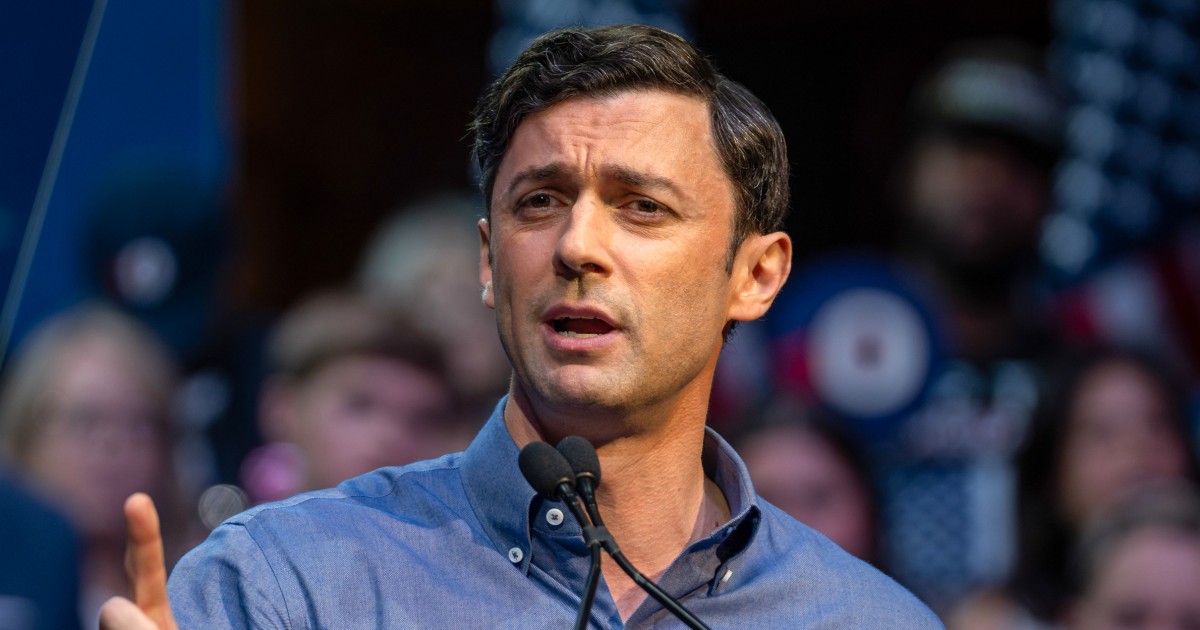
Others, like re-elected Sen. Jon Ossoff of Georgia, have also highlighted the technology’s catastrophic risks. “The titans of Silicon Valley dig bunkers for themselves and warn that the artificial intelligence they’re creating risks human extinction,” he said in his victory speech.
Polls and pundits agree that AI played a significant role in the election. “Six months ago, if you had told me that 56% of voters would have left their polling places stating that concerns about AI were crucial or important to their vote, I would have looked at you like you had 10 heads,” said Sacha Haworth, founder and CEO of the Tech Oversight Project, a Washington, D.C.-based watchdog and advocacy group.
Yet some AI experts predict that the variety of Democrats’ AI priorities could lead to fractured policy approaches and watered-down legislation, while other party leaders on AI predicted a more cooperative result.
“I think the Democrats are going to have a hard time wrangling their own perspectives on this,” said Samuel Hammond, director of AI policy at the Foundation for American Innovation, a right-leaning Washington, D.C., think tank. He highlighted the distance between proposals like the one championed by Sen. Bernie Sanders, I-Vt., to ban artificial superintelligence — referring to systems smarter than humans at all cognitive tasks — and more prosaic efforts to update permitting guidelines to build power plants and other AI-related infrastructure.
Alex Bores, a New York Assembly member who authored one of the country’s most substantial pieces of AI legislation — the RAISE Act — disagreed. He framed candidates’ differing priorities as an asset that will allow Congress to tackle many critical AI policy initiatives simultaneously.
Multiple policy approaches are “good and healthy as long as we’re working together to ensure that we are protecting the American people from the many different ways that this technology could harm people,” he said. “There is so much that we have to do in AI, foundational to who gets to decide what we’re building.”
Bores also said that pro-AI funding had proved toxic to some candidates, pointing to significant losses for candidates supported by pro-AI super PAC Leading the Future. The organization also spent heavily against Bores in his own primary campaign for Congress earlier this year, which he narrowly lost.
AI experts also predicted that Washington’s previous AI proposals would likely be significantly reimagined under the new political order.
Before the election, a bipartisan bill co-sponsored by Reps. Jay Obernolte, R-Calif., and Lori Trahan, D-Mass., called the FRONTIER Act had worked its way through Washington as one of the most likely pieces of legislation to pass.
The bill would require increased independent testing and oversight of the most advanced AI systems and mandate that leading AI companies create and publish safety-focused plans. However, Obernolte has faced an unusually competitive re-election battle. As of Sunday morning, his race had not been decided, according to NBC News.
Congress has not passed a significant AI law in recent years, in large part because Trump has opposed regulation. The president and his allies, many of whom hail from Silicon Valley’s tech circles, have insisted that legislation will stifle America’s economy and the AI industry.
“The only reason that communities throughout the U.S.A. should not want Data Centers is if they want to end up being backwards and poor,” Trump wrote in a Truth Social post in late August.
The Trump administration has repeatedly endorsed federal bills that would pre-empt, or override, state-level legislation. David Sacks, the former White House AI czar and current chair of the President’s Council of Advisors on Science and Technology, has said that state laws would lead to a harmful “patchwork” of legislation.
Yet Tuesday’s results point to increasing bipartisan interest in passing meaningful AI legislation, according to the Foundation for American Innovation’s Hammond. “AI is not nearly as left-right polarized as most other issues,” he said.
“Post-midterms, I think Republicans will feel less pressure from tech money and have, at least in the short run, greater degrees of freedom to express their parallel concerns about AI,” he added.
