

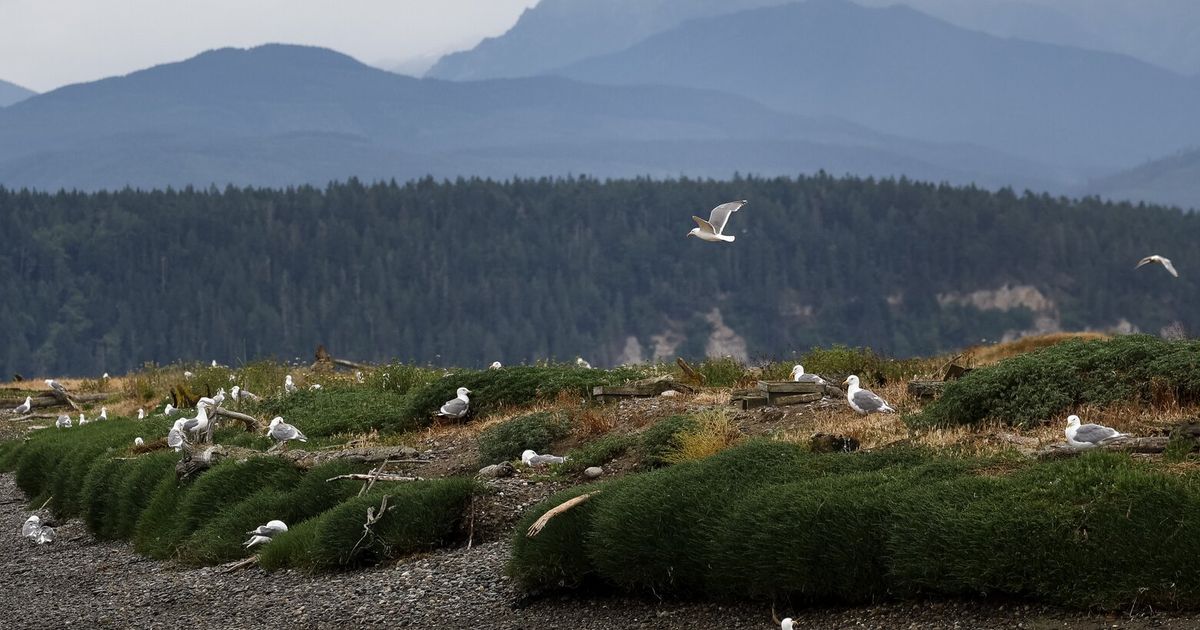
Out near the lighthouse at the end of Dungeness Spit, beyond the windswept dunes and washed-up logs, a driftwood sign says “Welcome to Serenity.” For hikers headed back toward Sequim, another piece of driftwood says, “Reality, 5 miles.” For the Jamestown S’Klallam, it is all “home.” Their proposal to transfer management of the Dungeness and Protection Island National Wildlife Refuges from the U.S. Fish and Wildlife Service to the tribe has caused many to ask, “Why?” (“We can’t let WA seabird refuges disappear from public oversight,” Oct. 18)
Raked by wind and waves, and with no freshwater and few trees, the spit and the island survived the settlers’ axes and plows. Dungeness Spit was protected in 1915, though only by an Executive Order. So far, that’s been enough. Protection Island, home to one of the largest seabird colonies in the Lower 48, was subject to a harebrained scheme to build a subdivision in the 1980s, but was rescued by local environmentalists and an act of Congress. Two years ago, the Jamestown S’Klallam Tribe entered into an agreement with the USFWS to comanage the refuges. That’s just been extended two more years.
In 2025, author Hampton was part of a group of ecologists and seabird experts organized by Audubon Washington who gathered at Dungeness to learn about their restoration efforts at both refuges. It was immediately clear that the tribe was essentially in charge, bringing renewed energy and funding. Under the federal system, these two refuges were lumped with four others to battle for limited dollars to address deferred maintenance. They weren’t getting sufficient funds. Using some of their own income, in two years the tribe repaired roads, docks, parking areas, bathrooms, signage and even the kiosk where you pay the $3 entrance fee to the spit. Instead of needing exact change, one can now pay with a credit card.
The tribe engaged the community and doubled the volunteer force, largely to control invasive weeds and green crabs. Invasive species management is a key element of sustaining healthy ecosystems, yet federal budgets often neglect it. While the Department of Government Efficiency cut research funds at other refuges, the tribe expanded seabird research and puffin restoration, partnering with the Washington Department of Fish and Wildlife and experts like Scott Pearson and Peter Hodum.
The tribe is passionate about these efforts. They’ve played key funding roles in levee setbacks and riparian restoration along the Lower Dungeness River, at Jimmycomelately Creek and at the Big Quilcene River mouth. Birders have enjoyed special species such as black phoebes, red-shouldered hawks and red-eyed Vireos in these restored habitats. And the tribe’s role in the Dungeness River Nature Center at Railroad Bridge Park in Sequim has made it the preeminent environmental education center on the Olympic Peninsula. When AmeriCorps staff there were terminated by Department of Government Efficiency, the tribe rehired them.
The Jamestown S’Klallam are not unique in these efforts. The Lower Elwha Klallam Tribe initiated the effort to remove the dams on the Elwha River decades ago. This has not only restored eight salmon and other fish runs, it restored the flow of sediments that physically sustains Dungeness Spit. Across the continent, tribes are involved in restoring buffalo, condors, bighorn sheep, lynx and even butterflies.
The transfer from the USFWS to the tribe — technically, to the Bureau of Indian Affairs to be held “in trust” — requires congressional approval. This would immediately strengthen the protection of Dungeness Spit beyond the Executive Order. It would also reduce the uncertainty of federal management and replace it with a local government (the tribe) whose culture and resources are focused on ecosystem restoration.
Nevertheless, with no draft legislation yet available for public review, speculation about the details has fueled debate. Arguments against the proposal suggest the tribe has ulterior motives, echoing generations of distrust. They describe tribal sovereignty as a threat to the land. To be clear, federal laws such as the Endangered Species, Clean Water, Migratory Bird Treaty acts and many others do apply on Native lands. More importantly, the tribe has explicitly said that they are committed to maintaining current levels of public access and environmental protection, that no commercial activities will be permitted and that these obligations will be part of the legislation. In the meantime, we all await the text of the proposal.
When Fawn Wagner, the current refuge manager, was asked at a recent public meeting why the tribe wants to hold title for these refuges and steward them at their own cost, she replied simply, “Because it is our home.”
