

World leaders and delegates are gathering in Antalya, Turkiye, for COP31, the annual climate summit of the United Nations, which runs from November 9 to 20.
They meet as global emissions continue to climb. The world emitted 54.1 billion tonnes of greenhouse gases in 2025, 0.7 percent more than the year before and 68.5 percent more than in 1990, according to the latest figures from the European Commission’s Joint Research Centre (JRC) and the International Energy Agency (IEA).
Greenhouse gases, mainly carbon dioxide and methane, trap heat in the atmosphere, raising global temperatures and fuelling heatwaves, droughts, floods and other extreme weather conditions.
In this visual explainer, Al Jazeera breaks down which gases are warming the planet, which industries and countries emit the most, and how their emissions have changed over time.
Which gases are warming the planet?
Carbon dioxide (CO2) made up 73.8 percent of global greenhouse gas emissions in 2025. It is released mainly when fossil fuels such as coal, oil and gas are burned, while deforestation removes trees that would otherwise absorb it.
Methane (CH4) accounted for 17.6 percent of emissions that year, followed by nitrous oxide (N2O) at 5.3 percent and fluorinated gases (F-gases) at 3.3 percent.
Global CO2 emissions have risen by 76.3 percent since 1990, according to the JRC.
How is a warming planet affecting the world?
As these gases build up in the atmosphere, they trap more heat. In 2025, the heat stored in the world’s oceans reached its highest level on record, and the rate of ocean warming has increased sharply over the past two decades, according to the World Meteorological Organization (WMO).
Extreme weather has killed tens of thousands of people and forced millions from their homes in 2026, according to the WMO.
In Europe, heatwaves, droughts and wildfires between May and August caused more than 30,000 excess deaths, and 220,000 people were evacuated in France alone.
On August 26, a glacier collapse and the resulting flash flood in the Himalayas killed more than 1,500 people in Nepal along its border with China, while about 5,600 remain missing, according to the UN.
In June and July, Typhoon Bavi forced three million people to evacuate in China and killed 26 in the Philippines. Weeks later, severe Tropical Storm Maysak killed 171 people and caused more than $3bn in losses in China.
Earlier in the year, floods and windstorms across the western Mediterranean displaced more than 180,000 people in Morocco, while extreme cold and snow in North America killed 174 people.
The map below shows some of the most extreme weather events of 2026.

Where do the world’s emissions come from?
The world’s greenhouse gas emissions have more than doubled since 1970, rising from about 23 billion tonnes to 54.1 billion tonnes in 2025, according to the JRC.
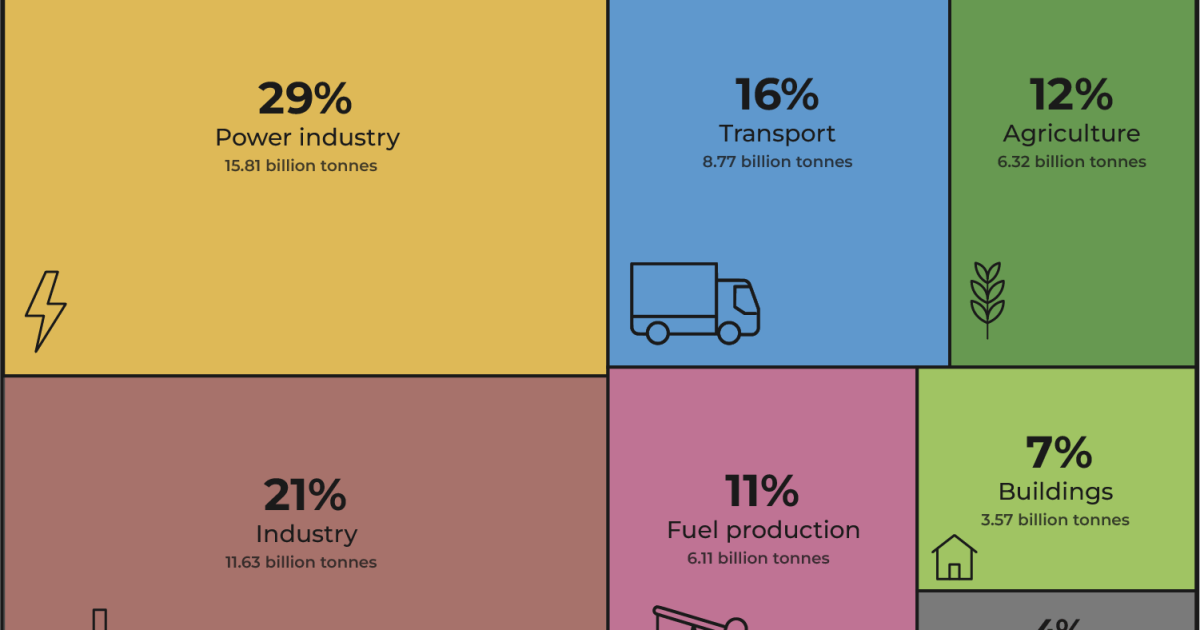
The power industry, which generates electricity, is the largest source, producing nearly 30 percent of global emissions in 2025. Its emissions have roughly quadrupled since 1970, driven by soaring demand for electricity in fast-growing economies such as China and India.
Industry, including manufacturing and mining, is the second-largest source at 21 percent. This covers fuel burned in factories as well as gases released when producing cement, metals and chemicals. Industrial emissions climbed steeply in the 2000s as China’s manufacturing boomed.
Transport, including cars, shipping and aviation, is third at 16 percent.
Together, these three sectors produce about two-thirds of the world’s emissions. The rest comes from agriculture (12 percent), the extraction of coal, oil and gas (11 percent), buildings (6.6 percent) and waste (3.6 percent).
Global emissions have fallen only a handful of times since 1970, including in the early 1980s, after the 2008 financial crisis and during the COVID-19 pandemic in 2020. Each time, they rebounded.

Who are the largest emitters of greenhouse gases?
In 2025, the three largest emitters produced almost half of the world’s greenhouse gases. China emitted almost 16 billion tonnes (29.5 percent), the United States 6.02 billion tonnes (11.1 percent) and India 4.51 billion tonnes (8.3 percent).
The 27 countries of the European Union together accounted for 5.8 percent, followed by Russia (4.8 percent), Indonesia (2.5 percent), Brazil (2.4 percent) and Iran (2.1 percent).
International shipping and aviation, which fall outside any single country’s total, together produced 2.6 percent of global emissions, more than most countries.
It was not always this way. The Industrial Revolution of the 18th and 19th centuries drove up emissions first in the West, particularly in the United Kingdom and the US, as they built factories and moved to mass manufacturing. Global emissions then rose sharply after World War II and have more than doubled since 1970.
China’s emissions surged in the early 2000s as its economy boomed, and it overtook the US as the world’s largest emitter in the mid-2000s.
But measured over time, the picture changes. Since the mid-18th century, the US has produced 23.5 percent of all CO2 emissions, compared with 15.4 percent from China, according to the Global Carbon Budget.

Which industries drive each country’s emissions?
In China, the power sector is the largest source, producing 42 percent of the country’s almost 16 billion tonnes of greenhouse gases. Industry accounts for 31 percent and fuel production for 9.5 percent.
In September 2025, Chinese President Xi Jinping, for the first time, pledged to cut the country’s greenhouse gas emissions by 7 to 10 percent from their peak by 2035.
In the US, transport is the largest source at 29 percent, mostly from cars and trucks. The power sector accounts for 26 percent and industry for 14 percent.
In India, which still relies heavily on coal for electricity, the power sector produces 35 percent of emissions, followed by industry at 24 percent and agriculture at 19 percent.
Explore the table below to see which sectors produce the most greenhouse gas emissions in each country.
