

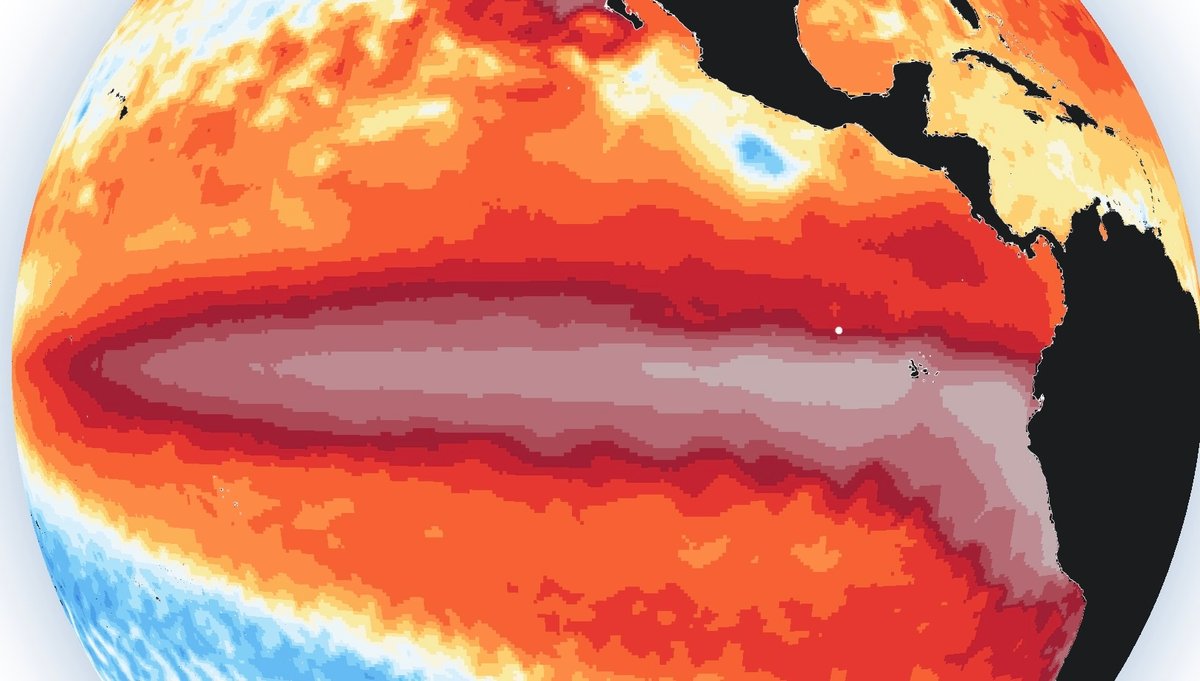
In the midst of an El Niño likely to be the strongest in living memory—perhaps even in the past 1,000 years—the massive pulse of heat being exhaled by the Pacific Ocean is sending global temperatures skyrocketing. Records are already being set well before the event is expected to peak. And this year could set a record, only to be eclipsed by 2027.
Both 2026 and 2027 will almost certainly come in at more than 1.5 degrees Celsius above average temperatures in preindustrial times, before humans dramatically ramped up the burning of fossil fuels—the threshold the world hoped to keep warming beneath. The question now is: Will we ever come back down below that benchmark once El Niño has exhausted itself? Or will this event mark a permanent step up on our current warming trajectory?
“Eventually there’s going to be a year where we don’t dip below 1.5C [on average], and based on what I’m seeing here, it might be this year,” says climate scientist Daniel Swain, a climate scientist at University of California Agriculture and Natural Resources.
On supporting science journalism
If you’re enjoying this article, consider supporting our award-winning journalism by subscribing. By purchasing a subscription you are helping to ensure the future of impactful stories about the discoveries and ideas shaping our world today.
How El Niño heats up the planet
To understand why El Niño can have such a marked effect on global temperatures, let’s delve into what happens during one. Normally, westerly winds pile warm waters up in the western tropical Pacific Ocean, but every few years, those winds slacken and sometimes even reverse, sending that water sloshing over to the eastern Pacific. Aside from raising coastal sea levels and setting off a domino effect of changes in global weather patterns, this shift releases massive amounts of heat from the ocean into the atmosphere.
But this year’s event is shaping up to be an El Niño unlike any we’ve ever seen. It’s “literally and figuratively out of uncharted waters,” says Zeke Hausfather, a climate scientist at Stripe and Berkeley Earth. By September of this year, sea surface temperatures in the part of the Pacific that is El Niño’s epicenter had already passed a daily record set in November 2015, and the phenomenon usually doesn’t reach its fever pitch until November or December. “This El Niño is growing so much faster than any other event,” Hausfather says.
Right now, models project that ocean temperatures in the Pacific core of El Niño could reach an astounding four degrees C above normal when the event reaches its zenith. They currently sit around a still jaw-dropping 3.4 degrees C above normal. Wherever sea surface temperatures peak between those numbers, they will absolutely smash the heat record from as long as we’ve had direct temperature measurements, which was set by an El Niño in 1877. (That event resulted in millions of deaths around the world from droughts and failed harvests linked to changes in weather patterns.) It would also be above estimates of past El Niño sea surface temperatures taken from coral and tree growth rings going back to the year 1100. And this year’s event would likely set a record even without the baseline ocean warming from climate change.
The extraordinary ocean heat released into the atmosphere will translate to a projected global average temperature of 1.52 degrees C above preindustrial temperatures for 2026 and perhaps a truly eye-popping 1.74 degrees C above for 2027. Typically the global heat effects of El Niño come in the year after the event begins because it takes time for that heat to spread. The rapid growth of this event means that 2026 could set the record for the hottest year, surpassing 2024. But whether or not it does, 2027 is virtually certain to take the crown.
How hot will the world stay?
Regardless of any records, this year and next will be the second and third years to surpass 1.5 degrees C above preindustrial levels (2024 being the first). Under the landmark 2015 Paris climate agreement, nearly 200 countries signed on to try to limit warming to no more than that amount, with two degrees C being a clear line that the world vowed not to cross.
Usually the temperature effects of an El Niño are temporary: ocean surface temperatures shift back to their normal configuration, and the heat released to the atmosphere is slowly emitted to space.
But in a rapidly changing climate, Swain, for one, wonders if the heat bomb released this year could fuel the feedback loops that are exacerbating global temperature rise. Sea ice melt could ramp up, meaning polar oceans absorb even more heat. More permafrost could thaw, releasing methane, a potent greenhouse gas. El Niño also drives drought that causes wildfires in many areas, which contribute massive amounts of planet-warming emissions to the atmosphere, says Kim Wood, an atmospheric scientist at the University of Arizona. It’s not impossible that these feedback effects could effectively lock in some of what would otherwise be a temporary global fever. “It’s possible that now at least a small portion of the warming from El Niños is not always so temporary anymore,” Swain says.

But he does emphasize there is considerable uncertainty. After all, there’s also a good chance the Pacific will swing into a La Niña, in which cold waters from deep in the ocean well up in the eastern Pacific. This counterpart to El Niño depresses global temperatures, though even La Niña years now are much warmer than even El Niño years of decades past. For example, the La Niña year of 2022 was hotter than the El Niño year of 1998—a blockbuster event at the time. If we get a strong La Niña, global temperatures might go down to 1.45 degrees C above preindustrial.
Hausfather acknowledges the possibility of staying above 1.5 degrees C after this El Niño but says he “would not be surprised at all if we go back below it.”
If we don’t stay above 1.5 degrees C with this event, it’s only a matter of time before we do. A new study released on Monday in Nature Climate Change, though, has estimated that land areas around the world have already experienced 90 to 94 percent of the warming that would be expected in a world where global temperatures have reached 1.5 degrees C above preindustrial. United Nations agencies have also already acknowledged that we will blow past the 1.5-degree-C goal of the Paris agreement eventually, with estimates that warming will peak at 2.6 degrees C above preindustrial before we can begin reversing the trend.
But when exactly we breach 1.5 degrees C for good and for how long we stay there depends heavily on decisions we make now and in the next few years.
