

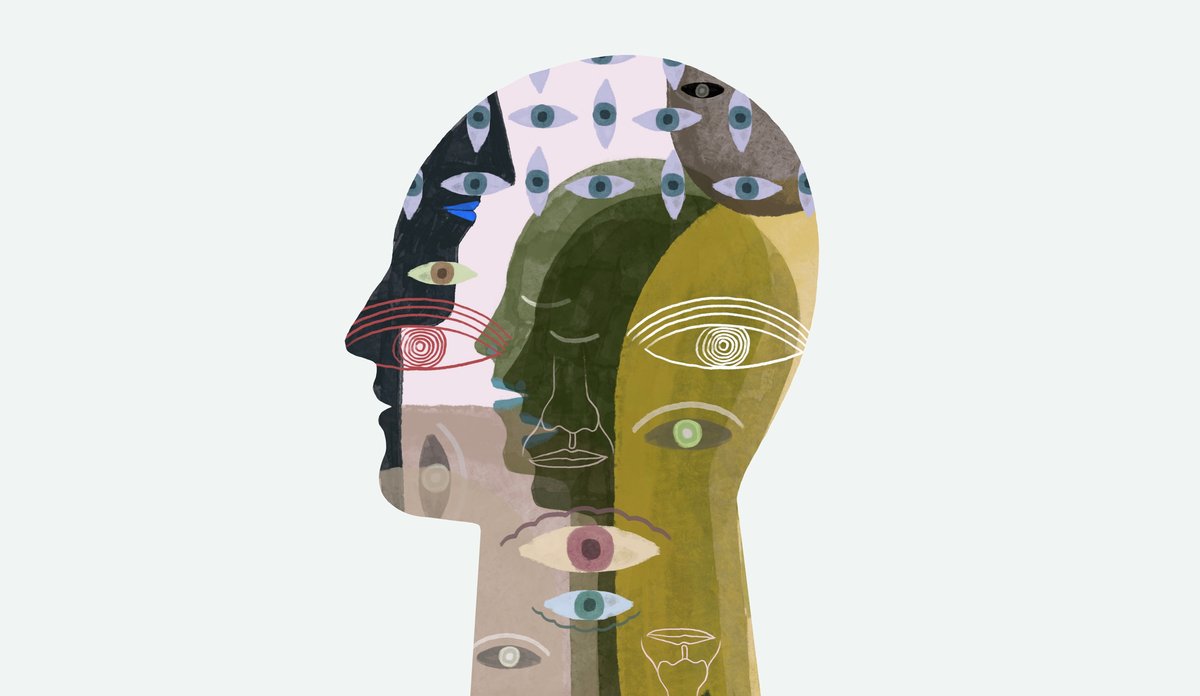
If you were to imagine the face of your favorite person, how well could you do it? Can you envision the shape of their nose? Or the texture of their hair? The exact hue of their eyes?
Some of us will answer yes, in fine detail—but others won’t be able to do it all. It turns out that the way we conjure images in our mind is highly individual, says Joel Pearson, a professor of cognitive neuroscience at the University of New South Wales in Australia, who studies aphantasia, or the inability to visualize images.
“We have a range of individual differences when it comes to ability to visualize,” Pearson says. At one end of the spectrum, there’s aphantasia—a lack of any mental imagery. On the other is “hyperphantasia,” or the ability to envision hyper-realistic mental images. “Most people are somewhere in the middle,” he says.
On supporting science journalism
If you’re enjoying this article, consider supporting our award-winning journalism by subscribing. By purchasing a subscription you are helping to ensure the future of impactful stories about the discoveries and ideas shaping our world today.
The ability to hold an image in our “mind’s eye” is linked to the visual cortex—the part of the brain that is largely responsible for processing our sense of sight. In general, the size of a person’s primary visual cortex is inversely correlated with the strength of their mind’s eye, although it’s unclear why.
In lab experiments, Pearson and his colleagues have found that “cortical excitability”—how responsive the brain’s cells are to stimuli—can influence their mental imagery, too. In a 2020 study published in eLife, they found that stimulating the visual cortex with electricity could increase or decrease a person’s visualization strength. This indicates that how responsive the visual cortex is to incoming information has a causal role in mental imagery, he says.
Other factors may be at play, too. A head injury, for instance, can affect a person’s imagination, and largely anecdotal reports suggest psychedelic drugs can do so as well, Pearson says. Some researchers also hypothesize that our visualization abilities may change with age.
Other evidence suggests aphantasia may be at least partly genetic because it seems to run in families. But for the most part, the reasons why any individual might lack the ability to picture something in their mind is largely a mystery. “We can’t explain why someone seems to be born with congenital aphantasia versus someone with very strong imagery,” Pearson says. It’s also unclear whether individuals with aphantasia simply have no mental imagery or if they’re just not consciously aware of it.
Much less is known about the other end of the scale, hyperphantasia. Pearson says he has heard of individuals who can watch a movie and replay it in their mind as if they were watching it for real. But finding those people—and getting them into the lab to study—has been a challenge, he says.
It’s also been a challenge to assess how strong a given person’s mind’s eye is, Pearson says. Aphantasia has been documented at least as far back as the 1880s, when English scientist Francis Galton asked 100 men to imagine an object such as their breakfast table and describe a couple of their mental image’s qualities, including how clear and distinct it was. Some of them, Galton reported, had no ability to do so.
Today scientists have developed more advanced methods. Pearson and his colleagues have tried out a few techniques, including a test that involves a phenomenon called “binocular rivalry,” in which two different stimuli, such as different color patterns, compete for dominance when they’re presented to each eye; in the test, imagining which of the two you will see just before both flash in front of you makes it more likely that you will actually see it. Other assays measure a person’s physiological responses to mental imagery, such as their pupil size when they think about something bright or their skin conductance when they envision something scary, such as a shark fin swirling nearby in the water.
“If you think in pictures, it will amplify any emotional response you have to things,” Pearson explains, “because it’s almost like it’s tricking the rest of your brain into thinking the thing is happening right in front of you, even though it’s not.”
Recently, researchers have started using computer algorithms and functional magnetic resonance imaging (fMRI) to “decode” what people are thinking about. Researchers can train an algorithm on a person’s brain activity when they look at, say, a letter of the alphabet. Then, when that person visualizes that letter, the computer can recognize, or “decode,” that thought.
How we picture things in our heads can have a profound effect on our lives—and not always in the ways you might think. Having aphantasia, for example, doesn’t necessarily limit creativity, Pearson says. As Scientific American previously reported, some of the world’s best animators, including Pixar co-founder Ed Catmull and former Disney animator Glen Keane, have said they don’t think in images. And some research suggests imagery may impact a person’s perception of risk, Pearson says—if you can visualize the feeling of bungee jumping, for instance, it may change your decision of whether to try it out.
People with strong mental imagery, meanwhile, are more likely to experience anxiety or post-traumatic stress disorder after an upsetting event.
To test your own mental imagery, try the Vividness of Visual Imagery Questionnaire, Pearson says—but keep in mind that these tests are not definitive.
“It’s an amazing example of how we all think in very different ways,” Pearson says. “It turns out, if you think in pictures or not, it will change the how you make decisions.”
