

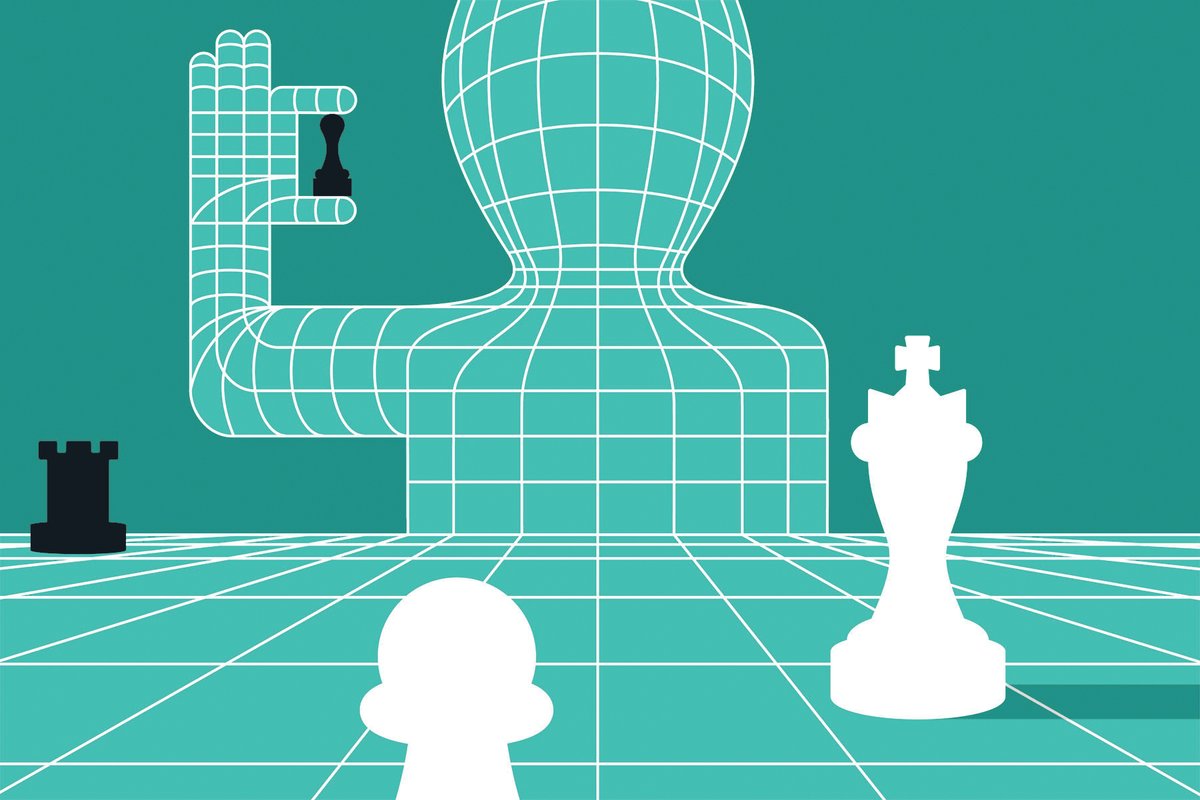
In 1997, artificial intelligence—in the form of a computer system called Deep Blue—beat the best human player at the time at chess, and it hasn’t slowed down. Every year the technology improves, but researchers are still trying to understand the source of AI’s strategic superiority. Sure, many chess engines can use a brute-force approach to evaluate a huge number of moves, but how does that shape their gameplay? A recent paper in APS Open Science highlights one likely feature, with implications as AI strategy expands its scope.
“Probably our paper is the closest to understanding what these machines are doing,” says study senior author Vito D. P. Servedio, a physicist at Complexity Science Hub in Vienna. “Otherwise it looks like they are playing magic.”
Early chess AIs, including Deep Blue, internally played out many branches of a decision tree before making a move—a technique called tree search. Many modern chess engines, such as Stockfish and Leela, use trained neural networks to guide their tree search. The researchers collected human vs. human and Stockfish vs. Leela games from online databases. At each point in the games, they measured “strategic tension”—the number of mutual interactions possible between opposing pieces. Tension is often higher when there are more possible moves.
On supporting science journalism
If you’re enjoying this article, consider supporting our award-winning journalism by subscribing. By purchasing a subscription you are helping to ensure the future of impactful stories about the discoveries and ideas shaping our world today.
The scientists found that once each player had made 20 moves, the average tension in human games exceeded that of the AI games. Up to that point, people tend to rely on memorized tactics and hope the complex piece interactions will force human opponents to slip up. But after it, human tension drops below that of AI games, which remains high. As terrain becomes more unfamiliar, people may simplify their arrangement of pieces because they can’t hold complicated dynamics and multiple options in their heads. “The result makes sense,” says Merim Bilalić, a psychologist at Northumbria University in England, who wasn’t involved in the research. People need to reduce cognitive load, but “engines don’t really have that problem.”
Furthermore, higher-rated human players maintained greater tension throughout their games. Tension was also greater in games with more allotted time (higher in “classical” than in “rapid” chess and lowest in “blitz” chess). And when Stockfish searched deeper trees of possible gameplay, tension increased. Though higher tension correlated with greater ability in both humans and AI, the study didn’t show that it led to, or came from, that ability.
Chess continues to be a fruitful model for studying cognition in humans and machines. Servedio says his team’s findings may apply to higher-stakes situations such as diplomacy, where AI might reach better outcomes but at the risk of complicating matters. “This is very dangerous because when you have high tension, systems are very unstable,” he says. “So just a small error from one of the sides will cause a disaster.”
Subscribe to Support Independent Journalism
Great science journalism requires human expertise, time, effort and creativity. And it costs money. That’s why I and the journalists here at Scientific American hope you’ll join our community.
When you subscribe, you are supporting staff and freelance journalists who are passionate about telling science stories that are true, important and compelling. Our editors and reporters are often experts in their fields, which means they understand the nuances of big discoveries and can untangle the breakthroughs from the hype. With a subscription, you are also supporting rigorous fact-checking to ensure the words we publish are precise and accurate. And you’re supporting original illustrations, graphics and photos that bring you closer to an advanced laboratory, an ice sheet in Antarctica or a space mission in orbit. You’re helping us craft other types of high-quality journalism as well: Our newsletters are carefully written, edited and curated by staffers you have or will come to know and love. Our Science Quickly podcast is based on original reporting, collaboration with editors and scientists and exacting production.
Subscriptions keep this engine running so we can continue to deliver thoughtful, rigorous and independent science journalism to you. In an era of viral misinformation, this work is crucial. If you value what we do, I hope you’ll consider joining us as a subscriber
