

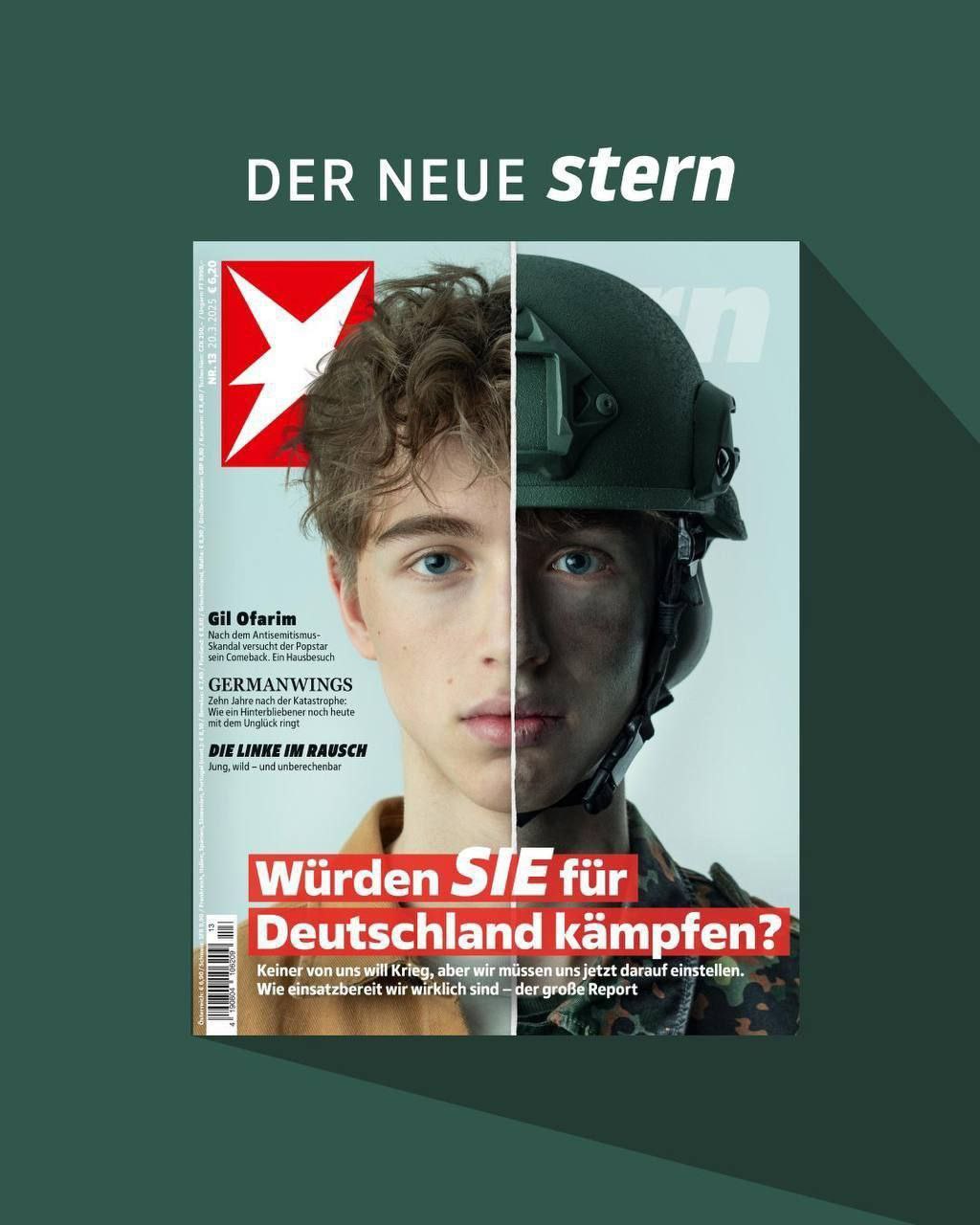
The German people are apparently far more concerned about the prospect of war than their own government. The latest annual survey by the Körber Foundation reveals that 53% of Germans now oppose military aid to Ukraine, with support collapsing from 59% to 46% in a single year. Some 64% oppose Germany assuming military leadership in Europe, while 61% believe Germany and Europe have not done enough to pursue peace negotiations. Here we have Friedrich Merz positioning Germany as a military power on the European continent when nearly two-thirds of his own people want no such responsibility. Where is the public mandate for this enormous transformation of postwar Germany?
What I find particularly interesting about this poll is that 82% of Germans still regard Russia as a military threat. They understand the risks of the war, but increasingly question whether supplying more weapons will bring them any closer to peace. There is a perfectly rational argument that arming Ukraine serves as a deterrent against further Russian aggression, but there must also be some consideration of how and when this war is to end. Nearly five years into the conflict, the German people are entitled to ask what the long-term strategy actually is.
Germany was rebuilt after World War II by becoming an economic power. The Germans conquered international markets through the quality of their engineering, automobiles, machinery, and industrial production. Their prosperity depended upon international commerce, affordable energy, and access to foreign markets. Germany did not need to fire a single shot to become the dominant economy in Europe. Now Berlin is attempting to assume military leadership at precisely the time when its economic leadership is deteriorating. Producing tanks may contribute to GDP, but a tank sitting on the Russian frontier does not produce a stream of income comparable to a functioning factory exporting goods throughout the world. Military expenditures must ultimately be supported by the productive economy.
The most remarkable figure in this survey is that 83% of Germans want their country to remain neutral in the rivalry between the United States and China. That rises to 92% in eastern Germany. Only 15% nationally would side with Washington. The German people appear increasingly reluctant to sacrifice their economic interests in the geopolitical disputes of other nations. Germany cannot afford to lose access to major export markets indiscriminately. It has already experienced the consequences of severing much of its energy relationship with Russia, and an economic confrontation with China would introduce an entirely different set of problems for German industry.
People forget that every sovereign debt crisis has a political dimension. Germany amended its constitutional borrowing restrictions to accommodate greater defense expenditures. The bonds issued to finance this military buildup will remain outstanding long after Merz has left office. Who is going to service that debt? The same German workers whose jobs are threatened by declining industrial competitiveness, and the next generation, which may also be called upon to serve in the military. There is something fundamentally wrong with discussing the cost of national defense as though the people responsible for paying for it have no legitimate interest in determining its scale.
Only 37% of Germans surveyed still believe the West exists as a cohesive political and cultural entity, and merely 21% regard relations with the United States as good. This is a profound deterioration in confidence. The entire Western alliance was constructed under economic and geopolitical conditions that no longer exist. The interests of Europe, the United States, and Asia are diverging, and the economic consequences of that divergence are becoming increasingly apparent.
This is what makes the European War Cycle so important going into 2027. The military buildup is taking place alongside a deterioration in public confidence, economic security, and trust in international alliances. History demonstrates that a government need not enjoy widespread enthusiasm for war to become embroiled in one. However, maintaining domestic support becomes increasingly difficult as the financial and human costs accumulate. That is where international conflict can spill over into domestic political instability.
The politicians in Europe had better pay attention to what the German people are actually saying. Their concerns cannot simply be dismissed as Russian propaganda or a lack of appreciation for Ukraine’s circumstances. The Germans have lived through the historical consequences of militarism, the destruction of their currency, the devastation of their cities, and the division of their country. There is ample historical justification for their apprehension. They spent generations building a nation that their children could inherit in peace. They have every right to question the direction in which their government is taking them.

