

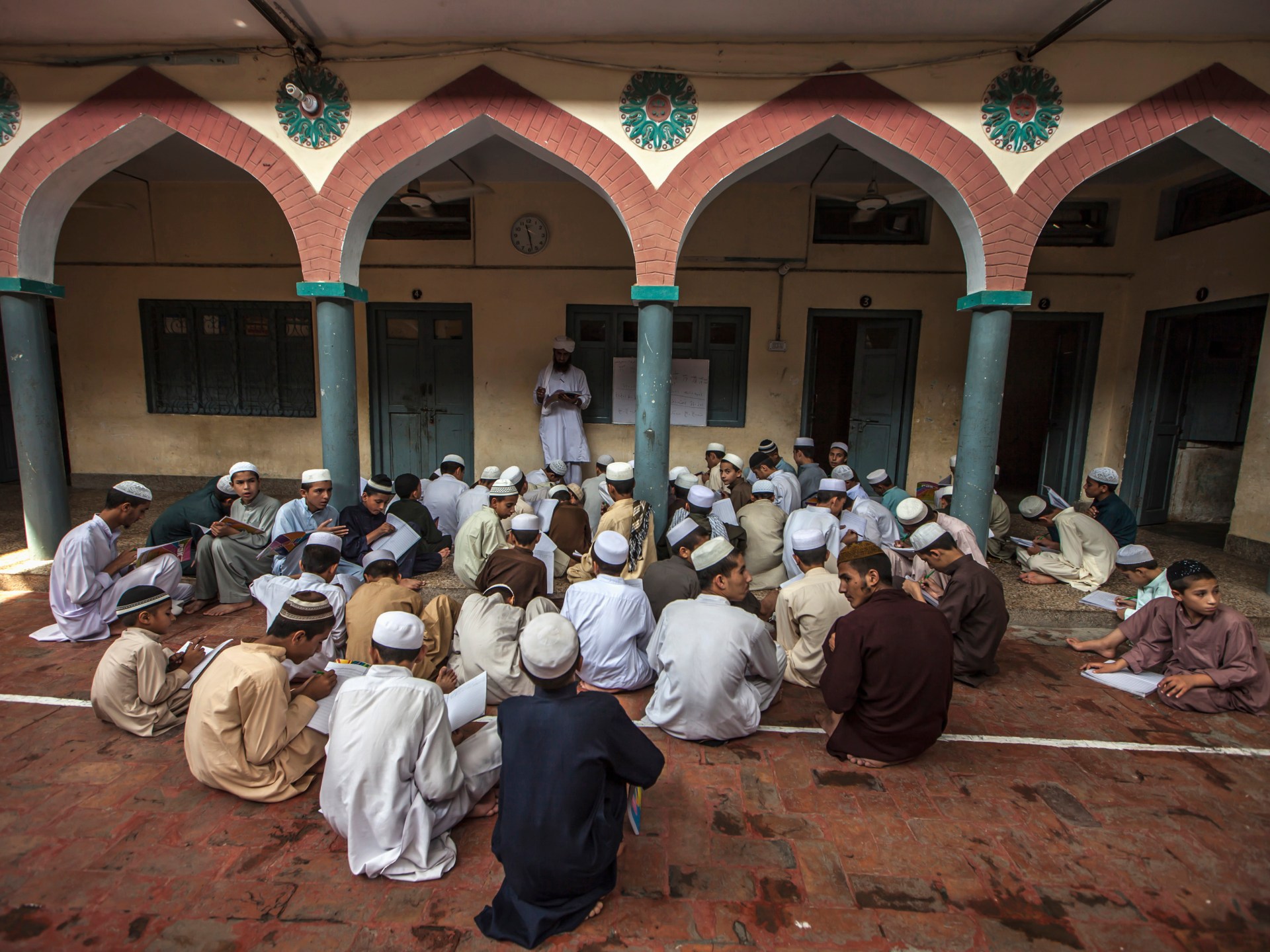
Islamabad, Pakistan – After fending off protests from the opposition Pakistan Tehreek-e-Insaf (PTI) party, the Pakistani government now faces a new challenge – a potential agitation led by Fazal-ur-Rehman, leader of the religious Jamiat Ulema-e-Islam-Fazl (JUIF) party.
Rehman, a veteran politician and part of the ruling coalition that governed Pakistan from April 2022 to August 2023, is urging the government to approve a bill that was introduced in October to amend the registration process for religious seminaries.
In October, the legislation was passed along with the controversial 26th amendment – moved by the government, and for which they needed the support of JUIF legislators – which gives parliament oversight on judicial appointments.
However, when the bill reached him for final approval, President Asif Ali Zardari raised “technical objections” and sent it back to parliament for further deliberation. The government of Prime Minister Shehbaz Sharif has since indicated that it too has concerns about the bill – sparking a standoff.
Rehman has since engaged in dialogue with government officials, including Sharif, arguing that the current law governing religious seminaries undermines their autonomy.
Last week, he warned that reversing commitments made to his party could further destabilise Pakistan’s already volatile political landscape.
“We want to create an atmosphere of trust. It is the government’s responsibility to improve the situation, but it seems to be pushing people towards extremism and protest,” Rehman said in Peshawar.
So what does the current law say, and what would the new bill do? What are the concerns Zardari and others have raised? And what comes next, for the bill and for Pakistan’s fractured polity?
How were seminaries governed historically?
The debate over registering religious seminaries, also known as madrassas, has long been contentious in Pakistan.
Historically, seminaries were registered under the colonial-era Societies Registration Act of 1860 at the district level. This decentralised system left the government with little control over seminary curricula, activities or funding.
In particular, state or federal education officials had no scrutiny over seminaries, which only dealt with local bureaucrats.
Over time, concerns grew over the absence of any effective monitoring of the curriculum, finances, or activities of these schools.
Why did more stringent regulation begin?
The tipping point was the 9/11 attack and the launch of the so-called “war on terror” by the United States. Pakistan, under military leader General Pervez Musharraf, sought to reform seminaries.
Many of the men who joined armed groups like al-Qaeda, or those who later founded Tehreek-e-Taliban Pakistan (TTP), were revealed to be past students of seminaries in Pakistan, leading the government to declare the proposed reforms “indispensable” for national security.
After the deadly attack by the TTP on the Army Public School, an army-ran school, in December 2014 in Peshawar, the Pakistani government introduced the National Action Plan, a comprehensive document which sought to, among other proposals, oversee the registration of religious seminaries.
Between 2018 and 2022, the Financial Action Task Force (FATF), an intergovernmental money laundering and financing watchdog set up by the G7 in 1989, placed Pakistan on its “grey list” of countries not fully compliant with its regulations. Countries on the grey list risk losing critical foreign investment.
One of the FATF’s demands before removing Pakistan’s name from the list was for the government to bring religious seminaries under its control, to ensure transparency in their financial operations.
In 2019, under the PTI government of former Prime Minister Imran Khan, seminaries were reclassified as educational institutions and placed under the Ministry of Education.
This led to the creation of the Directorate General of Religious Education (DGRE), which is currently headed by Ghulam Qamar, a retired two-star general who is also a counterterrorism specialist.
The DGRE mandated annual audits and expanded seminary curricula to include subjects like mathematics and science.
Since its inception, more than 18,000 seminaries and two million students have been registered.
However, many seminaries, including those affiliated with JUIF, refused to join the system and continued to operate under the Societies Registration Act.
What is in the proposed legislation by the JUIF?
The JUIF’s amendment to the Societies Registration Act shifts seminary registration responsibilities back to district deputy commissioners, removing oversight by the Ministry of Education.
The bill also proposes that seminaries with multiple campuses be allowed to register as a single entity, a move the JUIF argues will reduce government interference and protect the autonomy of these institutions.
What are the government’s objections?
Religious affairs minister, Chaudhry Salik Hussain, has defended the government’s resistance to approve the JUIF bill.
Hussain, in a statement issued by the Ministry of Religious Affairs last week, said that the government wants education-related issues to remain under the purview of the Education Ministry, including the registration of seminaries.
Al Jazeera reached out to Hussain, as well as Information Minister Attaullah Tarar, to seek comments on the controversy, and why legislators from parties in the government had backed the bill in parliament with an overwhelming majority in the first place if they had reservations. Neither has responded.
However, at a recent conference in Islamabad earlier this week, government officials and religious leaders expressed concerns over the JUIF’s proposed changes. Information Minister Tarar claimed there were “legal complications” in the bill – without spelling those out – and called for further consultations.
Federal Education Minister Khalid Maqbool Siddiqui also added that rolling back the existing registration mechanism was out of the question, emphasising that such a move would not serve the nation’s interests.
“Seminaries reforms have been a serious issue in terms of national security as well,” he said.
What does this mean for Pakistan’s politics?
Sharif’s government might not urgently need the JUIF’s political support any more after the passage of the 26th amendment. But its failure to keep its commitment to a party that helped it pass a controversial constitutional amendment – which former Prime Minister Imran Khan’s PTI argues would weaken the independence of the judiciary – raises questions about the government’s credibility.
“It would be better if the government resolves this issue without creating any further mess,” Shahzad Iqbal, an Islamabad-based political analyst and news anchor, told Al Jazeera.
But that won’t be easy. The government, Iqbal said, appeared to be under “pressure from some other quarters”, over the bill.
In July, Lieutenant-General Ahmed Sharif Chaudhry, head of the Pakistani military’s media wing, the Inter-Services Public Relations (ISPR), had mentioned during a news conference that more than half of the country’s religious seminaries were unregistered and their details, including the source of their funding, were unknown.
This, according to Lahore-based analyst Majid Nizami, is the reason why the ongoing debate about religious seminaries and their control ultimately could come down – “directly or indirectly” – to what Pakistan’s powerful military establishment wants.
“The DGRE is led by a former major-general with a long history of counterterrorism experience,” Nizami told Al Jazeera. “When and if a military establishment gives any approval, only then the political parties would act on it. It is not a political concern; it is a military concern.”
