

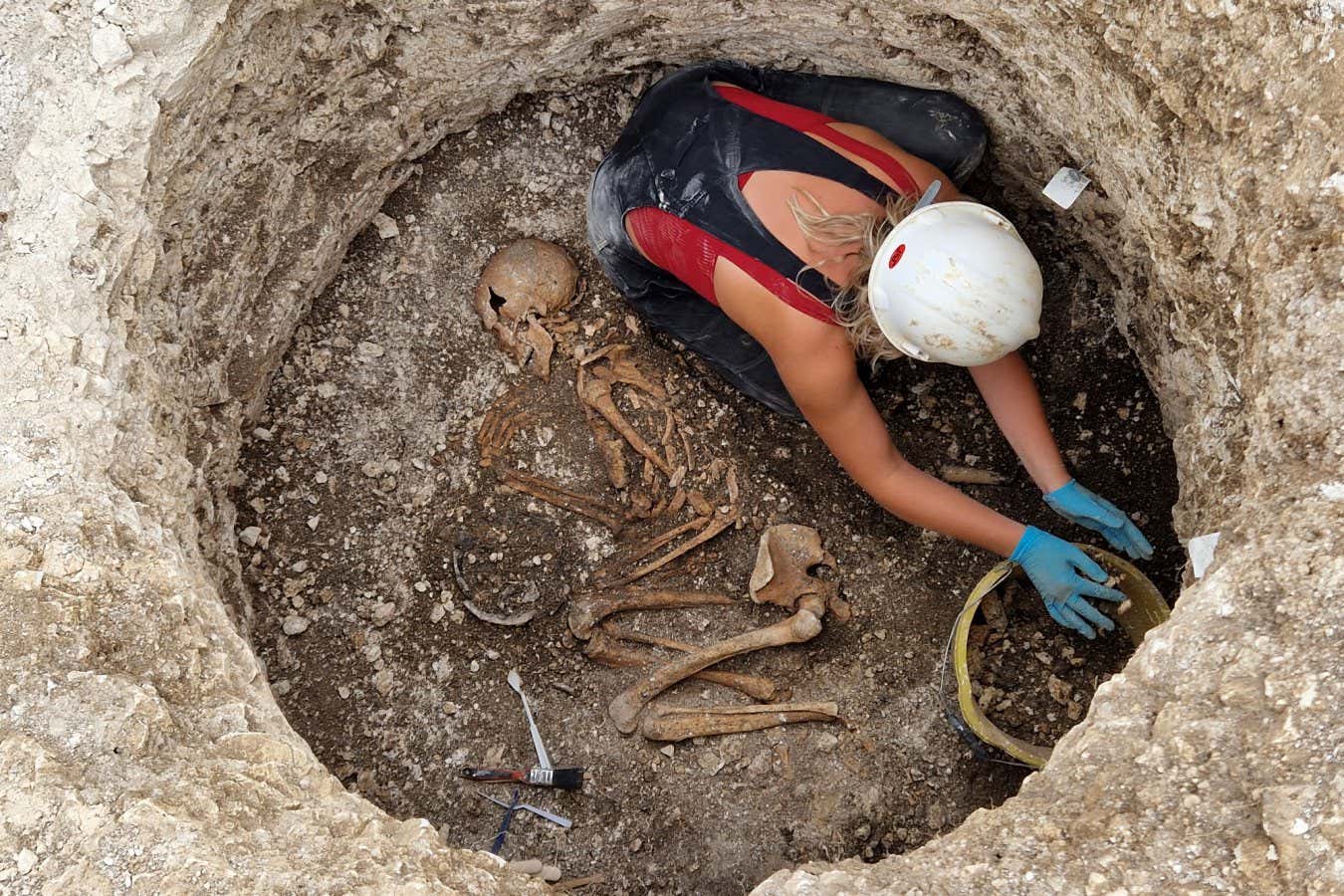
A late Iron Age Durotrigan burial at Winterborne Kingston in Dorset, UK
Bournemouth University
Genetic analysis of people buried in a 2000-year-old cemetery in southern England has bolstered the idea that Celtic communities in Britain placed women centre-stage, showing that women remained in their ancestral homes while men moved in from other communities – a practice that lasted centuries.
The work supports growing archaeological evidence that women had high status within Celtic societies across Europe, including Britain, and gives credence to Roman written accounts that were often thought to be exaggerated for Mediterranean audiences when they described Celtic women as empowered.
Since 2009, human remains of the Durotriges tribe have been unearthed during excavations of an Iron Age burial site at Winterborne Kingston in Dorset, UK. The Durotriges occupied the central southern English coast from around 100 BC to AD 100 and probably spoke a Celtic language.
Human remains from Iron Age Britain are rare because prevailing funerary customs, including cremation or depositing bodies in wetlands, destroyed them. However, the Durotriges buried their dead in formal cemeteries in the chalk landscape, which aided their preservation. Archaeologists have found that Durotrigan women were more often buried with valuable items, suggesting high status and possibly a society focused on women.
Lara Cassidy at Trinity College Dublin and her colleagues have now analysed the genomes of 55 Durotrigan individuals from Winterborne Kingston to untangle how they were related to one another and other Iron Age populations from Britain and Europe.
Cassidy says there were two big “aha moments”. Both were related to mitochondrial DNA – small loops of DNA that we inherit only through the maternal line, since they are passed down via the egg cell and don’t integrate with other DNA.
As the mitochondrial DNA results for each individual came in, the team noticed the same genetic sequence appearing again and again. It became apparent that more than two-thirds of the individuals were descended from a single maternal lineage, originating from a common female ancestor a few centuries earlier.
“My jaw dropped at that moment,” says Cassidy. “This was a clear signature of matrilocality, or husbands moving to live with their wives’ families – a pattern we’d never seen before in prehistoric Europe.” Patrilocality, in which a woman moves to her male partner’s community, is usually the norm.
To find out if the matrilocal pattern was a distinct phenomenon of the Durotriges or if it could have been more widespread across Britain, Cassidy began trawling through data from an earlier large genetic survey of Iron Age Britain and Europe. Her jaw dropped again. She noticed cemeteries across Britain where most individuals were maternal descendants of a small set of female ancestors.
It adds to the growing pile of evidence that Iron Age women were relatively empowered, says Cassidy. “Matrilocality typically co-occurs with cultural practices that benefit women and keeps them embedded in their family support networks,” she explains.
In modern societies, matrilocality has been associated with higher female involvement in food production, higher paternity uncertainty and protracted male absence. In such societies, it is the man who migrates into a new community as a relative stranger and depends on his partner’s family for his livelihood.
“Men typically still dominate formal positions of authority, but women can wield huge influence through their strong networks of matrilineal relatives and their central role in the local economy,” says Cassidy.
Cassidy’s team went on to compare the British DNA dataset with data from other European sites, revealing repeated waves of migration from the continent, aligning with archaeological evidence. This showed that southern Britain was a hotspot for cultural and genetic exchange between 2500 BC and 1200 BC during the Bronze Age, as well as during a previously unknown Late Iron Age influx at the time of the Durotriges.
Previous studies have suggested that Celtic languages probably arrived in Britain between 1000 BC and 875 BC, but the new findings widen that window. “Celtic languages were possibly introduced on more than one occasion,” says Cassidy.
“This is very exciting new research and is revolutionising how we understand prehistoric society,” says Rachel Pope at the University of Liverpool, UK, who has previously found evidence of female-focused kinship in Iron Age Europe. “What we are learning is that the nature of society in Europe before the Romans was really very different.”
Topics:
