
Close Menu
    National News Brief
    Wednesday, June 17
    • Home
    • Business
    • Lifestyle
    • Science
    • Technology
    • International
    • Arts & Entertainment
    • Sports
    National News Brief
    Home » Robotic exoskeleton can train expert pianists to play faster

    Robotic exoskeleton can train expert pianists to play faster

    Team_NationalNewsBriefBy Team_NationalNewsBriefJanuary 17, 2025 Science No Comments3 Mins Read
    Share
    Facebook Twitter LinkedIn Pinterest Email


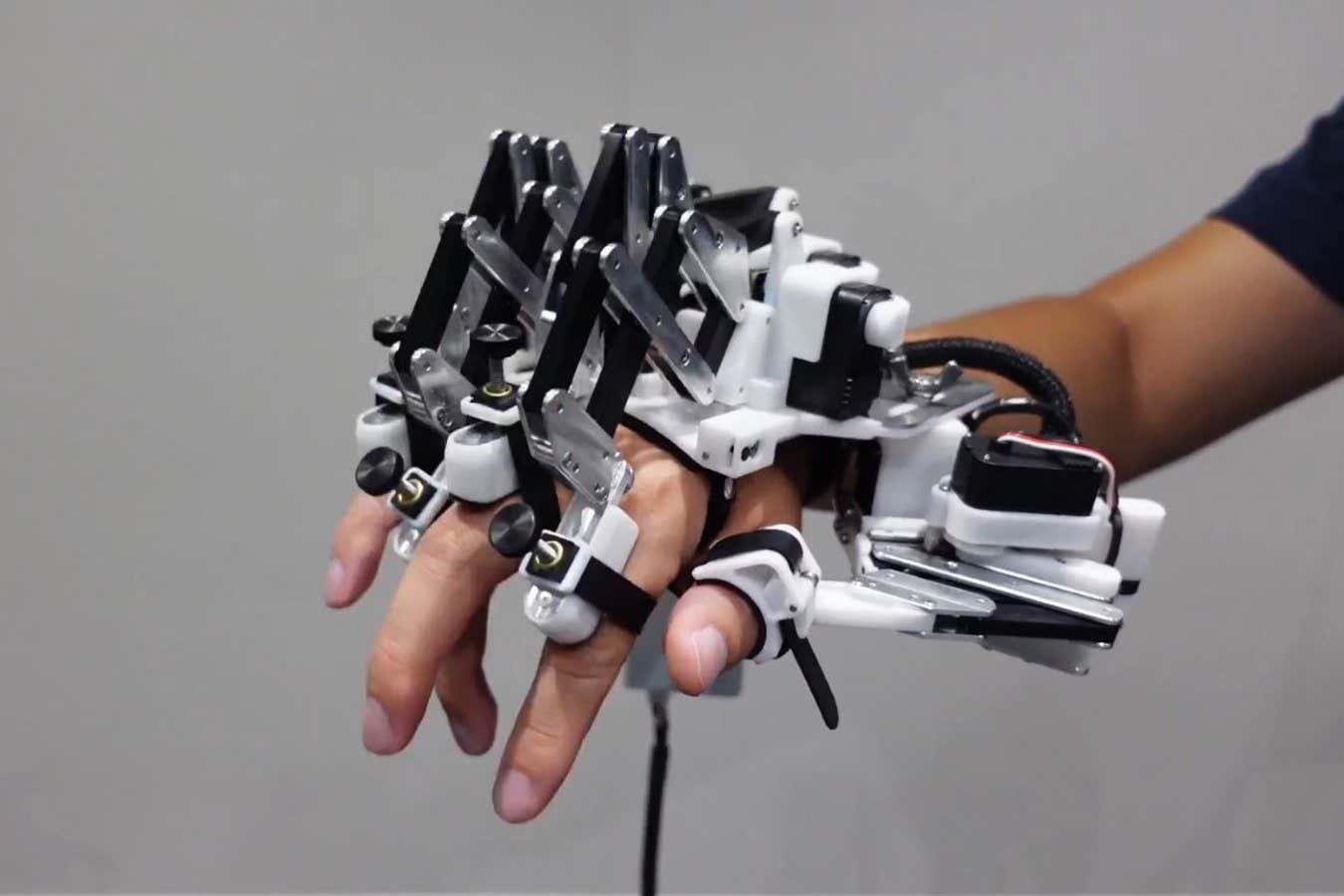
    A robotic exoskeleton can train people to move their fingers more quickly

    Shinichi Furuya

    A robotic hand exoskeleton can help expert pianists learn to play even faster by moving their fingers for them.

    Robotic exoskeletons have long been used to rehabilitate people who can no longer use their hands due to an injury or medical condition, but using them to improve the abilities of able-bodied people has been less well explored.

    Now, Shinichi Furuya at Sony Computer Science Laboratories in Tokyo and his colleagues have found that a robotic exoskeleton can improve the finger speed of trained pianists after a single 30-minute training session.


    “I’m a pianist, but I [injured] my hand because of overpractising,” says Furuya. “I was suffering from this dilemma, between overpractising and the prevention of the injury, so then I thought, I have to think about some way to improve my skills without practising.”

    Furuya remembered that his teachers used to show him how to play certain pieces by placing their hands over his. “I understood haptically, or more intuitively, without using any words,” he says. This made him wonder whether a robot might be able to replicate this effect.

    The robotic exoskeleton can raise and lower each finger individually, up to four times a second, using a separate motor attached to the base of each finger.

    To test the device, the researchers recruited 118 expert pianists who had all played since before they had turned 8 years old and for at least 10,000 hours, and asked them to practise a piece for two weeks until they couldn’t improve.

    Then, the pianists received a 30-minute training session with the exoskeleton, which moved the fingers of their right hand in different combinations of simple and complex patterns, either slowly or quickly, so that Furuya and his colleagues could pinpoint what movement type caused improvement.

    The pianists who experienced the fast and complex training could better coordinate their right hand movements and move the fingers of either hand faster, both immediately after training and a day later. This, together with evidence from brain scans, indicates that the training changed the pianists’ sensory cortices to better control finger movements in general, says Furuya.

    “This is the first time I’ve seen somebody use [robotic exoskeletons] to go beyond normal capabilities of dexterity, to push your learning past what you could do naturally,” says Nathan Lepora at the University of Bristol, UK. “It’s a bit counterintuitive why it worked, because you would have thought that actually performing the movements yourself voluntarily would be the way to learn, but it seems passive movements do work.”

    Topics:


    Source link

    Team_NationalNewsBrief
    • Website

    Keep Reading

    The secrets to keeping your brain sharp in old age

    Sperm have been made magnetic to allow IVF inside the body

    Could the keto diet help treat anorexia, schizophrenia and depression?

    Technology is changing our perspective on nature – at every scale

    Russia seeks mathematician’s extradition | Scientific American

    Glaciers are secretly teeming with life

    Add A Comment

    Comments are closed.

    Editors Picks

    Dak Prescott aiming to avoid surgery, IR stint likely

    November 8, 2024

    Kanye West Reveals Autism Diagnosis After Grammy Drama

    February 6, 2025

    Clint Eastwood’s Daughter Flaunts Her Slim Postpartum Body

    November 15, 2025

    US and Iran Reach Framework Deal to End War, Reopen Hormuz

    June 15, 2026

    Former One Direction member Liam Payne found dead in Buenos Aires | Music News

    October 17, 2024
    Categories
    • Arts & Entertainment
    • Business
    • International
    • Latest News
    • Lifestyle
    • Opinions
    • Politics
    • Science
    • Sports
    • Technology
    • Top Stories
    • Trending News
    • World Economy
    About us

    Welcome to National News Brief, your one-stop destination for staying informed on the latest developments from around the globe. Our mission is to provide readers with up-to-the-minute coverage across a wide range of topics, ensuring you never miss out on the stories that matter most.

    At National News Brief, we cover World News, delivering accurate and insightful reports on global events and issues shaping the future. Our Tech News section keeps you informed about cutting-edge technologies, trends in AI, and innovations transforming industries. Stay ahead of the curve with updates on the World Economy, including financial markets, economic policies, and international trade.

    Editors Picks

    Ghosts of empire: A quarantine centre and Laikipia’s colonial past | Ebola News

    June 17, 2026

    NFC North schedule breakdown: The toughest four-game stretches in 2026

    June 17, 2026

    Opinion | Ossoff: A Cross-Ideological 2028 Dark Horse

    June 17, 2026

    Work-life balance doesn’t exist for working parents

    June 17, 2026
    Categories
    • Arts & Entertainment
    • Business
    • International
    • Latest News
    • Lifestyle
    • Opinions
    • Politics
    • Science
    • Sports
    • Technology
    • Top Stories
    • Trending News
    • World Economy
    • Privacy Policy
    • Disclaimer
    • Terms and Conditions
    • About us
    • Contact us
    Copyright © 2024 Nationalnewsbrief.com All Rights Reserved.

    Type above and press Enter to search. Press Esc to cancel.