

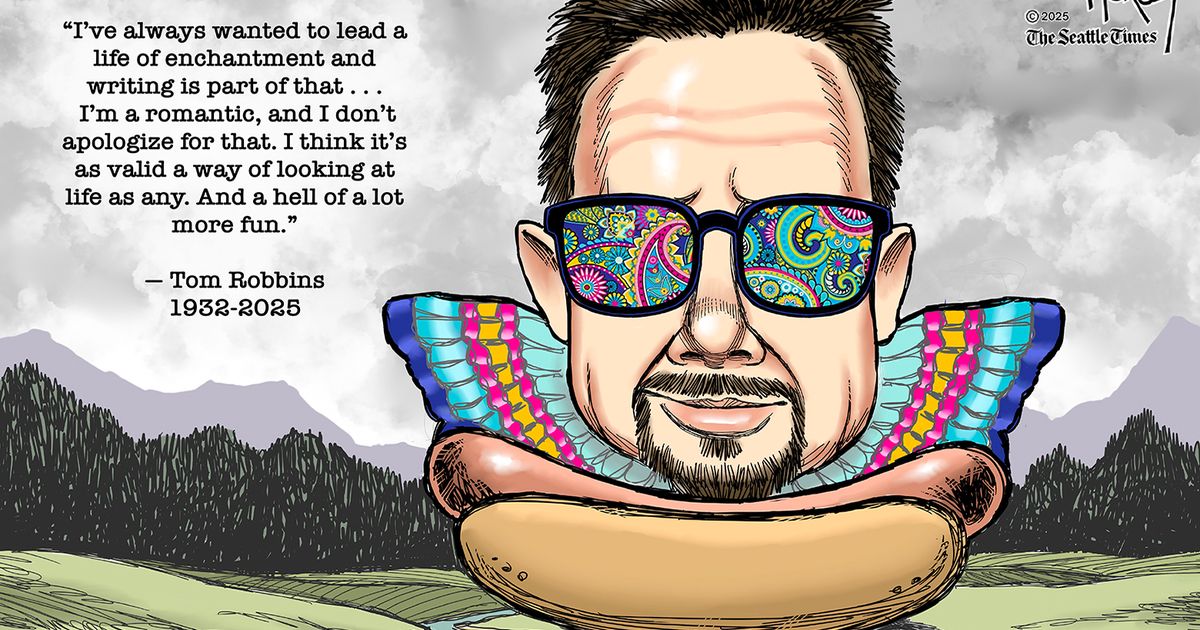
When I heard that La Conner’s loveable, best-selling novelist, Tom Robbins, had died on Sunday at age 92, I felt a pang of melancholy and also a bit of surprise. How could the literary world’s greatest imp – someone so perpetually young at heart – have been 92 years old?
I had the good fortune to share a public stage with Robbins a couple of times, as well as a drink and a conversation on at least one memorable occasion. Like many baby boomers, I came of age reading Robbins’ novels; first, “Another Roadside Attraction,” followed up with “Even Cowgirls Get the Blues,” and then his other entertaining works. His books are playful, funny and stocked with fabulously wild metaphors and unexpected allusions, but they also contain enlightened riffs on religion, philosophy, metaphysics, alternative lifestyles and the quirks of humanity we all share.
Critics who favor literature that is obtuse and rigidly serious were not fans of Robbins’ books, but millions of readers were. Robbins resisted those who said he needed to choose between getting more solemn or becoming purely comedic, rightly pointing out that life itself is filled with both laughter and tears, silly absurdities and cruel realities.
Robbins grew up in the South, but, as a young man, he ran as far as he could from the racism and narrow-mindedness of his home region, ending up in Seattle, where he worked for The Seattle Times until the 1960s counterculture lured him to alternative newspapers, political activism, rock festivals and psychedelic epiphanies. He spent something like a half century living in Skagit County, and no writer has captured the misty mysticism and rain-soaked eccentricity of this region any better.
In “Another Roadside Attraction,” Robbins wrote about “lipstick-orange starfish” in Puget Sound; flooded Skagit Valley fields that “could be successfully navigated by midget submarines”; Northwest landscapes that are akin to “a Sung dynasty painting, perhaps before the intense wisps of mineral pigment have dried upon the silk”; and gray, cloudy skies that turn the shrouded sun into “a little boiled potato in a stew of dirty dumplings.”
And Robbins celebrated women and their many powers, creating memorable characters like Sissy Hankshaw, the protagonist in “Even Cowgirls Get the Blues,” who hitches her way through modern Western adventures, unembarrassed by her two abnormally large thumbs. For whatever reason, one Robbins metaphor from that book has stuck in my memory for decades – his description of the story’s cowgirls, bedded down in their bunkhouse, making small sounds in their sleep that were “like the love cries of marshmallows.”
Those who knew Tom Robbins well seem to have nothing but good things to say about this kind, romantic, talented man. I wish I had known him better. Those of us living along the shores of Puget Sound should be proud and grateful that he came to live and create among us.
See more of David Horsey’s cartoons at: st.news/davidhorsey
View other syndicated cartoonists at: st.news/cartoons
Editor’s note: Seattle Times Opinion no longer appends comment threads on David Horsey’s cartoons. Too many comments violated our community policies and reviewing the dozens that were flagged as inappropriate required too much of our limited staff time. You can comment via a Letter to the Editor. Please email us at letters@seattletimes.com and include your full name, address and telephone number for verification only. Letters are limited to 200 words.
