

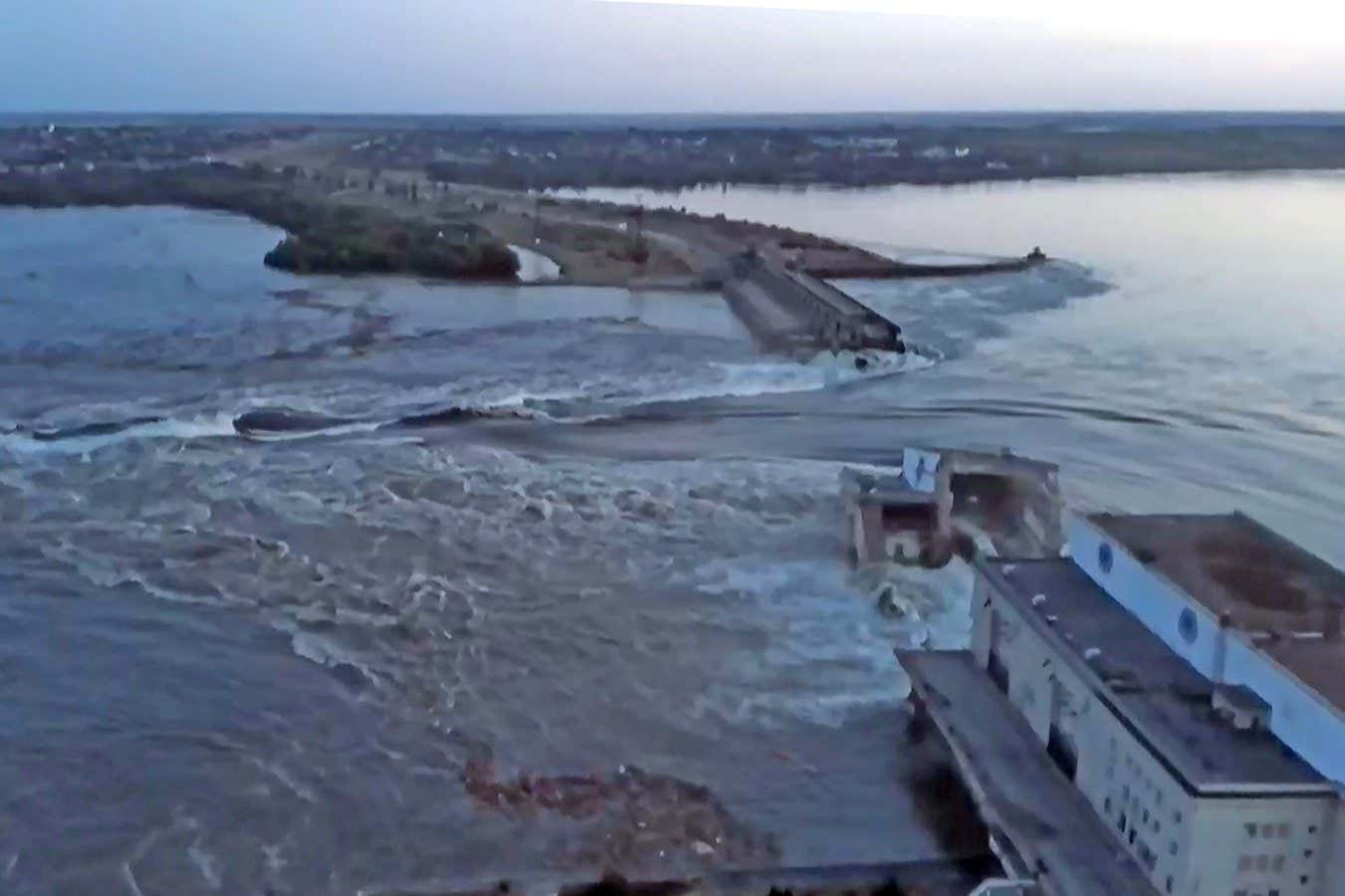
The Kakhovka dam on 6 June 2023, shortly after its partial destruction
Ukrhydroenergo / UPI / Alamy
The 2023 breach of Ukraine’s Kakhovka dam caused deadly flooding downstream, threatened to disrupt the cooling system of a nuclear power plant and deprived the region of water for irrigation. But an analysis almost two years later finds the most lasting consequence may be the huge volume of contaminated sediment left behind in the drained reservoir.
“The area of the former reservoir served as a big sponge that was accumulating various pollutants,” says Oleksandra Shumilova at the Leibniz Institute of Freshwater Ecology and Inland Fisheries, Germany. Exposure to these contaminants across an area almost as large as Luxembourg could pose a long-term threat to local populations and ecosystems, and could complicate debates about whether to rebuild the dam when the Russia-Ukraine war ends, she says.
On 6 June, 2023, a section of the Kakhovka dam in southern Ukraine collapsed after an explosion, releasing a torrent of water from one of the world’s largest reservoirs into the lower Dnieper river and Black Sea beyond. Ukraine and Russia have accused each other of destroying the dam, which was controlled by Russian forces at the time.
Ukrainian officials immediately anticipated that the flooding and pollutants in the water would destroy ecosystems. A spokesperson for the UK-based Conflict and Environment Observatory calls the destruction of the dam “the single most environmentally damaging act of the full-scale invasion”. But the ongoing war has made a more complete assessment in the area challenging.
To get a fuller picture, Shumilova and her colleagues reconstructed the flow of water and sediment after the breach using hydrological models, satellite images and data collected before Russia’s invasion. “Our aim was to give a clear scientific answer: what has happened based on scientific evidence?” she says.
They found the resulting flood would have carried nearly a cubic kilometre of sediment in the reservoir downstream, much of which was contaminated with toxic heavy metals and other pollutants from upstream industry and agriculture. The flood would also have picked up around 7 cubic kilometres of sediment downstream of the dam, as well as oil and other chemical products from flooded facilities along the river. When it reached the Black Sea, this floodwater formed a plume visible in satellite images across 7300 square kilometres of water.

Changes in water cover after the Kakhovka dam burst
EOSDA
While this immediate flooding was harmful, the researchers found the contamination left behind poses a big problem of its own. They estimate more than 99 per cent of the contaminated sediment in the reservoir remained. These sediments may contain more than 83,000 tonnes of toxic heavy metals such as lead, cadmium and nickel – and they are now exposed to the air across nearly 2000 square kilometres of the former reservoir.
This poses a health hazard to local people still collecting water from ponds that have formed there, says Shumilova. It may also harm plants and animals that have rapidly moved on to what was the bed of the reservoir. It could also complicate arguments from some Ukrainian environmental groups that the dam shouldn’t be rebuilt after the war in order to allow this once-flooded ecosystem to restore itself, she says.
Bohdan Vykhor at the World Wide Fund for Nature’s Ukraine division agrees that the contamination poses an issue for restoring the ecosystem. But he says other, more sustainable alternatives to supply the region with water and electricity should be considered, rather than simply rebuilding the dam.
“Building of the Kakhovka dam for the first time was a disaster for nature, destruction of the dam was a disaster for nature, and if we rebuild, it might be another disaster for nature,” he says.
Topics:
