

When Asad Dandia received a message from a young man named Shamiur Rahman in March 2012, he had no reason to suspect that he was under the watchful eye of state surveillance.
Rahman simply seemed interested in deepening his relationship with Islam and getting involved in charity work. As a Muslim community organiser in New York City, Dandia was happy to help.
The young man quickly became a regular at meetings, social events and efforts to help low-income members of the community. Rahman even spent a night in Dandia’s family home.
But nearly seven months later, Rahman made a confession over social media: He was an undercover informant for the New York City Police Department (NYPD).
Dandia ultimately joined a class-action lawsuit, alleging the city of New York singled out Muslim communities for surveillance as part of the wider “war on terror” in the United States.
Four years later, the city settled, agreeing to protections against undue investigations into political and religious activities.
But Dandia sees an echo of his experience in the present-day arrests of pro-Palestinian student protesters from abroad.
He is among the activists and experts who have observed an escalation of the patterns and practices that became core features of the “war on terror” — from unwarranted surveillance to the broad use of executive power.
“What I endured was very similar to what we’re seeing students endure today,” Dandia said.
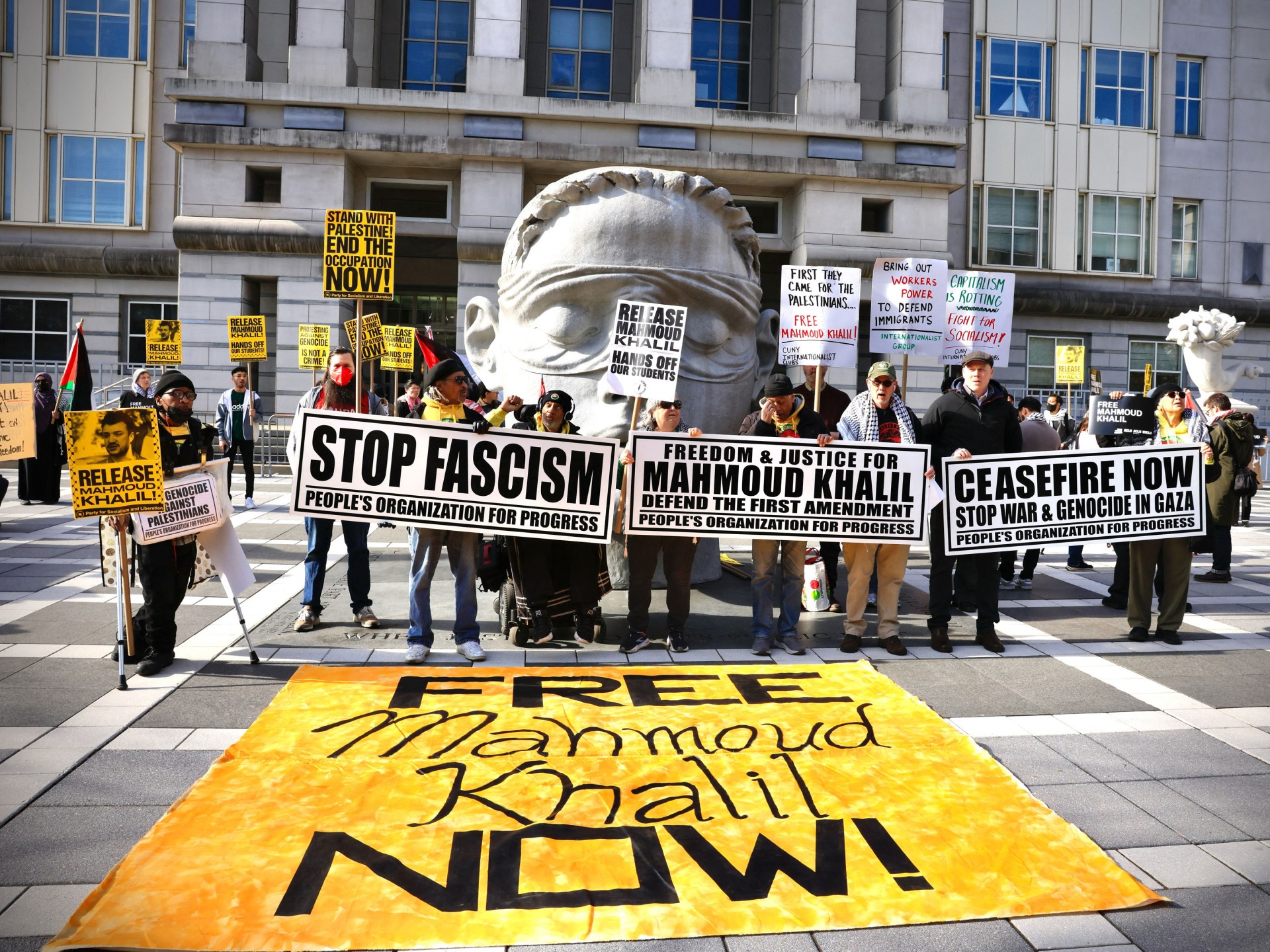
He noted that a lawyer who represented him is now working on the case of Mahmoud Khalil, a Columbia University student and permanent resident facing deportation for his pro-Palestine activism.
The administration of President Donald Trump has accused Khalil of supporting terrorism, though it has yet to charge him with a crime or release evidence to substantiate the claim.
Dandia said that the belief that Muslim, Arab and immigrant communities are inherently suspect is the common thread between their experiences. “Even if what Trump is attempting now is unprecedented, it’s drawing from longstanding traditions and policies.”
From neighbours to enemies
Scholars and analysts say that one of the throughlines is the pairing of harsher immigration enforcement with rhetoric focused on national security.
The “war on terror” largely began after the attacks on September 11, 2001, one of which targeted New York City.
In the days that followed, the administration of former President George W Bush began detaining scores of immigrants — nearly all of them from Muslim, Arab and South Asian communities — over alleged ties to terrorism.
The American Immigration Council, a Washington-based nonprofit, estimates that 1,200 people were arrested in the initial sweep. Many were ultimately deported.
But the immigration raids did not result in a single conviction on terrorism-related charges. A 2004 report by the American Civil Liberties Union (ACLU) noted that the government nevertheless advertised the deportations as “linked to the September 11 investigation”.
“Almost immediately after 9/11, Muslim communities were treated not as fellow New Yorkers who were living through the trauma of an attack on their city, but as potential accessories, witnesses, or perpetrators of a follow-on attack,” said Spencer Ackerman, a reporter who covered the war on terror and is the author of the book Reign of Terror.
The ACLU report says that some of those detained were held in solitary confinement and only allowed to leave their cells with shackles on their hands and legs. Some were kept in detention long after the government cleared them of any wrongdoing.
Fear in ‘the homeland’
Nikhil Singh, a history professor at New York University, believes that period of heightened fear caused the US to look inward for enemies, among its own communities.
“The argument that the US was fighting these non-state groups who didn’t have borders started to imply that the fight against those enemies could take place anywhere, including in what the Bush administration started to call ‘the homeland’,” said Singh.
He pointed out that those post-September 11 detentions exercised a broad view of executive power, in order to justify a lack of due process for alleged terror suspects.
“A lot of what’s happening now can be traced back to this moment, where this argument became normalised that the executive is responsible for keeping the country safe and, for that reason, needs to be able to suspend basic rights and ignore constitutional restraints.”
Art Eisenberg, executive counsel at the New York branch of the ACLU, explained that the history of targeting immigrant communities for national security concerns stretches beyond the “war on terror”.
“The origins of policing and surveillance and undercover work targeting immigrant groups goes all the way back to the beginning of the 20th century. The New York City police intelligence bureau used to be called the Red Squad, but earlier it had been called ‘the Italian squad’,” said Eisenberg.
Over time, those operations morphed to target new sources of potential dissent: communists, civil rights activists and the Black Panthers, among others.
But he added that the “war on terror” marked an escalation of that targeting. And those types of actions can have lasting effects on communities.
The ACLU notes that, in the years after the September 11 attacks, more than one-third of Pakistanis in a Brooklyn neighbourhood known as “Little Pakistan” were deported or chose to leave the area.
Later, in 2012, when it was revealed that authorities had been spying on Dandia’s organisation, donations started to dry up, and the mosque where they held meetings told them to meet outside instead.
No one had been charged with a crime. But the chilling effect of the surveillance caused the organisation to eventually close its doors, according to Dandia.
“People always ask this question: If you’re not doing anything wrong, why should you worry?” said Dandia. “But it’s the government that is deciding what is right and wrong.”
Escalating attacks
Under the Trump administration, critics say vague allegations of terrorism continue to be seized upon as a pretext to silence dissent.
In a statement about Khalil’s arrest, the Department of Homeland Security claimed that his involvement in campus protests against Israel’s war on Gaza showed he was “aligned” with the Palestinian armed group Hamas.
On Wednesday, masked federal agents also grabbed a 30-year-old Turkish graduate student named Rumeysa Ozturk off the street near Tufts University and took her away as she was on her way to dinner.
In that case, the Department of Homeland Security likewise accused Ozturk of taking part in activities “in support of Hamas”, without offering details.
The US has designated Hamas a foreign terrorist organisation since 1997. US law prohibits citizens and residents from providing “material support” to such organisations.
But Samuel Moyn, a professor of law and history at Yale University, said the recent arrests have failed to meet that threshold.
“The scary thing is that they have dropped the pretence of even accusing people of material support for terrorism,” Moyn told Al Jazeera. “They are relying on a claim that these views are at odds with US foreign policy.”
Singh pointed out that the seemingly arbitrary detentions allow Trump to draw on the legacy of the “war on terror”, while he pursues his own aims, including a crackdown on immigration.
“It’s the immigration agenda intersecting with the war on terror,” said Singh. “The former involves slowly chipping away at traditional constitutional rights, while the latter gives you a framework of broad presidential power.”
If left unchecked, Ackerman said that an expansive view of presidential power could pave the way for further human rights abuses, even beyond immigrant communities.
“If there’s never any accountability for institutionalised abuses, those abuses will continue and they will intensify,” he said. “That is the lesson not just of the war on terror, but of a lot of noxious human history.”
“If the Trump administration can say that what you say, what you post on social media, what you put on a placard, redounds to the benefit of a terror entity, then there really is nothing you can do to protect your freedom to say things that people in power disapprove of,” he added.
