

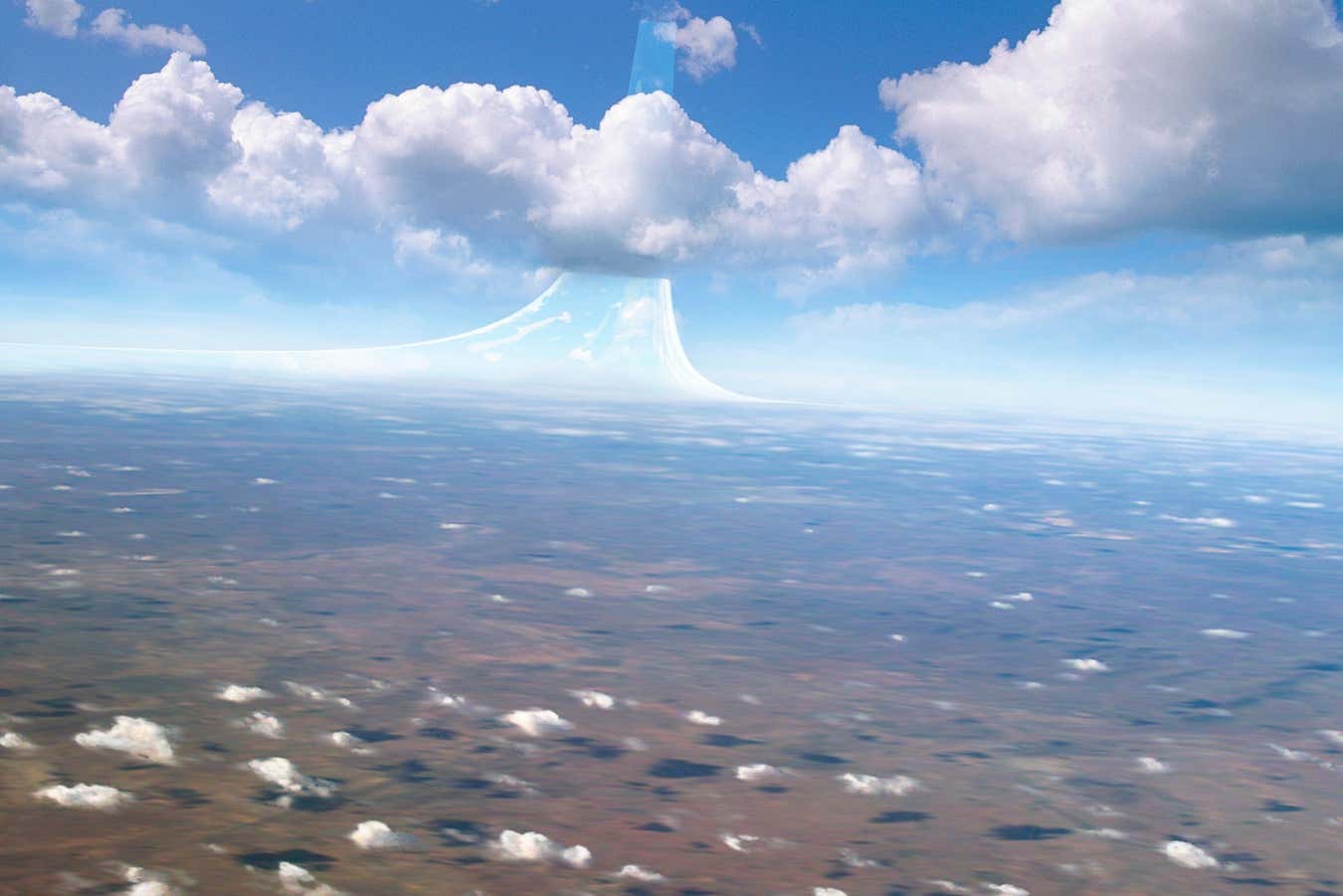
“Why not build just the equator? Much cheaper.”
Alamy Stock Photo
Somebody told me about Dyson spheres in the mid-1970s. Maybe it was Poul Anderson. Freeman Dyson’s revolutionary construction had habitats and widgetry of any description surrounding a star. Point was, Earthly telescopes could find alien life by looking at certain stars.
I absorbed the science fiction writers’ version: a ping pong ball as big as Earth’s orbit, enclosing a sun and collecting all of its sunlight for industrial use. Colonise the inner surface.
I played with it. I’d need generated gravity – violating general relativity – and fantasy-sized funding. Without both, you’d spin it, and only the equator would be useful…
Why not build just the equator? Much cheaper. Spin at – I fudged numbers, because this isn’t Sol – 770 miles per second. At this size you could keep most of the atmosphere inside with 1000-mile-high walls, no roof. Leakage would be tolerable. Spread a landscape across the interior: 3 million times the area of Earth. Population: larger than you’d think, because I made another assumption: the human race evolved elsewhere, in three stages, childhood, breeder and protector (the adults). I’d written about them elsewhere. The Pak protectors are intelligent tool-users; breeders (Homo habilis) are not. Protectors built the Ringworld… and landscaped it, and populated it with Homo habilis. Pak protectors are not ecologists; they didn’t bring anything they didn’t like.
With breeders spread all over the Ringworld, the protectors suddenly became extinct. I assumed a war killed them off. Without protectors to cull them, breeders moved into hundreds of ecological niches. So if you assume a population such as 100 million (for a primitive Earth) times 3 million, you’d be short. Mutating breeders shaped to use ecologies vacated by the equivalent of bats, hyenas, lions, many carnivores and herbivores… Ghouls, or Night People, are everywhere, keeping the Ringworld clean and often civilised…
I was a novice, a few years into a new career. These numbers were scary. Would I be laughed off the stage? New writers were giving up the sense of wonder as passé. But an engineer had written that engineers aren’t scared by big numbers.
The detail I added to The Ringworld Engineers almost writes itself.
It’s always noon. I’ll have to invent night.
The back of the Ringworld is the mask of a planet. Sea bottoms are always shallow and flat, because humans use only the top of an ocean. Fjords and harbours are everywhere, for the convenience of boatfolk. Mountains show subtle stairways.
Ringworld’s success delighted me. It won several awards. It also generated feedback – which also delighted me. Over the next 10 years I got enough feedback, in letters and conversation, along with my own afterthoughts and elaborations, to require a sequel: The Ringworld Engineers. And feedback continues.
The Ringworld is a great gaudy intellectual toy. Readers are inclined to go on playing with it after they’ve finished the book. I approve completely: a person should go on thinking about a book; if they don’t, they aren’t getting their money’s worth.
A professor in England informed me that the Ringworld floor would require the tensile strength of an atomic nucleus. Otherwise, the spin would tear it apart. (So I invented scrith.) MIT students at the World Science Fiction convention in 1971 were chanting in the halls: “The Ringworld is unstable.” (I knew that; I added attitude jets in The Ringworld Engineers.) A Florida high school class spent a semester on the Ringworld, and decided that my worst problem was that all the topsoil would wind up in the bottoms of the oceans. (Tough one! I put a system of pipes in the seabeds, ran them rimward and over the tops of the rim walls, and got spill mountains, and whole new breeds of hominids to occupy them.)
I wrote that protectors lose their sexual urges and sex characteristics, leaving a fierce drive to protect their genetic line. A fan pointed out that they’d need a wonderfully precise sense of smell to sense unmutated descendants. Give them big noses! (I did.)
My shadow squares, which bring night to the Ringworld, needed work. There’s too much twilight, not enough night. They need to be much longer, five of them, orbiting retrograde!
Dan Alderson, a scientist at Jet Propulsion Laboratory in California, where he was known as the “sane genius”, designed a system with four ringworlds. Three are orthogonal to each other, spinning on frictionless bearings. The fourth was built by Mesklinites. Hal Clement’s Mesklin has huge gravity and extreme cold. Dan needed an orbital radius the size of Jupiter’s or Saturn’s, and much higher speed.
Edward M. Lerner and I wrote five books retrofitting my Known Space. I kept him off the Ringworld, but my character Beowulf Shaeffer’s life became far more plausible, and Ringworld’s protagonist Louis Wu took on more detail.
Freeman Dyson thought it would all work better if smaller. At 1 million miles’ radius, a one-Earth gravity spin would take 24 hours! Orbiting the sun would give it seasons! And thousands of such objects in solar orbit would comprise… a Dyson sphere.
I put the alien Kzinti in many stories. When James Patrick Baen invited me to open Known Space to other writers, I told him Known Space was mine. But since I don’t write war stories, he could publish the era of The Man-Kzin Wars (but stay off the Ringworld). We had 15 volumes of the Man-Kzin War stories, a few of which are mine, before we closed it down.
I have the alien Pierson’s puppeteers as paintings, statuettes, origami, pipe cleaners… and Bonnie Dalzell put a puppeteer variation in the Smithsonian.
There’s been little feedback on Ringworld’s Teela Brown, who was bred for luck. Hers is the ultimate psychic power – author control, which teachers of writing say should never show – or else she’s a statistical fluke. In a big enough population you must find a person who has been consistently lucky. I never decided which description holds. I had Wu playing the eternally optimistic Doctor Pangloss (from Voltaire’s Candide) throughout all four Ringworld books. Whatever happens to Teela, a reader can see it as the best of all possible worlds.
Larry Niven’s Ringworld is the latest pick for the New Scientist Book Club. Sign up and read along with us here.
Topics:
