

Spend enough time in San Francisco, peering into the cyberpunk future, and you may find that weird things start seeming normal. Fleets of self-driving cars? Yawn. A start-up trying to resurrect the woolly mammoth? Sure, why not. Summoning a godlike artificial intelligence that could wipe out humanity? Ho-hum.
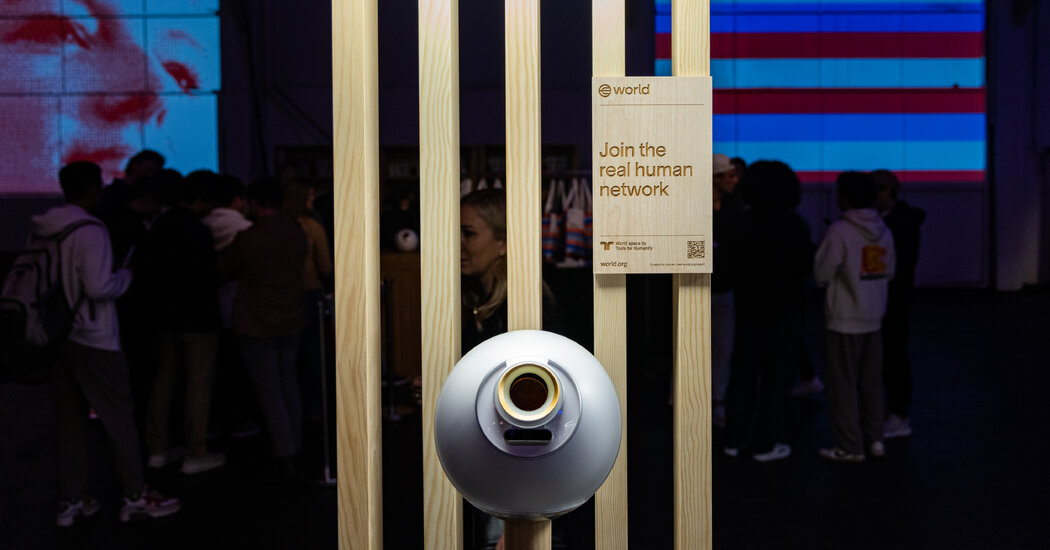
You may even find yourself, as I did on Wednesday night, standing in a crowded room in the Marina district, gazing into a glowing white sphere known as the Orb, having your eyeballs scanned in exchange for cryptocurrency and something called a World ID.
The event was hosted by World, a San Francisco start-up co-founded by Sam Altman of OpenAI that has come up with one of the more ambitious (or creepy, depending on your view) tech projects in recent memory.
The company’s basic pitch is this: The internet is about to be overrun with swarms of realistic A.I. bots that will make it nearly impossible to tell whether we’re interacting with real humans on social networks, dating sites, gaming platforms and other online spaces.
To solve this problem, World has created a program called World ID — you can think of it as Clear or TSA PreCheck for the internet — that will allow users to verify their humanity online.
To enroll, users stare into an Orb, which collects a scan of their irises. Then they follow a few instructions on a smartphone app and receive a unique biometric identifier that is stored on their device. There are baked-in privacy features, and the company says it doesn’t store the images of users’ irises, only a numerical code that corresponds to them.
In exchange, users receive a cryptocurrency called Worldcoin, which they can spend, send to other World ID holders or trade for other currencies. (As of Wednesday night, the sign-up bonus was worth about $40.)
At the event, Mr. Altman pitched World as a solution to the problem he called “trust in the age of A.G.I.” As artificial general intelligence nears and humanlike A.I. systems come into view, he said, the need for a mechanism that tells bots and humans apart is becoming more urgent.
“We wanted a way to make sure that humans stay special and central in a world where the internet was going to have lots of A.I.-driven content,” Mr. Altman said.
Eventually, Mr. Altman and Alex Blania, the chief executive of World, believe that something like Worldcoin will be needed to distribute the proceeds from powerful A.I. systems to humans, perhaps in the form of a universal basic income. They discussed various ways to create a “real human network” that would combine a proof-of-humanity verification scheme with a financial payments system that would allow verified humans to transact with other verified humans — all without relying on government-issued IDs or the traditional banking system.
“The initial ideas were very crazy,” Mr. Altman said. “Then we came down to one that was just a little bit crazy, which became World.”
The project launched two years ago internationally, and it found much of its early traction in developing countries like Kenya and Indonesia, where users lined up to get their Orb scans in exchange for cryptocurrency rewards. The company has raised roughly $200 million from investors including Andreessen Horowitz and Khosla Ventures.
There have been some hiccups. World’s biometric data collection has faced opposition from privacy advocates and regulators, and the company has been banned or investigated in places including Hong Kong and Spain. There have also been reports of scams and worker exploitation tied to the project’s crypto-based rewards system.
But it appears to be growing quickly. Roughly 26 million people have signed up for World’s app since it launched two years ago, Mr. Blania said, and more than 12 million have received Orb scans to verify themselves as humans.
World stayed out of the United States at first, partly out of concern that regulators would balk at its plans. But the Trump administration’s crypto-friendly policies have given it an opening.
On Wednesday, World announced that it was launching in the United States and opening retail outposts in cities including San Francisco, Los Angeles and Nashville, where new users can scan their eyes and get their World IDs. It plans to have 7,500 Orbs in the country by the end of the year.
The company also revealed a new version of its Orb, the Orb Mini — which is not, in fact, an orb. Instead, it looks like a smartphone with glowing eyes, but serves the same purpose as the larger device. And World announced partnerships with other businesses including Razer, the gaming company, and Match Group, the dating app conglomerate, which will soon allow Tinder users in Japan to verify their humanity using their World IDs.
It’s not clear yet how any of this will make money, or whether privacy-conscious Americans will be as eager to fork over their biometric data for a few crypto tokens as people in developing parts of the world have been.
It’s also not clear whether World can overcome basic skepticism about how strange and sinister the whole thing can feel.
Personally, I’m sympathetic to the idea that we need a way to tell bots and humans apart. But World’s proposed fix — a global biometric registry, backed by a volatile cryptocurrency and overseen by a private company — may sound too much like a “Black Mirror” episode to reach mainstream acceptance. And even on Wednesday, in a room packed with eager early adopters, I met plenty of people who were reluctant to stare into the Orb.
“I don’t give up my personal data easily, and I consider my eyeballs personal data,” one tech worker told me.
World’s connection to Mr. Altman has also drawn scrutiny. During the event, a few skeptics pointed out that by virtue of his position atop OpenAI, he is in some sense fueling the problem — an internet full of hyper-convincing bots — that World is trying to solve.
But it’s also possible that Mr. Altman’s connection could help World scale quickly, if it teams up with OpenAI or integrates with its A.I. products in some way. Maybe the social network that OpenAI is reportedly building will have a “verified humans only” mode, or perhaps users who contribute to OpenAI’s products in valuable ways will someday be paid in Worldcoin.
(The New York Times has sued OpenAI and its partner, Microsoft, claiming copyright infringement of news content related to A.I. systems. OpenAI and Microsoft have denied the claims.)
It’s also entirely possible that privacy norms may shift in World’s favor and that what feels strange and sinister today may be normalized tomorrow. (Remember how weird it felt the first time you saw a Clear kiosk at the airport? Did you promise that you’d never hand over your biometric data, then eventually relent and accept it as the cost of convenience?)
When it was my turn to step up to the Orb, I removed my glasses, opened my World app and followed the instructions it gave me. (Look this way, look that way, step back a bit.) The Orb’s cameras whirred for a minute, capturing my iris’s texture. A ring around the Orb glowed yellow, and it let out a happy chime.
A few minutes later, I was the owner of a World ID and 39.22 Worldcoin tokens. (The tokens are worth $40.77 at today’s prices, and I’ll be donating them to charity, once I figure out how to get them off my phone.)
My Orb scan was quick and painless, but I spent the rest of the night feeling vaguely vulnerable — like I had just agreed to participate in a clinical trial for some risky new drug without reading about the possible side effects. But many in attendance seemed to have no such qualms.
“What am I hiding, anyway?” a social media influencer named Hannah Stocking said, as she stepped up to take her Orb scan. “Who cares? Take it all.”
