

It’s full-on springtime now. My blackberries are sending out new canes, and the passion vines have broken ground. The nestlings in the bluebird box are old enough for their cries to be heard across the yard. The front-stoop skinks are awake, the first lightning bugs are blinking in the trees, and the first ruby-throated hummingbird has migrated safely back to Tennessee from his wintering grounds in South America. As they do every year, these signs of spring work to keep my anguish for the world at bay.
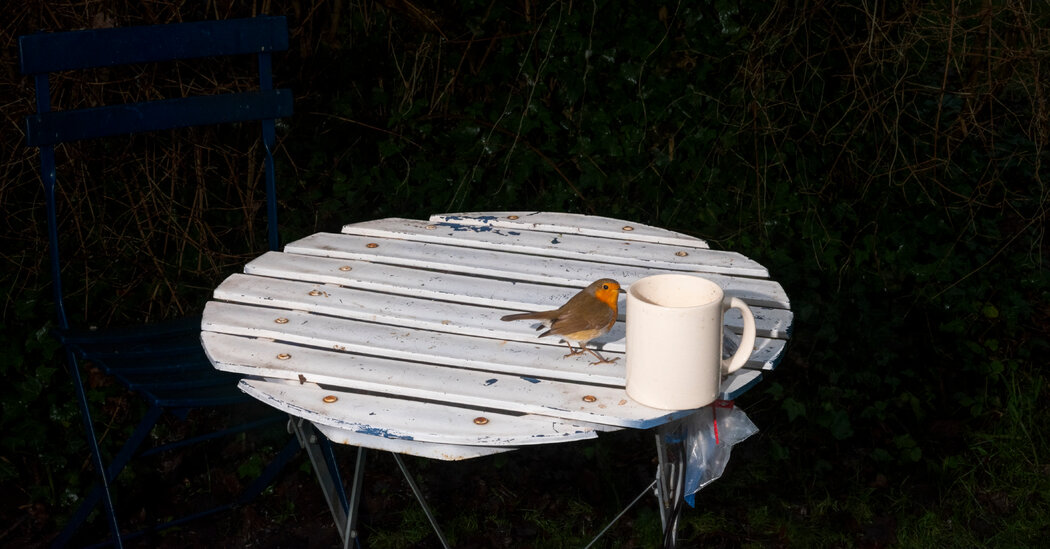
Not all signs of spring are a relief to see. For weeks now, robins have been crisscrossing the roads, flying right at tire level. I don’t know why they do this. Are they too crazed by hormones to remember that their one advantage over automobiles is flight? Are they too hungry after a lean winter to leave the ground and its spring-waking insects? Whatever the reason, I hold my breath a little every morning, hoping the best for low-flying robins.
Maybe it seems pointless, this worry about robins when the Trump administration is waging open war on the whole living world: taking steps to remove crucial protections of the Clean Air Act and the Clean Water Act and habitat protections from endangered species, to make it easier to drill and mine on public lands and fish in protected zones, to halt the expansion of renewable energy, to fire thousands of U.S. Forest Service and National Park Service employees, as well as the experts tracking the effects of climate change on Americans.
And all this is happening just as the data we do have increasingly point to a natural world in dire trouble. Last fall the World Wildlife Fund released the results of a study that showed shocking declines in wildlife populations across the globe — 95 percent in Latin America and the Caribbean, 76 percent in Africa, 60 percent in Asia and the Pacific. Just on Thursday the journal Science published a study showing that North American bird populations are in severe decline, with 75 percent of species affected. Most startlingly, birds are losing ground in places where they have traditionally thrived.
So, especially in spring, when the robins are flying right at tire level again — and the turtles are making their slow methodical way to the other side of the road to lay their eggs again; and the road-crossing squirrels keep panicking again, changing their minds about the safest direction to go when a car is bearing down on them; and the baby opossums have climbed out of their mama’s pouch to cling to their backs, from which they can too easily fall if she tries to hurry — I slow down.
I wish everyone would slow down. Surely the least we can do is to give our wild neighbors time to cross the roads we have built through the middle of their homes.
There’s much more we can do, too, of course. As the entomologist and wildlife ecologist Douglas W. Tallamy points out in his new book, “How Can I Help: Saving Nature With Your Yard,” big change requires technical innovation and political will, but that doesn’t mean there’s nothing individuals can do. “Changes in our landscaping paradigm,” he writes, “can be enacted by everybody and anybody, regardless of our vocation, age, background training or financial resources.”
Wildlife-friendly changes in how we manage our yards and public spaces include choosing native plants that provide food and habitat for native species, protecting insects by building a brush pile, leaving the leaves where they fall and waiting till full spring (after nighttime temperatures have reached at least 50 degrees for two straight weeks) to clean up the garden. It can mean protecting everybody — human beings and wildlife alike — by skipping the herbicides, pesticides, fungicides and synthetic fertilizers.
We need to recognize that an insect-chewed leaf is not a sign of damage but a sign of life: Some hungry creature is eating the leaf, which means that some other hungry creature has insects to eat, and the wild world is behaving exactly as it evolved to behave.
These small local landscapes are becoming ever more crucial in the context of a world on fire. “In an era of climate change, with extreme weather putting huge stress on natural habitats, the patches of ground that we tend around our houses can turn into places of refuge,” the conservation biologist Thor Hanson points out in his new book, “Close to Home: The Wonders of Nature Just Outside Your Door.” When we cherish and tend what we have the power to tend, we make a place where vulnerable creatures at least have a chance.
So choose redbud trees over crepe myrtles and asters over chrysanthemums. Brake for robins and turtles and opossums. Turn off unnecessary outdoor lights to protect migrating birds. Keep pets leashed or indoors. Never use rodenticides, which move up the food chain, or glue traps, which trap indiscriminately and inflict horrible suffering. Start replacing your lawn with native sedges and ground cover that need not be mowed. Where you still have turf grass, set your mower blades as high as possible — and walk the property before you cut — to give creatures hidden in the grass a chance to flee. Hold off on tree-trimming till nesting season has passed.
Maybe all this seems impossibly insufficient in light of the challenges we face, especially now that we are working not just against time but against the might of the federal government. But when the changes we make are changes that many others also make, it’s possible to move the needle — not just for this robin, or this turtle, or this firefly, but for them all. “In the United States alone,” Dr. Tallamy notes, “135 million acres are now in residential landscapes, and those landscapes are controlled by hundreds of millions of people.”
It’s not hard to make these changes, and most of us are already convinced that we need to do exactly that: As Catrin Einhorn noted in a recent Climate Forward newsletter: “Most U.S. adults, including majorities of Protestants, Catholics and people of other religions, believe that the Earth is sacred and that God gave humans a duty to protect and care for it, a Pew Research Center survey found in 2022. But there is often a disconnect between that belief and environmental action.”
Maybe it will be a little easier to take significant environmental action if we understand that the entry point to environmentalism can be as simple as planting a native tree or turning off the outdoor lights or leaving the leaves where they fall. And if we remember that for every first step there are many other steps. We just need to take them one at a time, always looking for ways to bring others along with us.
