

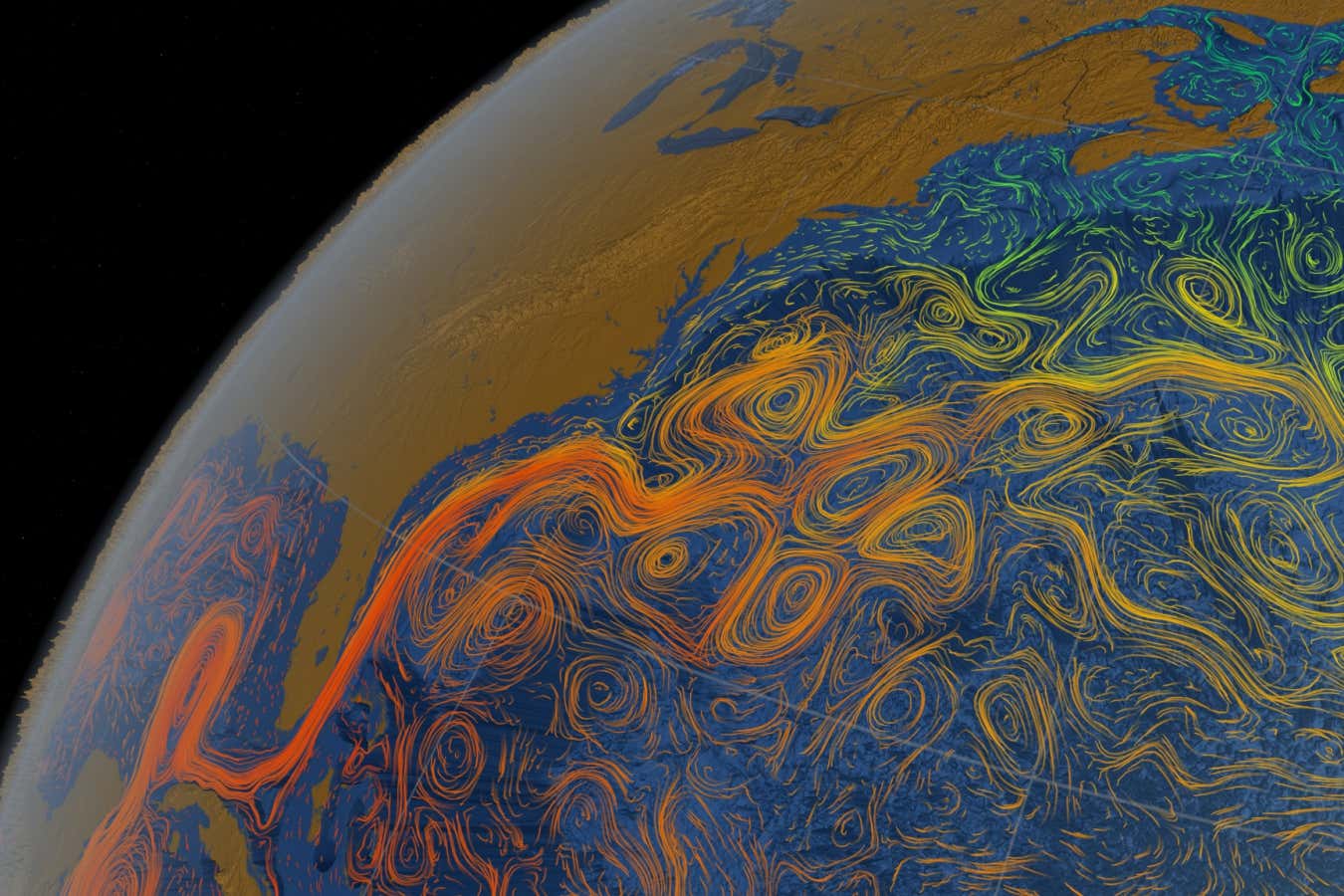
The AMOC is a system of ocean currents that circulates water within the Atlantic Ocean
NASA/Goddard Space Flight Center Scientific Visualization Studio
The slowdown of a major current in the Atlantic Ocean is boosting the sea level and associated flooding in the Northeast US, on top of the already-rising sea level due to climate change. A total collapse of this Atlantic Meridional Overturning Circulation (AMOC) as the planet warms could raise the sea level even further.
“If the AMOC collapsed, this would dramatically increase the flood frequency along the US coast, even in the absence of strong storms,” says Liping Zhang at the Geophysical Fluid Dynamics Laboratory of the US National Oceanic and Atmospheric Administration (NOAA) in New Jersey. “Even partial weakening [of the current] can already have substantial impacts.”
Melting ice sheets and warmer water due to human-caused climate change are leading to a rise in average sea level, but the rate of sea-level rise isn’t the same everywhere. For instance, some coastal land is sinking, speeding the relative rate of sea-level rise in those areas. Local sea level is also shaped by how heat, water and salt circulate in the ocean, with warmer and fresher water taking up more space than colder, saltier water.
On the US north-east coast, the sea level is rising three to four times faster than the global average over recent decades. A slowdown in the AMOC – which transports warm water from lower latitudes to the North Atlantic, where it cools, gets saltier and sinks – has long been proposed as a possible driver for this. When this overturning circulation weakens, deep water along the path of the current is expected to warm and expand, sloshing more water onto the shallow continental shelf.
The AMOC naturally varies in strength on different timescales, and climate change has contributed to a slowdown in recent decades as melting ice freshens the North Atlantic and its waters warm. But it wasn’t clear whether this slowdown was making a big difference to sea level.
Zhang and her colleagues used tide gauge measurements along the New England coast to reconstruct the local sea level stretching back more than a century. On top of a steady rise due to climate change, they found a marked pattern of fluctuation between low and high sea levels every few decades. Years with a high sea level aligned closely with years when the AMOC was weak, and these years also had more frequent coastal flooding.
The researchers then used two different ocean models to quantify how much fluctuations in the AMOC’s strength influenced the local sea level. While the main driver of changes was the steady rise due to climate change, they found the weakening AMOC substantially boosted the sea level and associated flooding. In different parts of the coast, they found that a slowdown in the AMOC was behind 20 to 50 per cent of flooding since 2005.
Because the natural cycles in the AMOC’s strength are largely predictable, the findings could enable researchers to forecast which years will see lots of flooding up to three years in advance, says Zhang. This could help make long-term decisions about infrastructure and emergency preparedness.
“It demonstrates that the AMOC really does matter to [sea level rise],” says Chris Hughes at the University of Liverpool, UK, who wasn’t involved in the research. “It’s not just there in models or theory, it’s actually there in the real world.”
It isn’t clear how much of the recent weakening of the AMOC is due to climate change and how much is due to natural variations. However, the findings add support for projections that much of the US East Coast could see a surge in the sea level if the AMOC were to completely collapse in response to climate change – which, though unlikely, is possible.
A near-total collapse of the current could raise the sea level by around 24 centimetres, says Hughes. “It doesn’t sound very huge, but it doesn’t have to go up very much to have a big effect.”
Topics:
