

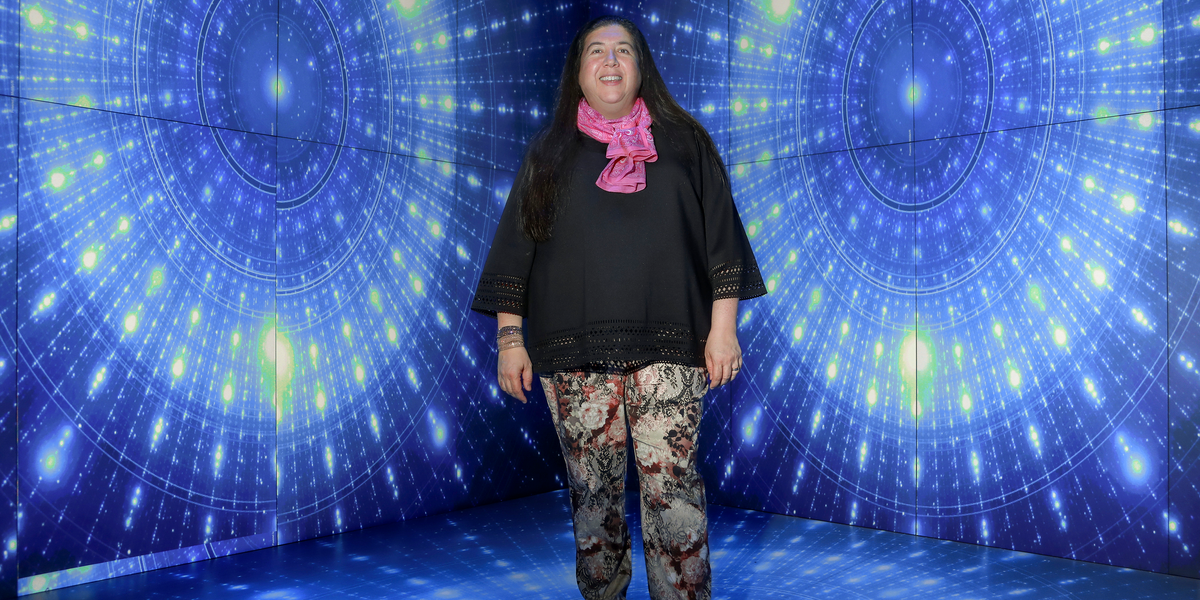
Carolina Cruz-Neira is living proof of just how far a “plan B” can take you. Growing up, she was determined to become a professional ballet dancer. But after injury ended her ballet dreams, Cruz-Neira went on to become a pioneer of virtual-reality technology.
Carolina Cruz-Neira
Employer:
University of Central Florida
Occupation:
Computer-science professor
Education:
Bachelor’s degree in systems engineering, Universidad Metropolitana in Caracas; master’s degree in electrical engineering and computer science, University of Illinois Chicago; Ph.D. in electrical engineering and computer science, University of Illinois Chicago
A computer-science professor at the University of Central Florida (UCF) and IEEE Fellow, Cruz-Neira is best known for developing the Cave Automatic Virtual Environment, or CAVE, an immersive VR system that turns a small room into an interactive 3D digital world, in the 1990s. Over her nearly 40-year career she has also developed VR tools for fields as varied as medical research and defense.
Unlike many engineers, though, Cruz-Neira had little interest in technology as a child. When her dreams of a career in ballet ended the year before she graduated from university, she fell back on the technical skills she had been developing and began working as a software engineer. But her heart wasn’t in it—until an introduction to early VR technology set her off on a new trajectory.
“I found I could work with computer systems in real time in a way that was very visual and in touch with your users, equivalent to how you are in touch with your audience as a dancer,” she says.
Born to Dance
Cruz-Neira’s childhood was split between Spain, where she was born, and Venezuela, where her parents ran a fashion import business. She started ballet classes at the age of three, and by the time Cruz-Neira was a teenager, she was spending two or three hours every evening at the dance studio. “I always had my ballet shoes in my backpack,” she says. “So even if I was in school I would be dancing around the hallways.”
Her determination to fill any spare time with ballet, combined with a natural aptitude for math and science, pushed her into studying more technical topics. “I could do math homework in 10 minutes, but if I had to read a book and write an essay, it would take me hours,” she says. “So I went into science and engineering just because I needed more time in the dance studio.”
Cruz-Neira was determined to make a career in ballet, but her father encouraged her to get a bachelor’s degree as a backup. He told her that computers were the future and encouraged her to study systems engineering at the Universidad Metropolitana in Caracas, where she enrolled in 1982.
Dreams Crushed
In 1986 at the age of 21, Cruz-Neira broke her knee in a skiing accident, putting an end to her hopes of becoming a professional ballerina. The news was devastating, she says, but the same year she started as an intern at Teleprovenca, a Venezuelan company that provided computing services to large corporations. Cruz-Neira graduated cum laude the following year and transitioned to a full-time position as a software architect.
She excelled in the role and was promoted from intern to manager in less than two years. But she found little enjoyment in it. “That was a very dark time in my life,” she says. “I was almost like a robot that was just mechanically doing things.”
In this application of CAVE, researchers use a digital twin to study the design of a new zoo pavilion. Emerging Analytics Center/University of Arkansas at Little Rock
Still, she continued to develop her technical skills. In 1989 she won a scholarship to study in the United States and enrolled in a master’s program at the University of Illinois Chicago to study electrical engineering and computer science. Cruz-Neira’s first year was spent learning English and taking courses in subjects like databases, networking, and parallel computing.
But in her second year she discovered the university’s Electronic Visualization Laboratory—at the time a joint program offered by the engineering and art departments that focused on computer graphics and computer animation. There, Cruz-Neira finally found a way to connect her technical skills with her artistic passions.
“That’s when I started to be motivated again and excited about what I was doing,” she says. “It was a very stimulating environment.”
Building the CAVE
Cruz-Neira’s master’s thesis focused on using interactive 3D graphics to present financial data. When she graduated in 1991, she briefly held a job with IBM developing data-visualization tools for stockbrokers on Wall Street. But she found the corporate structure too restrictive. “I felt like a racehorse that was tied to the back of the stable, because I had all these ideas but had to stay on point on the project,” she says.
A few months into the job, her master’s program adviser offered to take her on as a Ph.D. student in the Electronic Visualization Laboratory, an opportunity she couldn’t pass up. Just before she began her Ph.D., in August 1991, Cruz-Neira attended the Special Interest Group on Computer Graphics and Interactive Techniques (SIGGRAPH) conference, which featured an exhibit of early VR devices. She immediately fell in love with the technology. “Whatever digital world you could imagine in a computer, you could actually put a person in the middle of that world,” she says.
But she found that the cumbersome early VR headsets limited the kinds of experiences that could be created. The chance discovery of some old industrial projectors in one of the university’s storage rooms gave her the inspiration for an entirely new approach.
 Cruz-Neira first unveiled CAVE in 1992 at the SIGGRAPH conference while pursuing her Ph.D. Carolina Cruz-Neira
She hooked the machines up to graphics workstations built by Silicon Graphics and used them to project a virtual environment onto bedsheets taped to the walls. Her professors loved the idea, and Cruz-Neira began developing it into the Cave Automatic Virtual Environment, referred to by the recursive acronym CAVE.
A year later, in 1992, she unveiled the first version of CAVE at SIGGRAPH. Users wore stereoscopic glasses synchronized with the projector that turned 2D images displayed on the walls into 3D graphics. A motion-capture system also detects the wearer’s orientation, which makes it possible to continuously adapt the projections to fit the user’s perspective.
From Art to Science
Cruz-Neira spent the rest of her Ph.D. continuing to develop the system. She says the project was inspired by a desire to allow groups of people to share artistic and creative experiences, but she quickly realized its broader potential. It could also be used as a collaborative space for science or engineering, she says.
For example, she worked with Argonne National Laboratory to develop a CAVE system that allowed biologists to interact with molecular dynamics simulations. The project helped researchers accelerate the development of new drugs to treat AIDS, which at the time was a death sentence. This is one of the projects Cruz-Neira is most proud of.
 In newer versions of the CAVE system, haptic gloves like the ones Cruz-Neira wears here allow users to feel virtual objects.VARLab/University of Central Florida
After completing her Ph.D. in 1995, she cofounded the Virtual Reality Applications Center at Iowa State University, and since then has held positions at several U.S. universities, including her current professorship at UCF.
Over the years her work has broadened, Cruz-Neira says. She now creates software for real-time information manipulation in fields as varied as energy, pharmaceuticals, and finance. Her group is “display agnostic,” she says, so they work with all kinds of devices, including CAVE, VR headsets, and standard monitors.
Currently much of her focus is on “digital twins”—dynamic virtual copies of real-world objects that can be used for simulation and testing. Despite the excitement around this technology, Cruz-Neira says it’s really just an evolution of the ideas she was using in her molecular dynamics simulations in the ’90s.
“That was a digital twin of a molecular system,” she says of her past project. “It had simulation, it had interactivity, it had real-time interconnections with many other systems. So, in a sense, we aren’t going into new areas. We are evolving with the times.”
But she hasn’t forgotten her roots. Cruz-Neira still regularly stages interactive experiences at theaters, museums, and art galleries with CAVE and other systems, and she recently produced a dance performance. “I still keep in touch with my more artistic side,” she says.
From Your Site Articles
Related Articles Around the Web
