
Close Menu
    National News Brief
    Thursday, June 25
    • Home
    • Business
    • Lifestyle
    • Science
    • Technology
    • International
    • Arts & Entertainment
    • Sports
    National News Brief
    Home » Your brain tracks your sleep debt – and now we may know how

    Your brain tracks your sleep debt – and now we may know how

    Team_NationalNewsBriefBy Team_NationalNewsBriefJune 19, 2025 Science No Comments3 Mins Read
    Share
    Facebook Twitter LinkedIn Pinterest Email


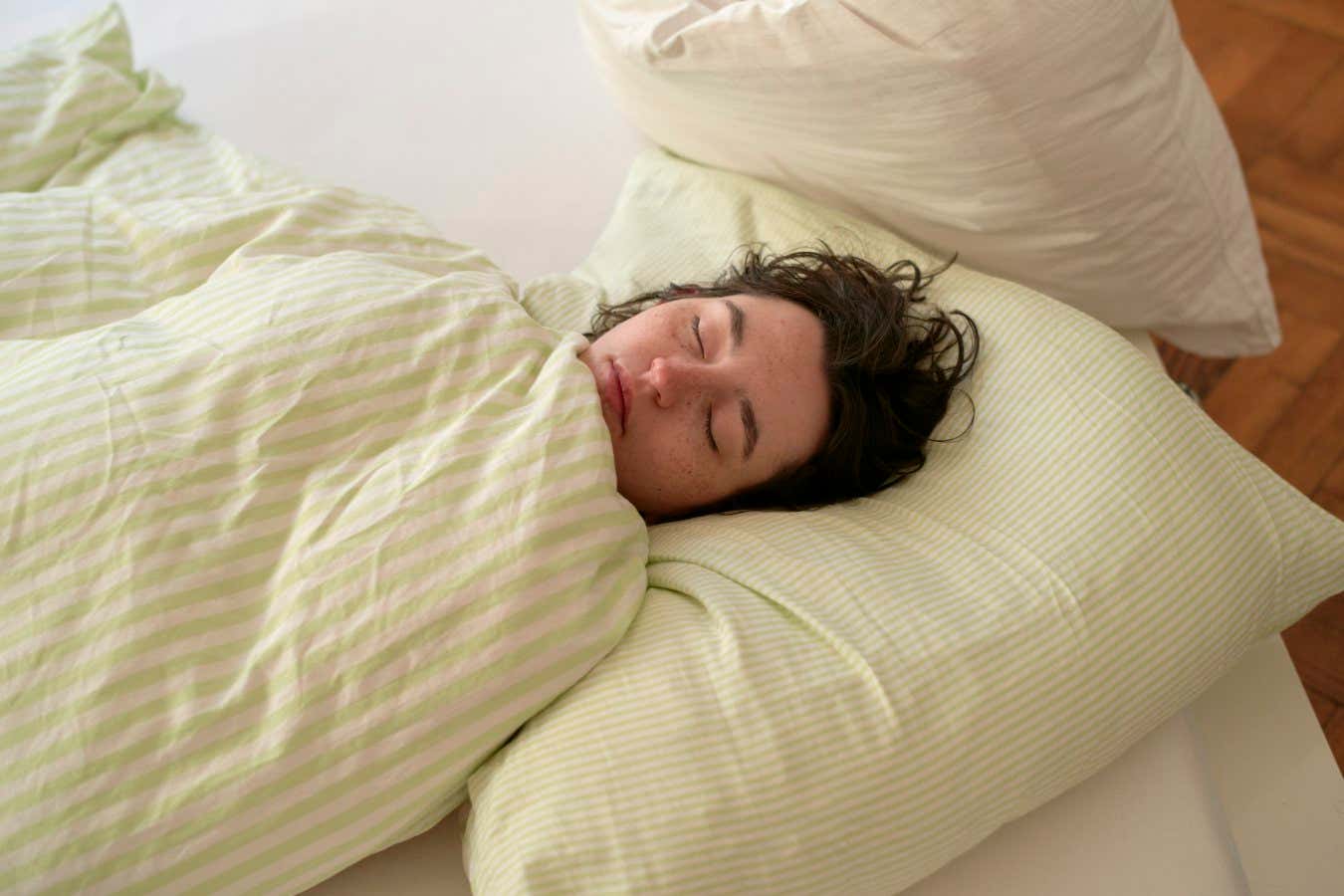
    How does the brain encourage us to make up for sleep loss?

    Connect Images/Getty Images

    Researchers have discovered neurons in mice that help their brains track and recover from sleep debt. If a similar pathway exists in humans, it could improve treatments for sleep disorders and other conditions marked by sleep impairment, such as Alzheimer’s disease.

    We are all familiar with sleep debt, or the gap between how much sleep you need and how much you actually get. But until now, it wasn’t clear how the brain tracks sleep loss – or compels us to make up this difference.

    Mark Wu at Johns Hopkins University in Maryland and his colleagues mapped brain pathways in mice that are involved in sleep by injecting a tracer into 11 brain areas known to induce sleep. The tracer, which travels from neurons receiving signals to those sending them, revealed 22 regions with connections to at least four sleep-promoting areas.

    The researchers focused on a subset of 11 previously unidentified regions. Using a technique called chemogenetics, they gave mice specialised drugs that activate particular parts of their brains. They divided the mice into 11 groups of three to four individuals, activating a different area in each group.

    A region called the thalamic nucleus reuniens seemed to be key. When neurons in this area were stimulated, the mice experienced the greatest increase in non-rapid eye movement (REM) sleep – about twice the amount as mice that weren’t stimulated. However, it took several hours for the animals to fall asleep after stimulation, during which they seemed to prepare for rest.

    “When you go to bed, you probably brush your teeth, you wash your face, you fluff your pillow or arrange your blanket and then go to sleep,” says Wu. Mice do something similar. “They kind of groom their face, they clean their whiskers and then they fluff their nest up,” he says. This suggests these neurons aren’t an on-and-off switch for sleep – instead, they induce sleepiness.

    Another test also supported this idea. In six sleep-deprived mice, deactivating the thalamic nucleus reuniens brain cells made the rodents less sleepy – they were more active and spent less time nesting than control mice. They also got 10 per cent less non-REM sleep, on average.

    Other experiments showed that these neurons activate during sleep deprivation and quiet down once sleep begins.

    Together, the findings suggest this brain region drives sleepiness and triggers restorative sleep after sleep loss, says Wu. Developing therapies that target these neurons could lead to new treatments for hypersomnia – a sleep disorder characterised by excessive sleepiness after rest – as well as conditions such as Alzheimer’s disease, in which people don’t sleep enough.

    However, it isn’t clear if the same brain circuit exists in humans, says William Giardino at Stanford University in California. We also don’t know whether it plays a role in long-term sleep deprivation. “They’re focusing more on the short-term effects of sleep deprivation, which might not closely model humans with years and years and years of sleepless nights,” he says.

    Topics:


    Source link

    Team_NationalNewsBrief
    • Website

    Keep Reading

    Top quantum computer expert claims Microsoft’s ‘topological qubit’ doesn’t hold up

    Screwworm could be the first species targeted by an ‘extinction drive’

    Fluctuating oestrogen levels may alter how drugs enter women’s brains

    How underappreciated mathematician Emmy Noether helped prove physics’ most fundamental theories

    Huge crater in Australia may be the oldest impact structure on Earth

    You should turn off fans when it’s too hot – but how hot is too hot?

    Add A Comment

    Comments are closed.

    Editors Picks

    Muslim nations adopt Arab alternative to Trump’s Gaza plan

    March 8, 2025

    Flood of AI ‘garbage’ is pushing open-source developers to the limit

    June 9, 2026

    Heidi Klum Teases Her ‘Extra Ugly’ 2025 Halloween Costume

    August 8, 2025

    Bill allowing unelected WA board to remove sheriffs is wrong move

    March 23, 2026

    Australia sues consumer goods giant 3M over ‘forever chemicals’ in firefighting foam

    May 28, 2026
    Categories
    • Arts & Entertainment
    • Business
    • International
    • Latest News
    • Lifestyle
    • Opinions
    • Politics
    • Science
    • Sports
    • Technology
    • Top Stories
    • Trending News
    • World Economy
    About us

    Welcome to National News Brief, your one-stop destination for staying informed on the latest developments from around the globe. Our mission is to provide readers with up-to-the-minute coverage across a wide range of topics, ensuring you never miss out on the stories that matter most.

    At National News Brief, we cover World News, delivering accurate and insightful reports on global events and issues shaping the future. Our Tech News section keeps you informed about cutting-edge technologies, trends in AI, and innovations transforming industries. Stay ahead of the curve with updates on the World Economy, including financial markets, economic policies, and international trade.

    Editors Picks

    Morocco come back after historic Haiti goals to reach World Cup last 32 | World Cup 2026

    June 25, 2026

    NBA teams have one condition to trade for Ja Morant

    June 25, 2026

    Seattle Times endorsements, WA primary 2026: 41st Legislative District, Pos. 1

    June 25, 2026

    More Popeyes stores face closure in franchise bankruptcy: See an updated list of locations

    June 25, 2026
    Categories
    • Arts & Entertainment
    • Business
    • International
    • Latest News
    • Lifestyle
    • Opinions
    • Politics
    • Science
    • Sports
    • Technology
    • Top Stories
    • Trending News
    • World Economy
    • Privacy Policy
    • Disclaimer
    • Terms and Conditions
    • About us
    • Contact us
    Copyright © 2024 Nationalnewsbrief.com All Rights Reserved.

    Type above and press Enter to search. Press Esc to cancel.