

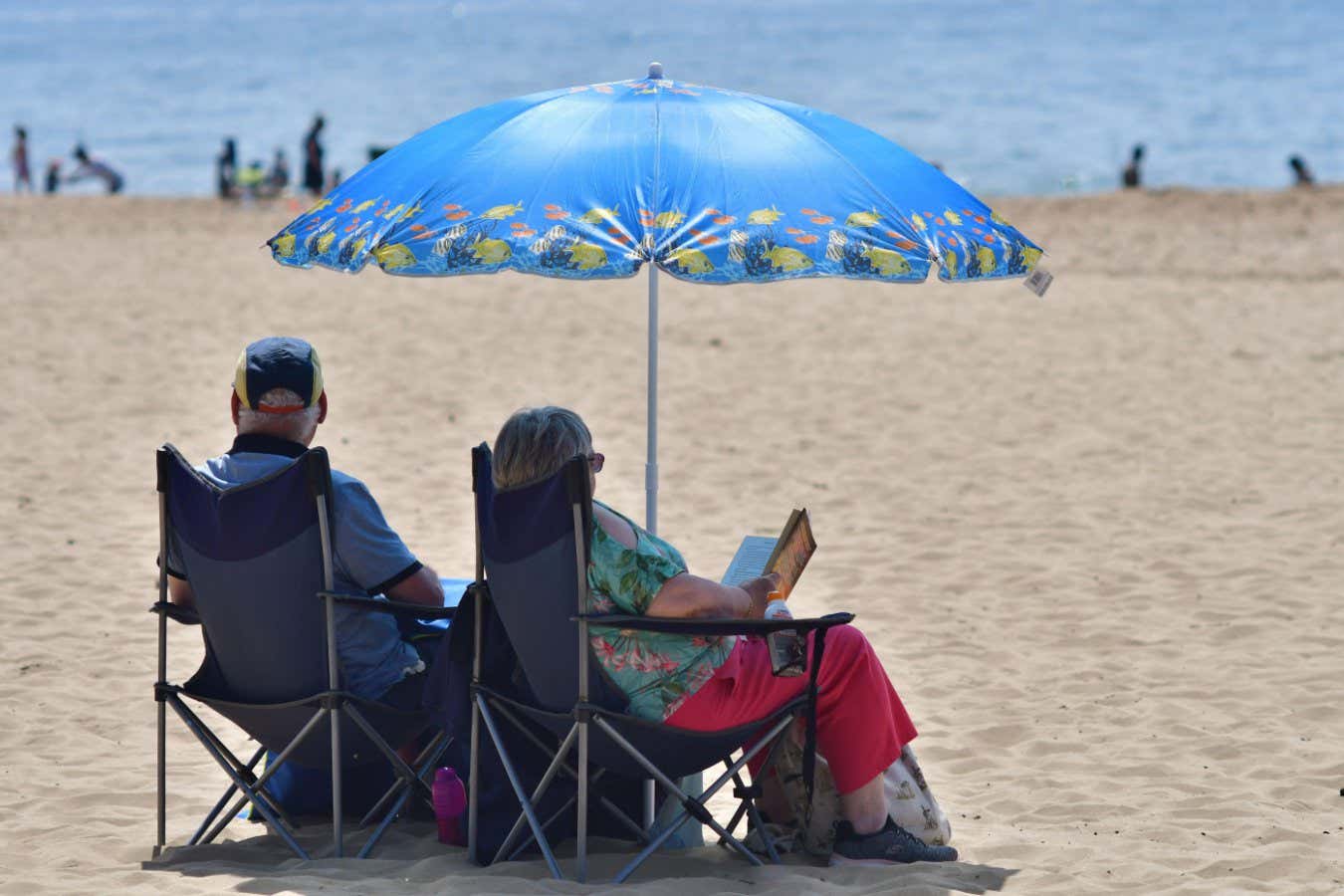
Sitting in the shade is one easy way to avoid the sun’s UV rays
Paul Biggins/Alamy
People have been trying to protect their skin from the sun since at least the time of the ancient Egyptians, and we have known for more than a century that ultraviolet (UV) light exposure is linked to burns and skin cancer. But there is often still confusion about the best way to avoid sunburn, whether you can treat it and how much each burn increases your risk of developing cancer. Understanding what sunburn involves at a cellular level, though, can help.
“Sunburn is an inflammatory reaction,” says Lesley Rhodes at the University of Manchester in the UK. It occurs when the UV radiation in sunlight damages the proteins, fats and DNA in cells within the upper layer of the skin, known as the epidermis, kicking off a cascade of inflammatory effects that lead to redness, swelling, pain and peeling.
UVB radiation causes most of this damage, while UVA rays, which have a longer wavelength and also penetrate the skin, contribute much less. “UVB, as a rule of thumb, is 1000 times more effective than UVA at causing sunburn,” says Antony Young at King’s College London.
In response to UV damage, skin cells release inflammatory molecules that dilate blood vessels in the dermis, the skin layer beneath the epidermis. This boosts blood flow to the skin within a few hours. In turn, this enhances the infiltration of immune cells from the blood into the skin, which further ramps up inflammation.
In people with lighter skin shades, the increased blood flow gives sunburned skin its pink or red colour. Those with darker skin tones may see their skin change to various shades of red, grey, brown and black. The elevated blood supply also means more fluid leaks from the blood into the skin, causing swelling. Both the swelling and inflammatory molecules stimulate nerves, making sunburned skin feel hot and painful.
In severe cases, blistering can also occur, where patches of skin cells in the epidermis become so damaged that they self-destruct. As these dead patches lift away from the layers beneath them, the space between becomes filled with fluid, forming bubble-like structures on the skin.
How does sunburned skin heal?
“A mild sunburn will resolve more quickly than a severe burn, when effects could go on for 72 hours or longer,” says Rhodes.
Healing begins when immune cells in the skin start producing anti-inflammatory molecules, usually within a few days after UV exposure. “It’s a self-resolving inflammation,” says Rhodes. “Various molecules and cells evolve over time and go from a pro-inflammatory to an anti-inflammatory state.” As a result, blood vessels stop dilating, and any redness, swelling and pain gradually subsides.
Stem cells at the bottom of the epidermis also boost healing by producing new skin cells more rapidly than usual. These replace the damaged ones, which shed or peel from the skin’s surface in large sheets to make way for the new growth. “You’re always shedding skin, but UV damage enhances that cell turnover,” says Young.
Unfortunately, there’s no good-quality evidence that applying after-sun or aloe vera gels can speed up the healing of sunburned skin, says Rhodes. These lotions mainly offer pain relief by providing a cooling sensation. Taking cold showers, applying cold flannels to the skin and using painkillers such as paracetamol (acetaminophen) or ibuprofen can also help with this.
What are the long-term effects?
Once the inflammation has died down and the damaged cells at the skin’s surface have shed away, the sunburn is over. But DNA damage to the stem cells deeper within the epidermis can have a much longer legacy.
“You get DNA damage, and DNA damage is repaired by the cells, but the repair is not 100 per cent perfect,” says Young. This results in genetic mutations and when these accumulate over time in genes that regulate cell growth and cell division, they raise the risk of skin cells growing uncontrollably and causing cancer.
Some studies suggest that experiencing five sunburns in a decade more than doubles your risk of melanoma, a form of skin cancer. However, these studies rely on people recalling how often they have been sunburned, which is prone to error. This makes it difficult to quantify exactly how much one instance of sunburn raises your skin cancer risk, says Young.
What are the best ways to prevent sunburn?
The skin pigment melanin gives some protection because it surrounds the DNA in skin cells, shielding it from UV damage. Because of this, people with darker skin shades have a much lower risk of skin cancer than people with lighter skin types – but that doesn’t mean darker skin can’t get inflamed and develop sunburn and DNA damage.
If you’re trying to work out the risk of burning on a given day, you need to gauge the UV index, a measure of ultraviolet radiation. Rachel Abbott at the University Hospital of Wales in Cardiff says you should apply sunscreen when the index is 3 or higher. Generally, the UV index is unlikely to exceed 3 in the early morning or evening, or between October and March in the UK. But UV rays are stronger nearer the equator, where sunscreen may be needed at any time of year. Luckily, it doesn’t have to be guesswork – there are plenty of free apps that can tell you your local UV index. “I use one every day,” says Abbott.
Most people don’t apply sunscreen at the thickness at which it is tested – 2 milligrams per square centimetre of skin – so Young says opting for SPF 50 sunscreen as a default is probably a good idea.
But one of the best ways to avoid sunburn is to stay out of the sun when it is highest in the sky. In the UK, that is between around 11am and 3pm, while the US has a longer window of 10am to 4pm. During this period, sunlight takes a shorter path through the atmosphere, meaning less UVB radiation is absorbed by the air and more hits your skin. If you’re outside, wearing a hat and long-sleeved clothing can also reduce your risk.
Topics:
