

With more than 8,000 Starlink satellites in the sky today, low Earth orbit may seem like the place to be to connect the next generation of Internet and cellphone customers. However, some players are placing their bets slightly closer to the ground.
Starting next year, Tokyo’s SoftBank Corp. will be beaming a prototype 4G and 5G phone and broadband service from the stratosphere to Japanese end users. Floating 20 kilometers above the Earth, the company’s airship-based mast will be using energy-regeneration tech and newly allocated spectrum. And the tech could ultimately pose a real, competitive threat to satellite-based platforms like Starlink.
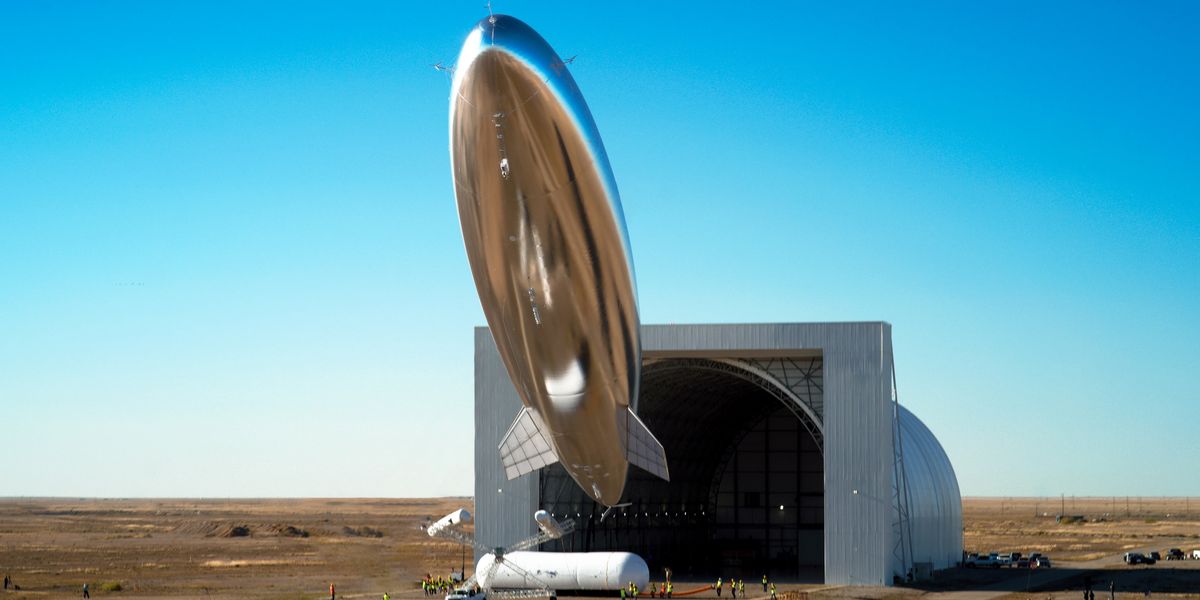
The Japanese telecom giant announced last month it had secured exclusive rights to deploy stratospheric, lighter-than-air craft over Japan. SoftBank’s precommercial airship “tower” delivering 4G and 5G cellphone service, the company said, will be coming in 2026. The solar-powered airship, developed by the Moriarty, N.M.–based Sceye, has already completed more than 20 successful test flights. In the same press announcement, SoftBank also described its plans to also use heavier-than-air, fixed-wing uncrewed aerial vehicles that the Japanese company has developed.
A Technical Blueprint for the Stratosphere
Unlike the SoftBank system’s fixed-wing signal repeaters, Sceye’s airship will be an autonomously piloted cell tower operating below outer space but still above the weather. The airship will carry the same type of base station used in terrestrial cell towers (called 4G eNodeB/5G gNodeB), which will comply with global broadband standards, as overseen by the Third Generation Partnership Project, or 3GPP.
“The mobile phone doesn’t know the difference between our platform and a tower,” says Mikkel Vestergaard Frandsen, Sceye’s CEO. “We just plug into existing infrastructure and operate under the same 3GPP protocol.”
Sceye’s airship uses advanced antenna systems that enable precision steering of the signal. Also known as beamforming, this 5G tech helps a network cover wide areas or, conversely, focus bandwidth down to a tighter cone, depending on demand. The company reports that its system’s latency is below 20 milliseconds. That would put it ahead of Starlink, which delivers today a network latency of 45 ms, according to a recent survey.
“This is not a relay system. We are the base station, able to respond to network demand from the stratosphere,” says Frandsen.
With a payload capacity of 250 kilograms and 10 kilowatts of onboard solar power capacity, the airship can power its telecom suite but also station-keep—something that neither balloons (which drift with the wind) nor fixed-wing UAVs (constrained by limited payload and power) can achieve.
Which is why Sceye’s advances in materials have been crucial for high-altitude endurance flights. According to the company, the fabric comprising the airship’s hull is five times as strong per unit mass as conventional high-altitude platform system (HAPS) materials. Sceye’s material is also 1,500 times more gas-tight, as well as being more resistant to both UV and ozone damage.
“There’s a lot of overlap between extreme sports like the America’s Cup or Formula One and our work on HAPS,” said Frandsen, who recruited engineers from both sectors. “It’s all about pushing materials to the limit, safely.”
But even using such a supermaterial for the airship’s skin, staying aloft at an altitude of 20 kilometers demands further innovations toward greater efficiency. “On this kind of machine, about 30 percent of the weight goes to the structure, and another 30 percent to the energy system,” says Vincenzo Rosario Baraniello, Head of the Earth Observation Systems Unit at the Italian Aerospace Research Centre (CIRA). “Improving those technologies gives a competitive advantage”.
Sceye’s silvery dirigibles are built for endurance, capable of pointing into the wind, and remaining in their area of operation for months at a time. Ultralightweight and flexible solar skins and high-density battery packs keep the equipment running overnight. While the system’s temperature- and UV-shielded payload compartment can withstand extreme stratospheric conditions. The airship can reach altitude in less than 30 minutes, with a single craft able to replace up to 25 ground towers.
Building on New Spectrum
The time has come, says Nikolai Vassiliev, chief of the Terrestrial Services Department at the International Telecommunication Union, for stratospheric systems like Sceye’s and SoftBank’s prototype network.
“We have established power limits, coordination rules, and allocated harmonized bands,” Vassiliev says. “Now it’s up to operators to deploy.”
Until recently, high-altitude platforms like Sceye’s and SoftBank’s helium-filled airship relied primarily on millimeter-wave spectrum, including bandwidth between 47- and 48-gigahertz frequencies. Millimeter waves, though, have limited range and are notoriously vulnerable to rain and other inclement weather. Which is why, in part, the World Radiocommunication Conference in 2023 opened up a number of microwave bands between 700 megahertz and 2.6 GHz for HAPS.
These lower-frequency bands effectively opened the way for direct-to-device connections from stratospheric airships and other high-altitude platforms. “The availability of harmonized, low-band spectrum for direct-to-device HAPS has fundamentally changed the business case,” said Toshiharu Sumiyoshi of SoftBank’s Ubiquitous Network Planning Division. “We can now deliver service with commercially available handsets.”
Unlike earlier high-altitude platforms that acted like signal relays, Sceye’s high-altitude towers will ultimately allow users to cross coverage zones without losing service, thanks to handovers between ground and aerial nodes. And that could look and feel to the end user much like everyday terrestrial 4G and 5G coverage.
SoftBank is still weighing how best to deploy Sceye’s stratospheric platforms, whether as always-on infrastructure or as on-demand responders during emergencies and other periods of anticipated high demand. “Our current plan aims for one aircraft to stay in the air for one year,” says Sumiyoshi. “But both scenarios, continuous flight or launch in response to a disaster, are conceivable. And operational details will be finalized after precommercial testing in 2026, taking cost-effectiveness and multiuse options like remote sensing into account.”
Baraniello says whatever form the deployment ultimately takes, it marks an important step forward. “The partnership between Sceye and SoftBank is significant,” he says. “It shows that these platforms have reached a level of technological maturity that allows them to be deployed operationally. From an aerospace-engineering standpoint, that’s a big deal, and the market’s interest will further push research, industry, and development forward.”
UPDATE 1 Aug. 2025: The story was updated to clarify the ITU’s position on the harmonized bands it’s allocated (the ITU’s addition in bold) and to note that SoftBank and Sceye’s airships are helium-filled.
From Your Site Articles
Related Articles Around the Web
