

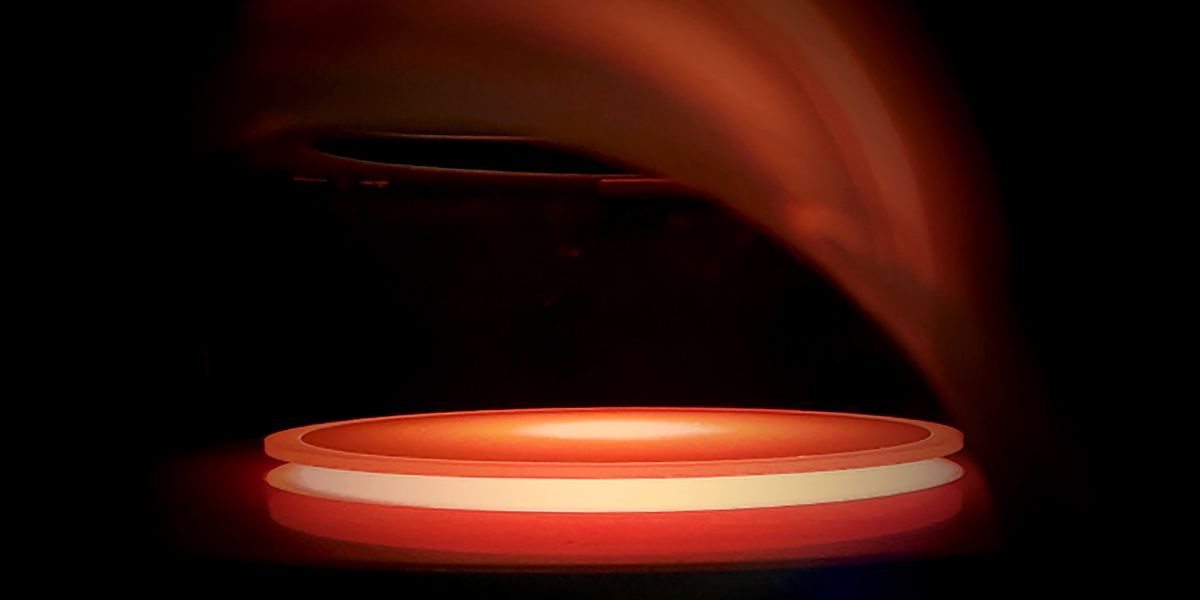
A new twist on pencil graphite might be a key ingredient to better cancer treatment, scientists in Singapore say. Graphite is composed of stacked layers of graphene, a single-atom-thick sheet of carbon atoms arranged in repeating hexagonal rings. Now add pentagons, heptagons, and octagons of carbon atoms into the sheet, and you’re looking at a new form of ultrathin carbon that promises to sharpen beams of subatomic particles used in proton therapy.
Ultrathin foils of carbon materials have been used for decades in proton therapy to filter particles into high-precision beams meant to kill tumors. But, they take time to make and often contain impurities from the manufacturing process that lower the precision of the beam. In research described in Nature Nanotechnology, Jiong Lu and his colleagues at National University of Singapore and in China developed a technique that can grow a 200-millimeter sheet of a new kind of ultrathin carbon material in just 3 seconds, with no detectable impurities.
Proton therapy is a noninvasive radiation treatment in which hydrogen ions are accelerated through a cyclotron to form a high-energy beam used to destroy DNA in tumors. In a cyclotron, an electromagnetic field accelerates ions of molecular hydrogen, which spiral outward as they pick up speed. They then strike a carbon foil that strips away the hydrogen’s electrons, leaving protons that exit the machine as a high-energy beam. Proton therapy is often preferred as a treatment because of its precision. The sharp beam eliminates tumors while preserving healthy tissue. The new carbon promises an even sharper and more energy-intense beam, potentially making the treatment more potent.
The benefits of the new material, called ultra-clean monolayer amorphous carbon (UC-MAC), are derived from its disordered ring structure, which contrasts with the perfect hexagonal rings in graphene. The structures present in UC-MAC create tiny pores in the material that are only one-tenth of a nanometer wide. The researchers have found a way to fine-tune these angstrom-scale pores to control how the material filters hydrogen ions, in order to produce proton beams with less scattering.
Nanograins and Nanopores
The new technique starts with depositing a thin film of copper on top of a sapphire wafer inside a chamber filled with high-density plasma. Depending on the temperature of the copper and the rate at which it’s deposited, irregular crystals a couple dozen nanometers in size called nanograins form. The nanograins provide the right conditions for UC-MAC to grow, and eventually, a complete layer of the atom-thick carbon material crystallizes on top of the copper. This growth happens in just three seconds, more than an order of magnitude faster than previous methods used to grow carbon foils.
Huihui Lin, a research scientist at Singapore’s Agency for Science, Technology and Research who worked on the project, explains that the synthesis’s rapid speeds come from the high density of the nanograins that form on the copper, and from the plasma in the growth chamber, which provides high quantities of particles that react with the substrate to form the carbon structure.
Despite its potential importance in cancer treatment though, Lin says that UC-MAC was originally designed with different applications in mind. “We tried it in electronics and optical devices, and after three years of work, we discovered its unique advantage as a membrane for producing precision proton beams,” he explains.
Because of the angstrom-size pores in the material, the team discovered that UC-MAC was uniquely suited to turning molecular hydrogen ions into protons. Accelerating molecular hydrogen ions through the cyclotron instead of already-filtered protons increased the quantity of protons in the beam in a given amount of time, by an order of magnitude.
Lin thinks it will still take time to get the material to the point of commercialization. He explains that like many other 2D materials, “you need tens of steps” to grow the carbon on the substrate. So, simplifying the process is crucial to getting closer to commercialization. Eventually though, the material may make proton therapy a more widely available treatment option. “The UC-MAC makes proton beams more tunable [and] affordable,” says Lin.
From Your Site Articles
Related Articles Around the Web
