

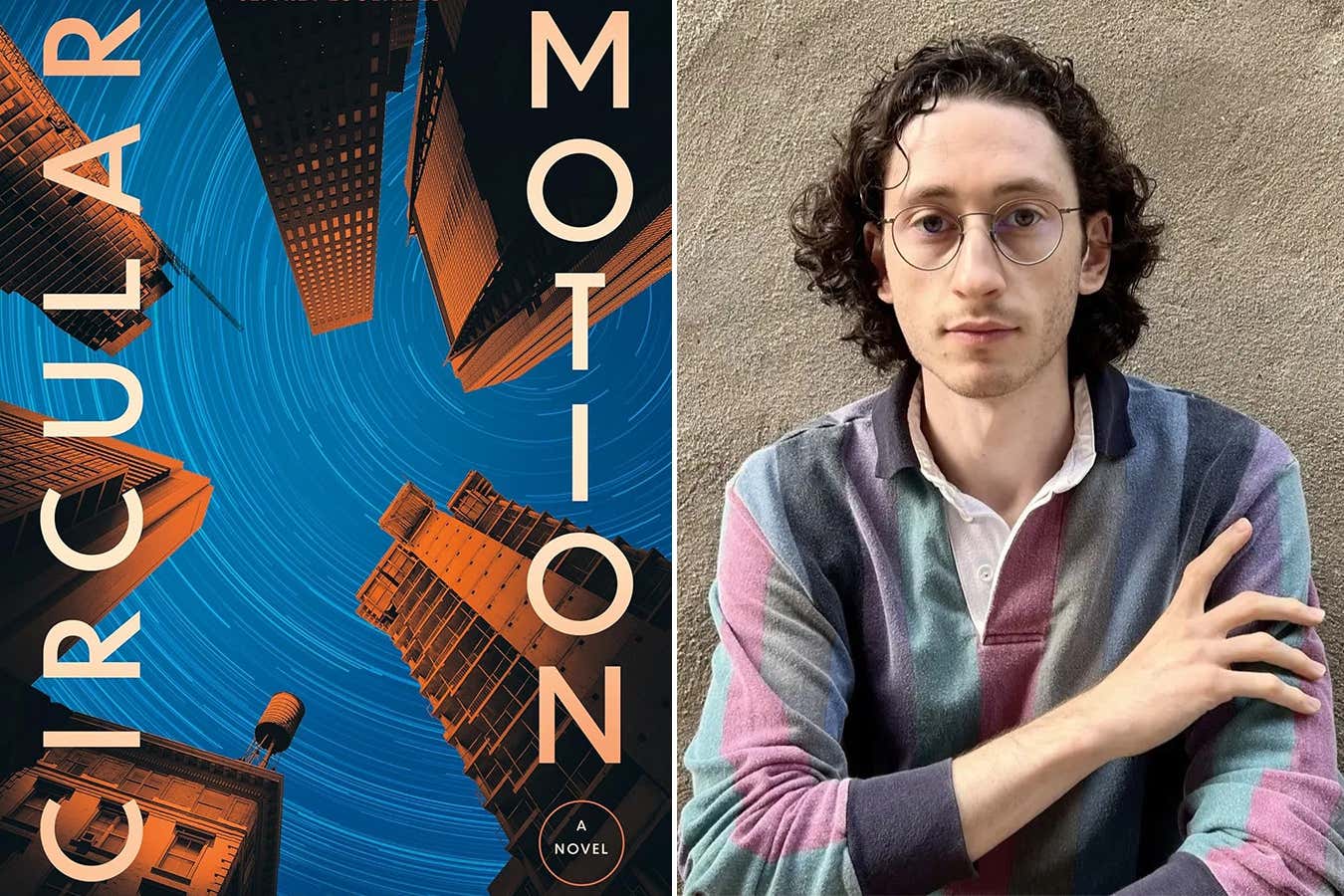
The New Scientist Book Club has been reading Circular Motion by Alex Foster
The New Scientist Book Club made a jump backwards through time for our latest read, Alex Foster’s Circular Motion, moving from the millennia-ahead future of Adam Roberts’s Lake of Darkness to a world that doesn’t feel so very far from our own. There is one major difference, though: Foster’s world is orbited by massive aircraft. This “Westward Circuit” enables those rich enough to travel the globe in a matter of hours – but it is also speeding up Earth’s rotation, leading, as the book progresses, to shorter and shorter days – eventually, to just 2 hours in duration.
As I’ve already said, I was blown away by this book. It ticked all the boxes I want ticked in my science fiction: an impending apocalypse of horrific proportions? Yes. A blinkered world trying to pretend it isn’t happening? Yes. A cast of interesting and intriguing characters who we really care about? Yes. In terms of sci-fi, it has been my favourite (new) read of the year so far. I found it enjoyably, spine-crawlingly horrible to see the effects of the accelerating Earth play out, whether that was the huge and physical (storms; changing gravity), or the more individual (how awful would it be to have a day of just 2 hours?).
Not all of you agreed with my two-thumbs-up take, however. (And isn’t that the joy of a book club, to be able to pick over fiction with your fellow readers?) I love a good dystopia, but for Niall Leighton, the dreadful reality of life on Foster’s Earth went too far. “I liked it, and I’m pleased I read it, but it was too dystopian, and I don’t think I’ll be putting it on anyone’s birthday present list,” he writes on our Facebook group. “I want to say it was solid literary science fiction, but I also struggled to suspend disbelief, and I thought it seemed contrived in places. I did think it managed a good balance between being character- and ideas-driven, but it was too dystopian for my taste.”
Niall wasn’t the only reader who struggle to get into the story – Jennifer Marano writes that “I usually have no trouble suspending disbelief, but I just couldn’t do it with Circular Motion.” And the dystopia was also a little too heavy for Gosia Furmanik. “I’m not sure dystopia has any meaning anymore nowadays, as all we have to do is read the news and look outside to know that we’re already there,” she writes. “Climate collapse, growing inequality and exploitation, people being blamed for their mental health issues instead of them being recognised as a systemic problem etc etc. Circular Motion had it all and it was a hard read for me because of that. Hit too close to home.”
I’m glad Gosia brought up climate change, because Foster told me in our video interview that the book was very much intended to have parallels with our current situation – the characters in the story create a huge, sky-covering “Shell” as a technological fix to the problems they’ve caused with the Westward Circuit – rather than just stopping flying the aircraft. Many of you saw those links between Foster’s characters facing disaster, and just getting on with things in the meantime, and our own lives. “The theme of hubris (pods and circuits and the attempts to build a shield to correct the problems with gravity and day length) was strong and obviously a lesson for today,” says Phil Gurski, while Steve Swan adds: “I think humans are remarkably adept at knowing the bigger picture but to keep that knowledge in the background and trying to get on with their lives. How many [in-passing] conversations have we all had where we try to set the world to rights, but then [say] ‘well there is nothing we can do about it’.”
For Niall, “it worked as well as any and better than most as a metaphor for climate change, complete with (spoiler) some ill-advised technological non-solutions, although I did struggle to suspend disbelief in the physics of it (would objects flying through the air in this way actually do anything to the planet’s rotation, even imperceptibly?).”
One thing I was confused about was the dating system Foster uses, which is written like this: “A.H. 976,314:17”. A number of you felt similarly; Eliza Rose took the same approach as me: “I didn’t figure it out but then I actually never tried. As I was reading it didn’t seem as though I would need it to figure out the plot etc. so…”. Phil adds: “I would have liked an explanation about the new AH system to measure time and why it was brought in.” Thank goodness, then, for Paul Jonas, who explained it to us all: “It’s in hundreds of thousands of hours and the same time throughout the world,” he writes. “970,000 being 11 years. But it’s going to get unwieldy unless it resets.”
There were a few comments about wanting more science in this science fiction from New Scientist Book Club members. “It felt to me that the science fiction was secondary, more of a backdrop to the stories of the characters, whether this is a good thing or not is up to individual tastes, I think,” adds Gosia. “What I did miss was some more speculation on how the Earth spinning faster and faster would affect the biosphere other than humans. This would have tremendous effects on plants and animals and I think writing about that would have made the book feel more real and less far fetched.” Gosia would also have liked to see Foster explore “stories of some less privileged people and how their lives were affected by the apocalypse (just as climate change is disproportionately affecting the global south)”.
“I wanted more about the world speeding up issue and the travel system. So it’s not science fiction enough for me,” writes Paul.
I’m hoping our next read will satisfy those cravings: it’s one of the most acclaimed sci-fi novels of all time: Ursula K. Le Guin’s award-winning anarchist utopia title The Dispossessed, from all the way back in 1974. We haven’t done a classic for a while, and Le Guin has been suggested by a few of you as the next author to tackle, so, here goes! Book club members can enjoy, very excitingly, an essay by the late Le Guin’s son, Theo Downes-Le Guin, in which he considers the novel as both a son and a reader (it’s fantastic), as well as a short extract from the opening of The Dispossessed. Do join the discussion about this stone-cold classic on our Facebook group, and let us know what you think.
Topics:
