

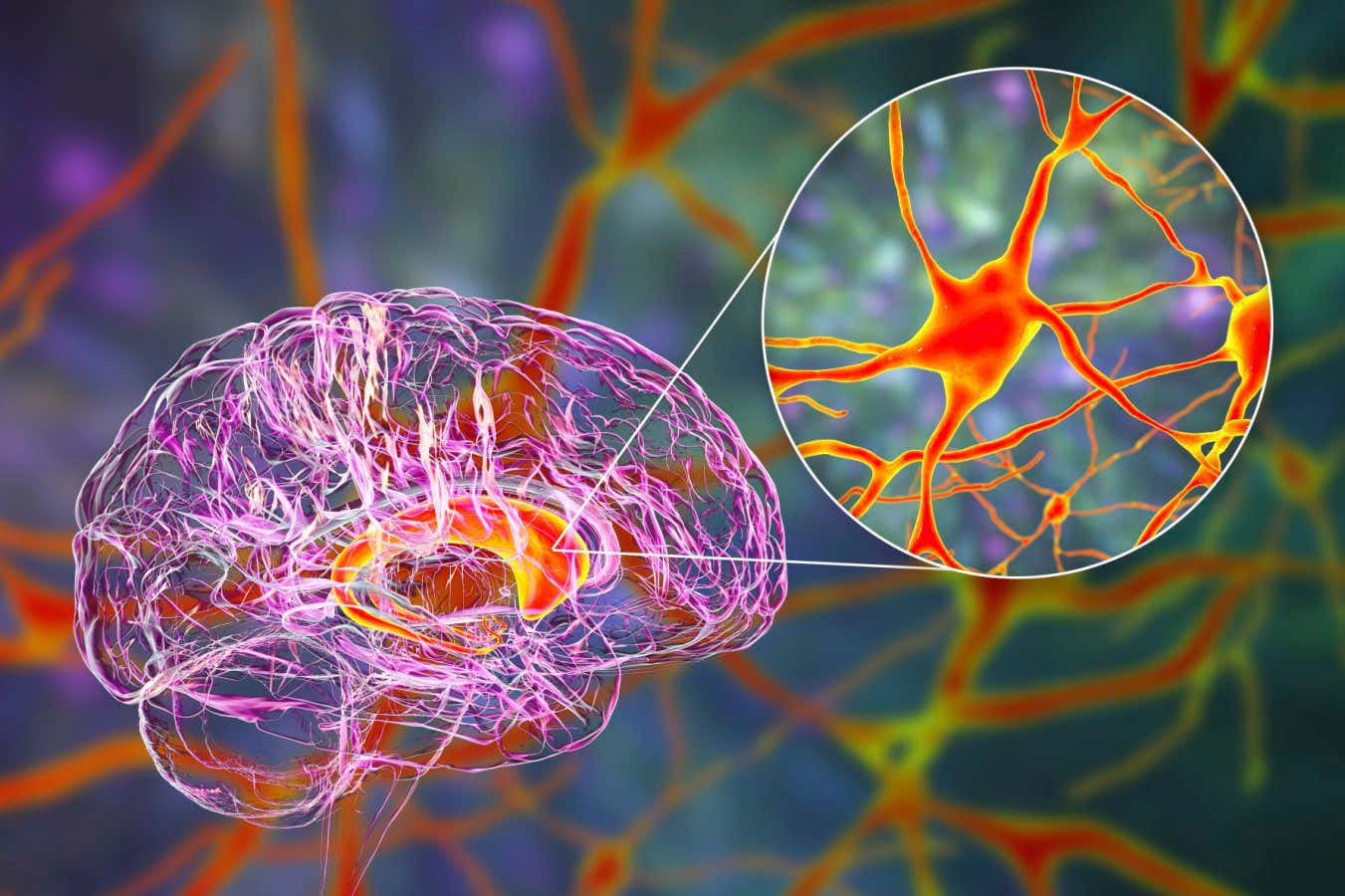
The caudate nucleus is one of the brain regions the gene therapy targets
KATERYNA KON/SCIENCE PHOTO LIBRARY
An experimental gene therapy has become the first treatment to successfully slow the progression of Huntington’s disease. While the findings are still preliminary, the approach could be a major breakthrough and may even lead to new therapies for other neurodegenerative conditions, like Parkinson’s and Alzheimer’s.
How does the therapy work?
The treatment, called AMT-130, targets abnormal proteins in the brain that are responsible for the progression of Huntington’s disease. People with the condition have a genetic mutation that causes the normally-benign huntingtin protein to accumulate in toxic clumps inside brain cells, ultimately killing them. Over time, this leads to memory loss, difficulty walking, slurred speech and other symptoms.
The experimental therapy, developed by the Dutch biotechnology company uniQure, stops the production of these mutant proteins. It does so by delivering genetic material to brain cells packaged inside a harmless virus. This material then directs cells to produce a small genetic molecule, called microRNA, which is designed to intercept and disable the instructions for producing the toxic protein. Think of it like a molecular stop signal.
How and where is the treatment delivered?
The treatment targets two brain regions first impacted by Huntington’s disease: the caudate nucleus and the putamen. Both are located deep inside the brain, so doctors use real-time brain scans to guide a thin catheter into them. The entire procedure takes 12 to 18 hours. One injection seems to be enough to permanently lower levels of mutant huntingtin in the brain.
How effective is the gene therapy?
Preliminary results released by uniQure suggest the gene therapy slows the progression of Huntington’s disease by about 75 per cent.
The finding comes from a clinical trial led by Sarah Tabrizi at University College London and her colleagues, in which 17 people with Huntington’s received a high dose of the treatment. Three years later, the researchers compared declines in cognition, movement and daily functioning with those of similar, untreated individuals. Declines that would normally be seen in one year of disease progression occurred in the treated patients over four years on average, Tabrizi told BBC News. Those who received the treatment also saw lower levels of a protein indicative of brain damage in their cerebrospinal fluid, further indicating the gene therapy slows Huntington’s progression.
“These findings reinforce our conviction that AMT-130 has the potential to fundamentally transform the treatment landscape for Huntington’s disease,” said Walid Abid-Saab at uniQure in a statement.
Are there any side effects?
While uniQure hasn’t published complete data on the therapy’s side effects, it said so far the drug appears to be safe and well-tolerated. The most common side effects were headaches and confusion, which either resolved without treatment or with steroids to reduce inflammation.
When will the therapy become available?
In a press release, uniQure said it expects to submit an application to the US Food and Drug Administration early next year, and, pending approval, the product could launch before 2027.
“However, it is still early days and a lot more testing is needed to see if there are side-effects of this new gene therapy, how long the benefits last and how well it works in the long term,” said Zofia Miedzybrodzka at the University of Aberdeen in the UK in a statement.
Could this approach help treat other brain conditions?
If this gene therapy ultimately proves successful, it could lead to the development of similar therapies for other neurodegenerative conditions, such as Parkinson’s disease or other types of dementia, said David Rubinsztein at the University of Cambridge in a statement. Researchers would just have to tweak the genetic material so it targets the toxic proteins that drive those conditions. “This could be a major breakthrough,” he said.
Topics:
