

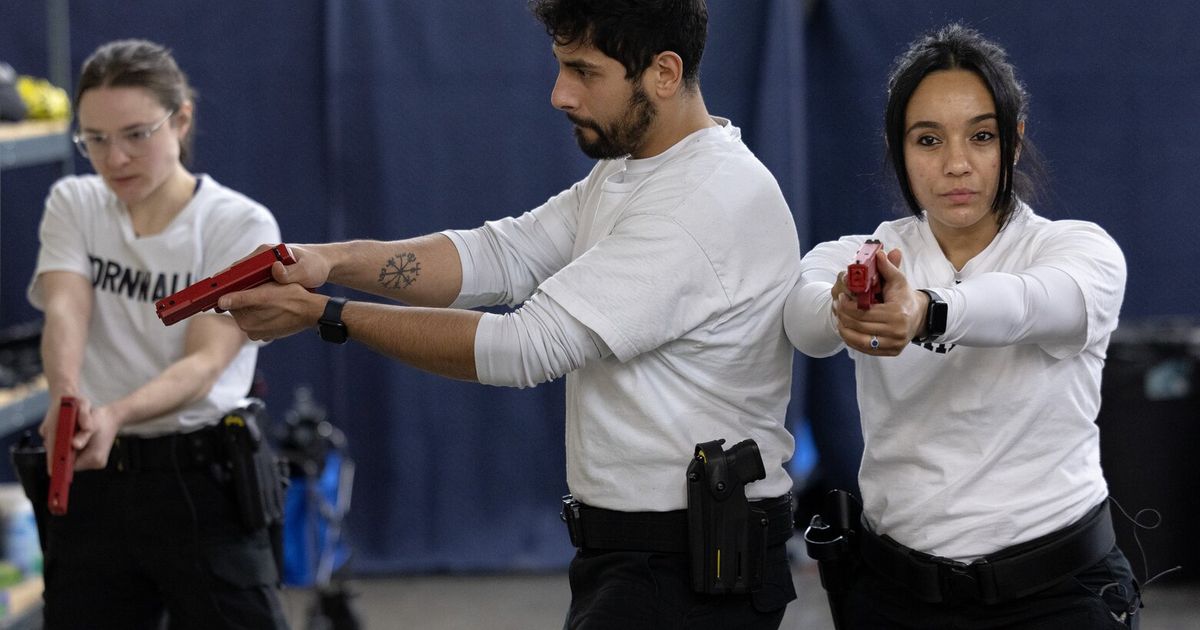
The debate on whether police are warriors or guardians has dominated policing reform conversations for over a decade. But this binary no longer fits the complexity of modern law enforcement or the values of today’s recruits. In Seattle, the Seattle Police Department’s Before the Badge training program offers a glimpse into what the future of policing can — and should — look like.
We need to move beyond the warrior vs. guardian dichotomy and embrace a holistic view of police as community-embedded first responders — grounded in service, responsibility and relational engagement. That’s the direction Seattle is heading, and the data shows it’s working.
Recruits are required to take part in the Before the Badge program before they start their mandatory 720-hour Basic Law Enforcement Academy training. They meet and talk with Seattle’s diverse communities, department colleagues and city leaders. They also study policing’s racist history and the science of relationship-based policing.
As investigators of data collected by Seattle’s BTB evaluation, now in its third year, we’ve spoken to hundreds of new recruits and analyzed their pre- and post-training attitudes. What we’ve found challenges long-standing assumptions about who becomes a cop and why.
Before the Badge comprises a strikingly diverse group: 54% of recruits identify as people of color, many speak multiple languages and most have less than six months of law enforcement experience. Recruits repeatedly emphasize that they want to be seen as human beings, not enforcers, and are motivated by service, reform, and connection. One said, “I saw the protests in Seattle on the news, and I realized this city needs a new kind of police officer.” Another added, “What happened in 2020 showed the cracks in policing. I want to be part of the solution, not the problem.”
Even before formal training begins, these recruits score lower on attitudes tied to negative police subculture and higher on guardianship and community orientation. One noted, “I grew up speaking two languages, and that’s something I can bring to people here who feel unheard.”
Before the Badge starts with community. Recruits engage with residents, business owners, youth in detention and people affected by the justice system. They listen, reflect and begin to understand the social context in which policing happens. One recruit said, “The training starts with the community. That told me this department is serious about doing things differently.” Another added, “If the community trusts me, everything else follows.”
The program also emphasizes emotional awareness and officer wellness — areas often overlooked in traditional academies. Recruits learn to monitor their stress, use techniques like deep breathing and reflect on how their emotions impact others. “I hadn’t realized how much my own stress level shows up in how people respond to me,” one recruit said. Another shared, “This was the first time in training we slowed down enough to think about how the community sees us.”
Seattle doesn’t use the term “guardian policing”— they don’t need to. What they’re doing is relational policing in action. One recruit called the training “phenomenal.” Another said, “It’s shocking to think this isn’t normal in other departments.”
It’s time for all of us — police, policymakers, scholars and the public — to move beyond outdated metaphors. Policing doesn’t need a new label. It needs a model that makes space for human complexity, empathy and accountability. The goal isn’t to make officers choose between warrior or guardian — it’s to equip them to show up as people first.
As one recruit put it, “The uniform can make people forget there’s a person behind it, but we’re learning to slow down and see the person in front of us, too.” Another said, “I came here to help, but I also need the skills to stay grounded and not lose myself in the job.”
If we want public safety that works, we must invest in systems that treat both officers and community members as people worthy of trust, care and connection. Seattle’s new recruits are motivated by service. Before the Badge shows how the warrior-vs.-guardian frame can be replaced with a more grounded vision: Policing that is human, relational and rooted in public service. One recruit summed it up best: “I joined to help, not to fight.”
To sign up for virtual SPD BTB Community-Police Dialogues to meet and talk with recruits who are going through BTB training, go to: st.news/badge
Disclosure: The Seattle University Crime & Justice Research Center receives funding from the city of Seattle to conduct the independent evaluation of the SPD Before the Badge training program. This research is Institutional Review Board-approved and operates independently.
