

Unlock the Editor’s Digest for free
Roula Khalaf, Editor of the FT, selects her favourite stories in this weekly newsletter.
China has launched an antitrust investigation against US chipmaker Qualcomm and imposed fees on American-owned ships docking at Chinese ports, as trade tensions mount between the two nations.
China’s State Administration for Market Regulation on Friday said Qualcomm failed to report its June acquisition of Israeli technology company Autotalks in accordance with the country’s laws.
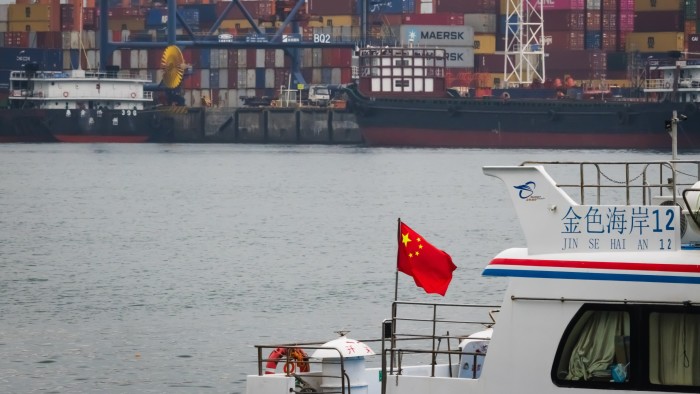
Earlier on Friday China’s transport ministry said ships owned by US companies or individuals would have to pay Rmb400 ($56) a tonne to dock. The fees and schedule broadly mirror rules announced by the US in April, which come into effect next Tuesday.
The US is requiring China-built vessels docking at US ports to pay $18 a tonne or $120 per container discharged, rates that will increase over three years.
Beijing has fired a volley of trade measures at Washington this week as it seeks leverage ahead of an expected face-to-face meeting between Trump and Xi in South Korea. Trump later on Friday cast doubt on whether the meeting would go ahead.
“From American ships to American chips, Beijing is apparently keen to find all aspects of weakness in American industrial sectors and economic ecosystem to show its muscles,” said George Chen, partner at Washington-based consultancy The Asia Group.
Beijing’s state-owned Global Times newspaper warned this week that China would take “necessary” and “far-reaching” countermeasures against foreign actions “targeting Chinese operators, vessels or crew engaged in international maritime transport and related services”.
The US embassy in Beijing did not immediately comment.
Qualcomm has faced previous scrutiny in China over deals. Beijing’s failure to approve the chipmaker’s planned $44bn NXP acquisition in 2018 ended up forcing the companies to abandon the deal.
Qualcomm’s patent licensing has also come under scrutiny in China, leading to a nearly $1bn fine in 2015.
China is one of Qualcomm’s largest markets as it supplies chips and licenses intellectual property to many Chinese smartphone makers.
Qualcomm said it was “fully co-operating” with the Chinese regulator and was “committed to supporting the development and growth of our customers and partners”.
The moves came a day after China’s commerce ministry unveiled new export controls on rare earths and related technologies.
They marked the first time Beijing deployed its own version of a so-called foreign direct product rule, a measure used by the US to sever China’s access to some semiconductor-related products through third countries.
Also on Thursday, Beijing announced new restrictions on shipments of some battery anodes and on lithium cathodes and precursors as well as equipment for making batteries.
Earlier on Friday, the Financial Times reported that China had stepped up enforcement of its controls on chip imports, as Beijing seeks to wean the country’s technology sector off US products such as Nvidia’s artificial intelligence processors.
The expanded export curbs on rare earths and batteries highlight China’s sweeping control over the supply chains of critical materials, components and technologies that underpin large swaths of global manufacturing, including the car and defence sectors.
Analysts said China’s escalation was probably designed to pressure Trump to relax export controls on semiconductors and open the US for greater Chinese investment.
“By mirroring US semiconductor restrictions with its own rare-earths restrictions, Beijing is trying to focus the trade negotiations on export controls and investment flows,” said Gavekal Research analysts Arthur Kroeber and Laila Khawaja in a note.
But in the process, China’s new controls are creating collateral damage among other trading partners, such as the EU, which says the measures are disrupting its companies.
Jens Eskelund, president of the EU Chamber of Commerce in China, said the latest rare earths restrictions would “add further complexity to the global supply chains” by widening the scope of items that export controls apply to and by introducing curbs over the use of related technologies outside China.
He added that the “most immediate concern” regarding export controls was the backlog of export licence applications still awaiting approval.
The German Chamber of Commerce North China said the low thresholds for the amounts of rare earths in the new rules meant they were “all-encompassing”.
“The new export controls are making the tense situation even worse,” said Oliver Oehms, chamber executive director. Their imposition showed that more dialogue between the German and Chinese governments was urgently needed, he said.
Businesses had already suffered multiple hold-ups under previous restrictions introduced in April, Oehms said, citing a German company that had its application for magnets delayed for three months, forcing it to suspend production.
Additional reporting by Joe Leahy in Beijing and Gloria Li in Hong Kong
