

This article is part of our exclusive IEEE Journal Watch series in partnership with IEEE Xplore.
The rapid buildout of fast-charging stations for electric vehicles is testing the limits of today’s power grid. With individual chargers drawing 350 to 500 kilowatts (or more), which makes charging times for EVs now functionally equivalent to the fill-up time for a gasoline or diesel vehicle, full charging sites can reach megawatt-scale demand. That’s enough to strain medium-voltage distribution networks—the segment of the grid that links high-voltage transmission lines with the low-voltage lines that serve end users in homes and businesses.
DC fast charging stations tend to be clustered in urban centers, along highways, and in fleet depots. Because the load is not spread evenly across the network, particular substations are overworked—even when overall grid capacity is rated to accommodate the load. Overcoming this problem as more charging stations, with greater power demands, come online requires power electronics that are not only compact and efficient, but also capable of managing local storage and renewable inputs.
One of the most promising technologies for modernizing the grid so it can keep up with the demands of vehicle electrification and renewable generation is the solid-state transformer (SST). An SST performs the same basic function as a conventional transformer—stepping voltage up or down. But it does so using semiconductors, high-frequency conversion with silicon carbide or gallium nitride switches, and digital control, instead of passive magnetic coupling alone. An SST’s setup allows it to control power flow dynamically.
For decades, charging infrastructure has relied on line-frequency transformers (LFTs)—massive assemblies of iron and copper that step down medium-voltage AC to low-voltage AC before or after external conversion from alternating current to the direct current that EV batteries require. A typical LFT can contain as much as a few hundred kilograms of copper windings and a few tonnes of iron. All that metal is costly and increasingly difficult to source. These systems are reliable but bulky and inefficient, especially when energy flows between local storage and vehicles. SSTs are much smaller and lighter than the LFTs they are designed to replace.
“Our solution achieves the same semiconductor device count as a single-port converter while providing multiple independently controlled DC outputs.” –Shashidhar Mathapati, Delta Electronics
But most multiport SSTs developed so far have been too complex or costly (between five and 10 times the upfront cost of LFTs). That difference—plus SSTs’ reliance on auxiliary battery banks that add more expense and reduce reliability—explains why solid-state’s obvious benefits have not yet incentivized shifting to the technology from LFTs.
Surjakanta Mazumder, Saichand Kasicheyanula, Harisyam P.V. and Kaushik Basu hold their SST prototype in a lab.Harisyam P.V., Saichand Kasicheyanula, et al.
How to Make Solid-State Transformers More Efficient
In a study published on 20 August in IEEE Transactions on Power Electronics, researchers at the Indian Institute of Science and Delta Electronics India, both in Bengaluru, proposed what’s called a cascaded H-bridge (CHB)–based multiport SST that eliminates those compromises. “Our solution achieves the same semiconductor device count as a single-port converter while providing multiple independently controlled DC outputs,” says Shashidhar Mathapati, the CTO of Delta Electronics. “That means no additional battery storage, no extra semiconductor devices, and no extra medium-voltage insulation.”
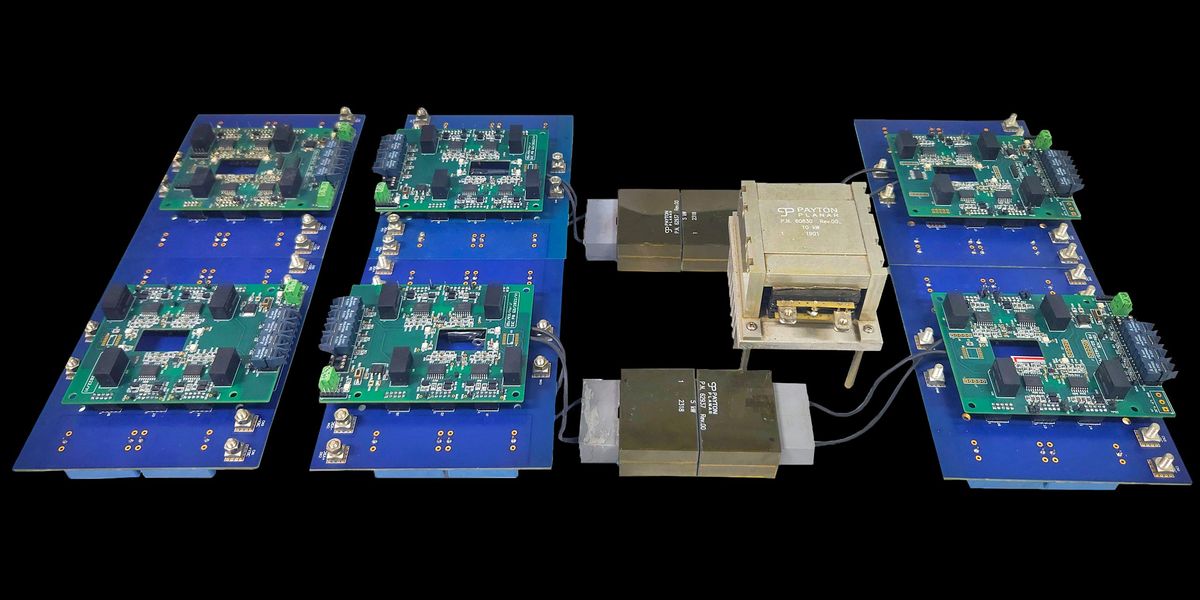
The team built a 1.2-kilowatt laboratory prototype to validate the design, achieving 95.3 percent efficiency at rated load. They also modeled a full-scale 11-kilovolt, 400-kilowatt system divided into two 200-kilowatt ports.
At the heart of the system is a multi-winding transformer located on the low-voltage side of the converter. This configuration avoids the need for costly, bulky medium-voltage insulation and allows power balancing between ports without auxiliary batteries. “Previous CHB-based multiport designs needed multiple battery banks or capacitor networks to even out the load,” the authors wrote in their paper. “We’ve shown you can achieve the same result with a simpler, lighter, and more reliable transformer arrangement.”
A new modulation and control strategy maintains a unity power factor at the grid interface, meaning that none of the current coming from the grid goes to waste by oscillating back and forth between the source and the load without doing any work. The SST described by the authors also allows each DC port to operate independently. In practical terms, each vehicle connected to the charger would be able to receive the appropriate voltage and current, without affecting neighboring ports or disturbing the grid connection.
Using silicon-carbide switches connected in series, the system can handle medium-voltage inputs while maintaining high efficiency. An 11-kilovolt grid connection would require just 12 cascaded modules per phase, which is roughly half as many as some modular multilevel converter designs. Fewer modules ultimately means lower cost, simpler control, and greater reliability.
Although still at the laboratory stage, the design could enable a new generation of compact, cost-effective fast-charging hubs. By removing the need for intermediate battery storage—which adds cost, complexity, and maintenance—the proposed topology could extend the operational lifespan of EV charging stations.
According to the researchers, this converter is not just for EV charging. Any application that needs medium-voltage to multiport low-voltage conversion—such as data centers, renewable integration, or industrial DC grids—could benefit.
For utilities and charging providers facing megawatt-scale demand, this streamlined solid-state transformer could help make the EV revolution more grid-friendly, and faster for drivers waiting to charge.
From Your Site Articles
Related Articles Around the Web
