


Priti GuptaTechnology Reporter, Mumbai
 NextWealth
Virudhunagar, a town in southeastern India, can boast temples that date back thousands of years.
But not far from those ancient sites, people are working on the latest tech – artificial intelligence.
One of those is Mohan Kumar.
“My role is in AI annotation. I collect data from various sources, label it, and train AI models so they can recognize and predict objects. Over time, the models become semi-supervised and can make decisions on their own,” he says.
India has long been a centre for outsourced IT support, with cities like Bangalore or Chennai being traditional hubs for such work.
But in recent years firms have been moving that work into much more remote areas, where costs for staff and space are lower.
The trend is know as cloud farming, and AI has given it another boost with numerous towns, like Virudhunagar, hosting firms working on AI.
So does Mr Kumar think he is missing out, by not being in a big city?
“Professionally, there is no real difference. Whether in small towns or metros, we work with the same global clients from the US and Europe, and the training and skills required are the same,” says Mr Kumar.

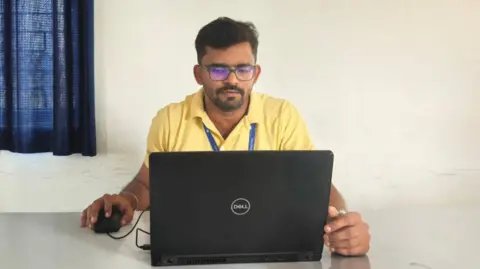 Mohan Kumar
Mr Kumar works for Desicrew. Founded in 2005 it was a pioneer in cloud farming.
“We realised that instead of forcing people to migrate to cities in search of jobs, we could bring jobs to where people already live,” says Mannivannan J K, the chief executive of Desicrew .
“For too long, opportunities have been concentrated in cities, leaving rural youth behind. Our mission has always been to create world-class careers closer to home, while proving that quality work can be delivered from anywhere.”
Desicrew does all sorts of outsourced work including software testing for start-up firms, building datasets to train AI, and moderating content.
At the moment 30 to 40% of its work is AI related, “but very soon, it will grow to 75 to 100%,” says Mr J K.
Much of that work is transcription – turning audio to text.
“Machines understand text far better,” he explains.
“For AI to work naturally, machines must be trained to understand variations in how people speak. That’s why transcription is such a crucial step, it forms the foundation for machines to comprehend and respond across languages, dialects, and contexts.”
Doing such work in a smaller town is not a disadvantage, Mr J K says.
“People often assume rural means underdeveloped, but our centres mirror urban IT hubs in every way – secure data access, reliable connectivity, and uninterrupted power. The only difference is geography. “
Around 70% of his workforce are women: “For many, this is their first salaried job, and the impact on their families is transformative – from financial security to education for their children,” says Mr J K.
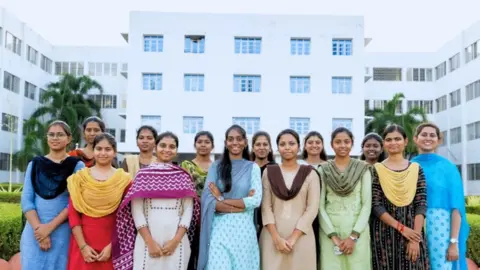 NextWealth
Founded in 2008, NextWealth was also an early mover in cloud farming.
Headquartered in Bangalore, it employs 5,000 staff in 11 offices in smaller towns across India.
“Sixty percent of India’s graduates come from small towns, but most IT companies hire only from the metros. That leaves behind a huge untapped pool of smart, first-generation graduates,” says Mythily Ramesh, co-founder and managing director of NextWealth.
“Many of these students are first-generation graduates. Their parents are farmers, weavers, tailors, policemen – families who take loans to fund their education,” she says.
NextWealth started with outsourced work from the back offices of big companies, but five years ago moved into artificial intelligence.
“The world’s most advanced algorithms are being trained and validated in India’s small towns,” says Ms Ramesh.
Around 70% of its work comes from the US.
“Every AI model, from a ChatGPT-like system to facial recognition, needs vast amounts of human-labelled data. That is the backbone of cloud-farming jobs.”
She thinks there is plenty more work to come.
“In the next 3–5 years, AI and GenAI will create close to 100 million jobs in training, validation, and real-time handling. India’s small towns can be the backbone of this workforce.”
She is hopeful that India can remain a hub for such work.
“Countries like the Philippines may catch up, but India’s scale and early start in AI sourcing gives us a five to seven-year advantage. We must leverage it before the gap narrows,” she says.
KS Viswanathan is a technology advisor, and formerly worked at India’s National Association of Software and Service Companies, the trade association for outsourcing firms.
“Silicon Valley may be building the AI engines, but the day-to-day work that keeps those engines reliable increasingly comes from India’s cloud farming industry,” he says.
“We are truly at a tipping point. If cloud farming continues to scale, small-town India could well become the world’s largest hub for AI operations, just as it became the hub for IT services two decades ago.”
But success is not guaranteed.
While Next Wealth and Desicrew both say they have access to reliable and secure internet connections, Mr Viswanathan says that is not always the case in India’s smaller towns.
“Reliable high-speed internet and secure data centres are not always at par with metros, which makes data protection a constant concern.”
Even if good connections are in place, work needs to be done to reassure clients.
“The bigger challenge is the perception rather than a technical one. International clients often assume small towns cannot meet data security standards, even when the systems are robust. Trust has to be earned through delivery.”
Back at NextWealth, Dhanalakshmi Vijay “fine-tunes” AI. For example, if it confuses two similar looking items, like a blue denim jacket and a navy shirt, she will correct the model.
“These corrections are then fed back into the system, fine-tuning the model so that the next time it sees a similar case, it performs better. Over time, the AI model builds up experience, just like updating software with regular patches to make it more accurate and reliable,” says Ms Vijay.
Such work has an effect in the real world.
“It’s me and team who indirectly train the AI models to make your online shopping experience easy and hassle free,” she says.
