

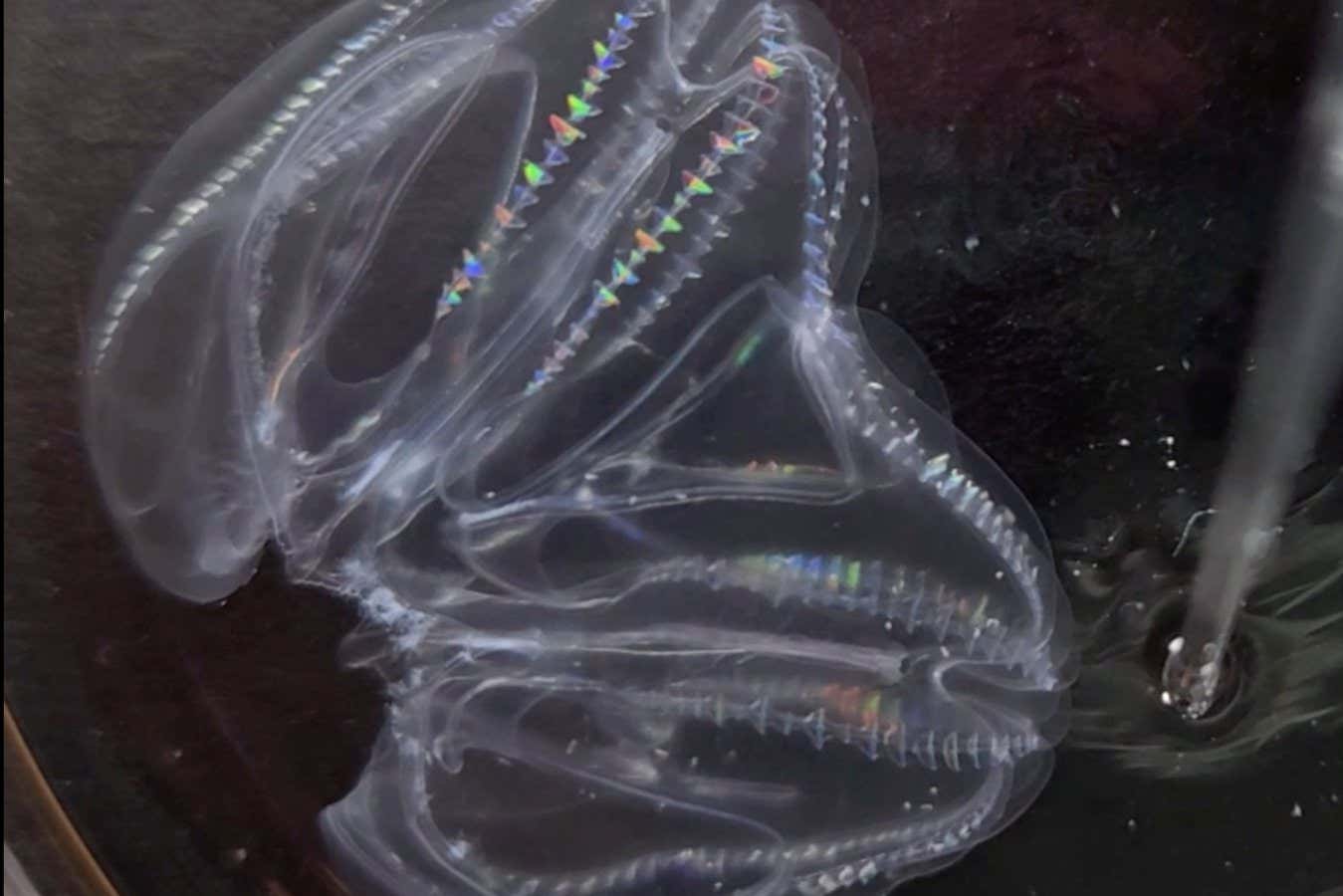
Shimmering sea creatures called comb jellies have an astonishing ability: if injured, two can merge into one, without showing the kind of tissue rejection reaction seen in other animals. What’s more, the two animals’ nervous systems integrate together and their digestive tracts fuse to share food.
The discovery could help scientists explore how immune systems evolved the ability to distinguish an organism’s own tissues from those of another, and develop insights into the evolution of nervous systems.
Despite their name, comb jellies, or ctenophores, aren’t jellyfish – their bodies are fundamentally different. They are the earliest creatures still living today to branch from the common ancestor of all animals, and their unusual biology makes them a fascinating subject for scientists exploring the early evolution of animals. For example, they have a unique nervous system consisting of nerve cells that merge together to form a continuous net-like structure, rather than having individual nerve cells like other animals.
Kei Jokura at the University of Exeter, UK, was studying the iridescent combs of beating hairs on a ctenophore species known as Mnemiopsis leidyi when he noticed an individual that was unusually large. It had two rear ends and two sensory organs known as apical organs, as if two individuals had somehow joined together.
To test this idea, he and his colleagues cut off parts of individuals that had been collected from different locations on different days – and were therefore unrelated to each other – and placed them together in pairs. In nine out of ten cases, the two bodies fused seamlessly into one in the space of a few hours. “I was very surprised,” says Jokura.
Unlike the norm in most other animals, one body didn’t reject the foreign tissue of the other, suggesting that the ctenophore immune system lacks the ability to distinguish between “self” and “non-self”, known as allorecognition.
When the team gently prodded one lobe, the whole fused body reacted as one, contracting its muscles in a synchronised way, suggesting that the two nervous systems had also fully merged. The digestive tract had fused too: when the team fed just one of the mouths, the food made its way into the joined tract.
“It’s a fascinating first finding,” says Pawel Burkhardt at the University of Bergen in Norway. “It opens many new questions you can study.” These could include when animals evolved allorecognition and how nerve nets form and process information.
These aren’t the only questions ctenophores could help answer. Burkhardt and his team recently found that when starved or injured, Mnemiopsis leidyi individuals can reverse their development, reverting from an adult stage to a larval-like stage, and then back again. Until now, the only known examples of animals with similar abilities have been a handful of jellyfish species such as the so-called immortal jellyfish (Turritopsis dohrnii) and a species of tapeworm.
The finding that ctenophores can also do this suggests that it might have been a feature of the last common ancestor of all animals, and may be more widespread among animals than previously thought. “What I personally find very fascinating [is] it could mean that the very first animals were more plastic, were more able to adapt,” says Burkhardt.
These enigmatic, shimmering animals are shaping up as keys to understanding a swathe of fundamental biological processes, some of which may even relate to human health, such as tissue rejection, regeneration and ageing. “It’s definitely a very valuable model to tackle some of these big-picture questions,” says Burkhardt.
Topics:
