

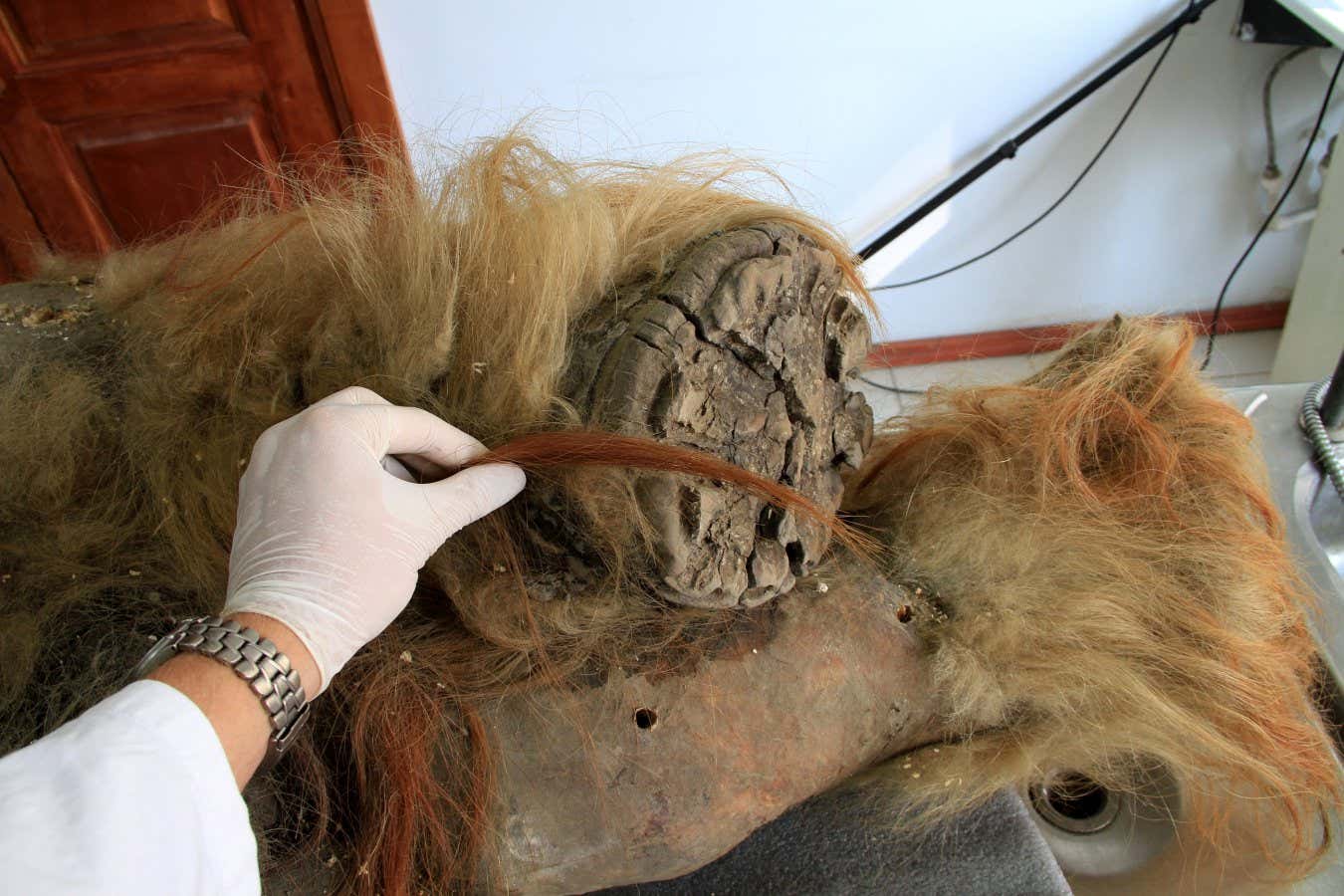
The skin and muscle of Yuka’s front left leg are exceptionally well preserved
Love Dalen
A woolly mammoth that was frozen in the Siberian permafrost for nearly 40,000 years has yielded the world’s oldest RNA.
The specimen, found in 2010 and nicknamed Yuka, is regarded as the best-preserved woolly mammoth (Mammuthus primigenius) ever found. Yuka was originally thought to be a juvenile female who died, possibly after being attacked by cave lions, at between 6 and 8 years of age.
Scientists have already been able to retrieve the DNA from many woolly mammoths, including some that are more than a million years old. The reconstruction of their genomes has raised hopes that one day the species – or genetically engineered animals that look like mammoths – could be brought back to life through genetic engineering.
DNA encodes the genetic instructions for making proteins in all animals. When a particular gene is turned on, the code in DNA is transcribed into another molecule called RNA. RNA is much less stable than DNA, and usually degrades within a few hours after death.
Until now, the oldest RNA ever recovered came from a wolf that was preserved in Siberian permafrost over 14,000 years ago. Now, Love Dalén at Stockholm University in Sweden and his colleagues have managed to extract RNA from one of Yuka’s legs – nearly tripling the previous record.
The team used the same techniques employed to obtain RNA samples from fresh, modern specimens, but slightly modified them to retrieve much smaller, older molecules.
“Yuka is exceptionally well preserved,” says Dalén. “The specimen likely underwent rapid freezing and long-term burial in permafrost, as evidenced by the preservation of both the muscle tissue and the woolly fur. This greatly increases the chances of RNA to have been preserved.”
However, working against the team was the fact that Yuka had been allowed to briefly thaw out during transportation from where the remains were discovered in north-east Siberia to Yakutsk. “Our assumption was that any truly ancient RNA still present in our samples would be degraded and fragmented in small pieces,” says Dalén.
The team had to take exceptional care to preserve all their samples from further deterioration and also prevent contamination. “We used liquid nitrogen to grind the samples, as well as sterile materials, a filtered air atmosphere, protective suits and a controlled laboratory environment to avoid any source of external modern contamination in our sequencing data,” he says.
RNA sequencing can give an indication of which genes were switched on at the time when the animal died. In the RNA that the team isolated from Yuka’s muscle and skin, they found signs of gene activity related to muscle metabolism and cell stress – consistent with the idea that Yuka died in a cave lion attack.
One of the big surprises was that, through a combination of DNA and RNA analysis, the team is now certain that Yuka was actually a male. “I have been around long enough to know that these things happen,” says Dalén. “Yuka is well preserved for being 40,000 years old, but not completely intact, so it is not always easy to morphologically sex an individual.”
The researchers also searched for any RNA viruses such as influenza and coronaviruses, but didn’t find anything of interest. “But I think we will in the future see several studies on ice age RNA viruses,” says Dalén. “There are, for example, some Pleistocene bird carcasses that would be really interesting to investigate with regards to bird influenza.”
The RNA sequences recovered in the study aren’t directly relevant for bringing about the de-extinction of mammoths, says Dalén, who is a scientific adviser to Colossal Biosciences, the company that earlier this year claimed to have brought the dire wolf back from extinction. But the study can give useful insights on which genes are important for the development of certain traits, he says. “RNA profiles from mammoths could in the future tell us how certain traits, like mammoth hair, were controlled genetically.”
Merlin Crossley at the University of New South Wales in Sydney says obtaining such ancient RNA is a remarkable achievement, but the findings don’t tell us much about the mammoth’s biology. “It’s a little bit like flying a light plane under the Sydney Harbour Bridge,” he says. “It’s an impressive technical feat, but I’m not sure what we learned from it.”
Crossley believes that, while older RNA samples may be found in the future, the team is close to the extreme limit of how long RNA can survive. He says it is also unlikely that useful information will be obtained from other mammoths because specimens like Yuka are so rare.
Embark on an exhilarating and one-of-a-kind expedition to uncover dinosaur remains in the vast wilderness of the Gobi desert, one of the world’s most famous palaeontological hotspots. Topics:
Dinosaur hunting in the Gobi desert, Mongolia
