

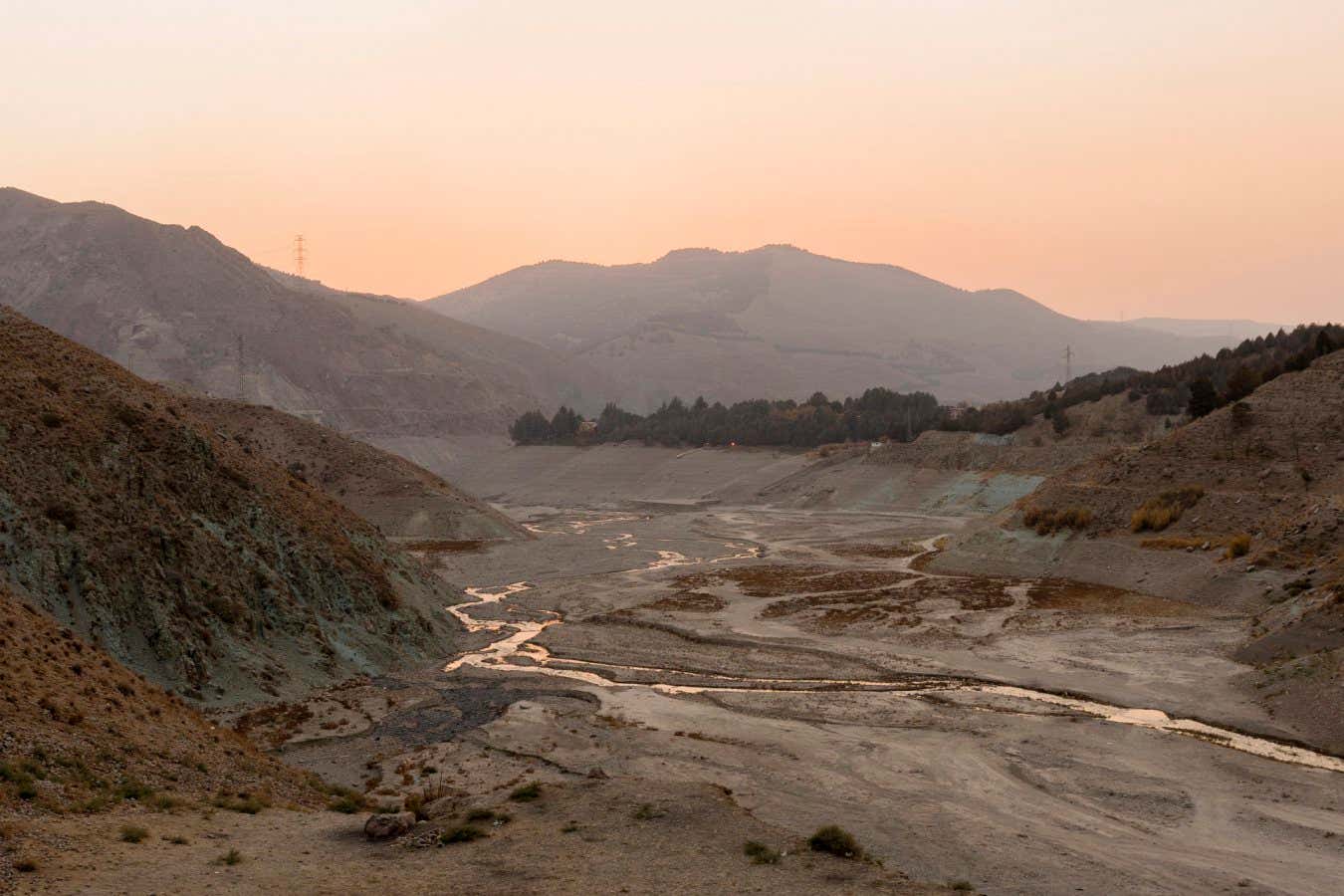
A dry riverbed near Latyan dam, one of the main water sources for Tehran, Iran
BAHRAM/Middle East Images/AFP via Getty Images
Iran is experiencing a drought so intense that the country’s president has said the capital city, Tehran, might have to be evacuated. In an attempt to bring rain, aircraft began a cloud-seeding operation on 15 November that is planned to last through the traditional rainy season until May. But experts caution that this technique is challenging and unlikely on its own to make a major dent in the water crisis.
How bad is the drought in Iran?
Rainfall across Iran is 85 per cent below average, and Tehran has received only 1 millimetre of rain this year. Reservoirs in the capital and in nearby regions are in a “worrying state”, officials have said, with water capacity under 5 per cent at 32 dams. Satellite images reveal some have dried up entirely.
Tehran residents have reportedly reduced water consumption by about 10 per cent, but that isn’t enough, officials say. Water pressure has been reduced at night, and authorities are planning to fine households and businesses that consume excessive water. If rainfall doesn’t pick up by December, the 14 million people who live in Tehran could have to start evacuating, the president has said.
What caused the drought?
Experts say the climate crisis has contributed to the drought, which has already lasted for five years. Iran is experiencing its driest autumn in 50 years, and Tehran, which often gets snow in November, is seeing temperatures of 15°C (59°F) or more.
But poor management is the main cause of what Kaveh Madani, a former Department of Environment official, calls Iran’s “water bankruptcy”. The government has massively expanded agriculture in dry areas, overtaxing water resources. Half a million illegal wells, many of them drilled by desperate farmers, have depleted the groundwater.
What is cloud seeding?
Cloud seeding was developed in the 1940s by scientists including Bernard Vonnegut, brother of the novelist Kurt Vonnegut. It involves dispersing particles that encourage the suspended water droplets in clouds to fall as rain. Although some projects have sprayed salt into low-lying clouds, many have focused on spreading chemicals, most commonly silver iodide, into higher, mixed-phase clouds. The supercooled liquid water droplets freeze on contact with this crystalline compound, forming ice crystals that grow heavy and fall as snow or rain.
It is often hard to know how much rain or snowfall would have occurred without the cloud seeding, though.
“The effects are very difficult to show because of the large natural variability of clouds,” says Andrea Flossmann at University Clermont Auvergne in France. “You look outside, you have a cloud field, and there are clouds that rain, and others don’t rain.”
An experiment in 2014 comparing two mountain ranges in Wyoming found that cloud seeding could strengthen precipitation by 5 to 15 per cent.
Can it solve the drought?
Iran, which previously accused Israel and the United Arab Emirates of stealing its rain through cloud seeding, now has its own programme that involves spreading seeding agents from cargo planes, drones and “ground generators”, a term that typically refers to smoke furnaces on high mountains.
It said it seeded clouds on 15 November in the basin around Lake Urmia, which, over two decades, has dried up into a salt plain littered with rusty boats. Areas west of the lake received up to 2.7 centimetres of rain early the next morning, according to a precipitation map run by the University of California, Irvine.
For a cloud-seeding campaign to replenish reservoirs, however, the clouds must contain a lot of water. That kind of cloud may be hard to find in arid Iran, where there aren’t many large water bodies to evaporate moisture into the air.
“Cloud seeding is often much more difficult during a drought because the atmosphere is so dry, and any clouds that are present may not have sufficient moisture,” says Karen Howard, a scientist at the US Government Accountability Office.
But masses of rain clouds have blown into Iran from the Black Sea in the past three days, even causing flooding in western provinces, including Ilam and Kurdistan, on 16 November.
Cloud seeding will be able to at least “squeeze out a few more drops” from weather systems like this, says Armin Sorooshian at the University of Arizona. “It’s not going to lead to extreme things like flooding or solving widespread drought,” he says. “But it can help a little bit.”
Topics:
