

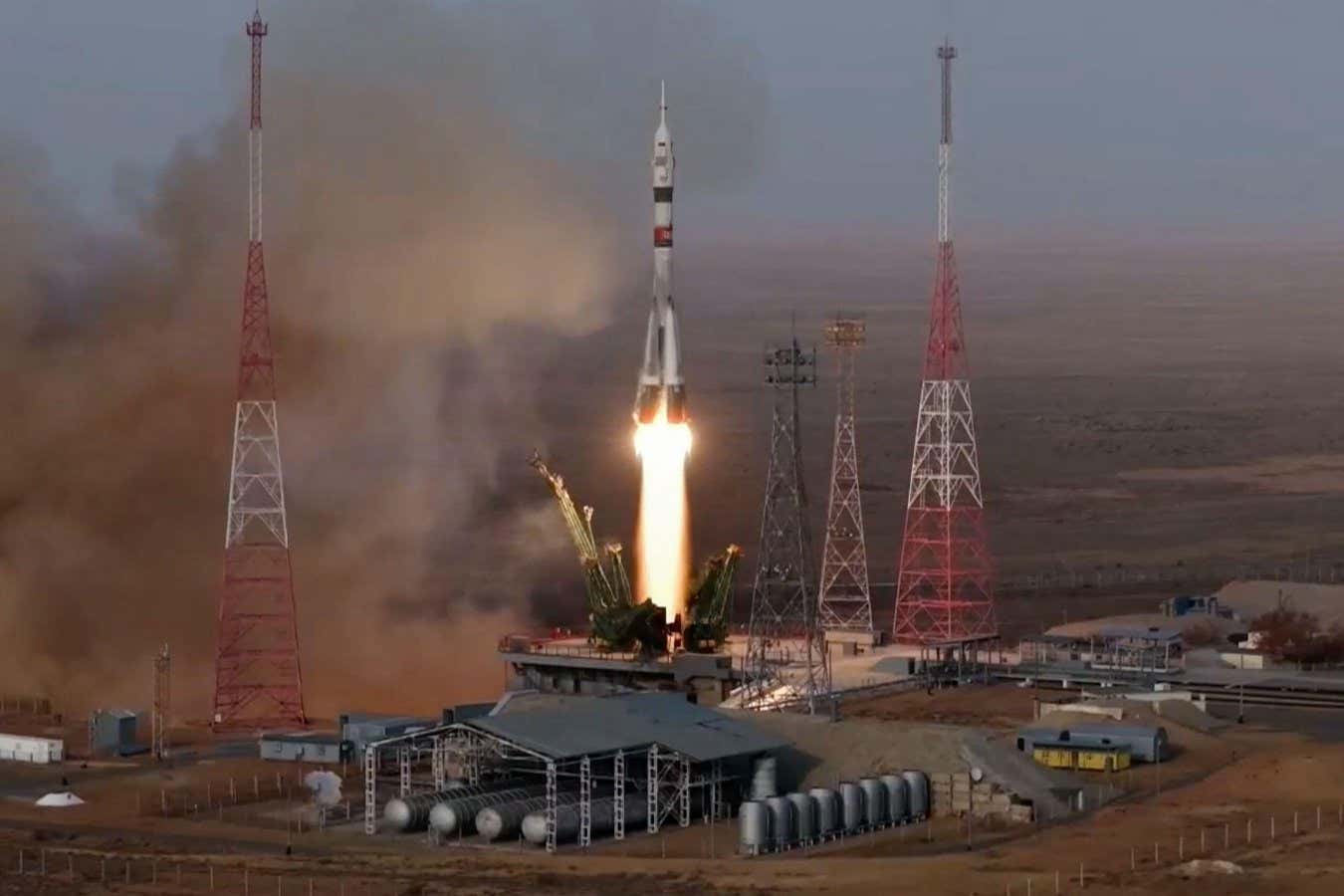
The Soyuz spacecraft blasting off on 27 November
Roscosmos space corporation, via AP/Alamy
The International Space Station (ISS) may soon become slightly less international. Russia’s only launch site capable of sending humans to orbit has suffered serious damage that could put it out of commission for two years. That would pose a dilemma for NASA: take on more costs and responsibility or let the ISS die.
A Soyuz spacecraft launched from Baikonur Cosmodrome in Kazakhstan on 27 November carrying two cosmonauts and a US astronaut. All three safely reached the ISS, but when engineers later inspected the pad it was clear that a multi-level support structure that sits beneath rockets, and is usually safely stowed early in the launch process, had became dislodged and collapsed into the bottom of the flame trench, where it was damaged.
Some reports suggest that repairs could take up to two years – although Russian space agency Roscosmos said in a statement that the damage would be repaired “in the near future”. Only time will tell the true extent of the problem.
Although the Baikonur Cosmodrome hosts dozens of launch pads, the affected one – Launch Pad 6 at Site 31, which dates back to 1958 – is the only one capable of sending crewed rockets to orbit. Davide Amato at Imperial College London says that Russia’s other launch sites have other problems that rule out their use: the Plesetsk Cosmodrome 650 kilometres to the north-east of Saint Petersburg is too far north to easily launch into the ISS orbit, and Vostochny Cosmodrome in the east of Russia close to the border with China lacks the correct infrastructure.
“A lot of space missions rely on single points of failure like this one, especially for programmes that are kind of winding down like the ISS,” says Amato.
Indeed, the ISS’s days were already numbered. Originally, it was due to have been scrapped in 2020 and has had several stays of execution. But under current plans, it will be allowed to gradually decline in altitude from next year until 2030 when a final crew will strip it of useful and historical equipment and allow it to continue its slow fall towards Earth, eventually burning up some time in 2031. When it does, it will create a spectacle that has been described as “400 tonnes of flaming chunks flying through the upper atmosphere at orbital speeds”.
Without Russia’s involvement, NASA would have to invest more money and resources to step up and keep the ISS going – a wearisome prospect even before factoring in that the project is in its final years.
But Amato doubts that the US will be willing to let the ISS die just yet. Without the ISS, the US and Europe have no destination in space for astronauts, and little reason to launch anyone to orbit until still-distant projects like commercial space stations and lunar settlements are built. This is in contrast to China, the US’s main economic rival, which has a thriving space station.
“It wouldn’t look good,” says Amato. “And there’s definitely tonnes of incredible research that is enabled by that platform, so that would be a huge loss.”
When construction of the ISS began in the 1990s, there was a different geopolitical climate. The Soviet Union had fallen, and there was a desire to create a project that encouraged cooperation between the two former superpowers. The ISS was carefully designed so as to not just promote cooperation but demand it: the Russian Orbital Segment (ROS), managed by Roscosmos, provides propulsion to keep the ISS in the correct orbit and avoid danger, and the US Orbital Segment (USOS), managed by NASA and European, Japanese and Canadian space agencies, provides electrical power from solar panels. Neither part can survive without the other.
But things didn’t go quite so smoothly, and relations between the US and Russia have been as tense in space as they have been on Earth – a situation that was exacerbated by Russia’s invasion of Ukraine’s Crimean peninsula in 2014, then full-scale invasion of Ukraine in 2022.
Now, if Russia were to pull out of the ISS project entirely, NASA and the other space agencies would have to ferry not only their astronauts but also more fuel, food and supplies that Russia would have otherwise provided. There would be other tricky questions to answer, such as whether those agencies took on official management and use of the Russian section of the ISS. NASA, given recent budget cuts, would have to ask itself if such a thing was even possible.
At the time of writing, much of the Roscosmos website was offline and the agency didn’t respond to a request for comment about the extent of damage at Site 31. The European Space Agency and the Canadian Space Agency also failed to respond to a request for interview from New Scientist.
NASA spokesperson Jimi Russell told New Scientist that the agency “coordinates closely with its international partners, including Roscosmos, for the safe operations of the International Space Station and its crew members”. But Russell declined to answer questions about the ongoing involvement of Russia, or whether contingency plans were in place should it decide to sever its involvement.
There is time to assess these issues before Russia’s next scheduled crewed mission to the ISS in July, but the country will need to urgently develop a plan to resolve the issues at Baikonur.
Leah-Nani Alconcel at the University of Birmingham, UK, says that as far as getting people to the ISS goes, there are other options, such as SpaceX’s Dragon capsule, which already ferries US astronauts into orbit. If the US-based SpaceX is the only means of reaching the ISS, it would essentially reverse the situation that existed earlier this century. For almost a decade following the retirement of the Space Shuttle, the US was unable to get astronauts into orbit on its own and had to rely on Russia to launch people to the ISS.
“It might cause difficulties with the contractual arrangements for launch provision, but that would be a problem for the lawyers, not the engineers,” says Alconcel.
Such a plan would take the pressure off NASA slightly, removing the responsibility of suddenly developing a plan to replace Russian knowledge and capabilities.
“NASA operating the ISS alone would be a significant challenge, since Roscosmos trains only its cosmonauts to perform certain critical functions on the Russian orbital segment – NASA does the same for the American segment,” says Alconcel.
Topics:
