
Close Menu
    National News Brief
    Tuesday, May 5
    • Home
    • Business
    • Lifestyle
    • Science
    • Technology
    • International
    • Arts & Entertainment
    • Sports
    National News Brief
    Home»Science

    Forming moon may have taken three big impacts early in Earth’s history

    Team_NationalNewsBriefBy Team_NationalNewsBriefDecember 3, 2025 Science No Comments3 Mins Read
    Share
    Facebook Twitter LinkedIn Pinterest Email


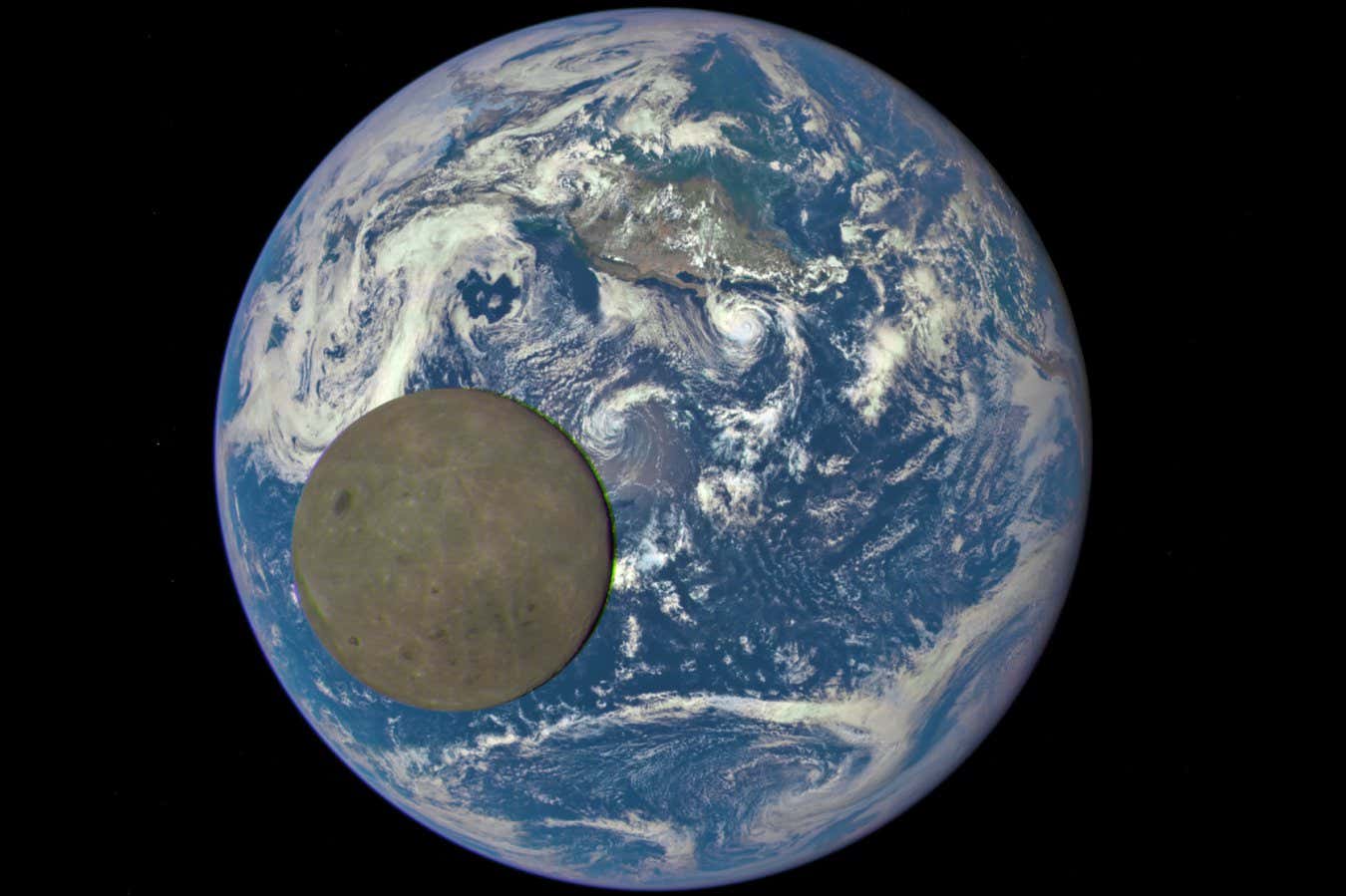
    The moon may have had a more complicated birth than we thought

    NASA/NOAA

    Multiple impacts on Earth might better explain our moon’s origin than a single giant impact 4.5 billion years ago – and could help solve one of its biggest mysteries.

    Pinning down the origin of our moon has been hard. The leading idea is that it was formed early in the history of the solar system in the aftermath of an impact between Earth and a giant Mars-sized object known as Theia, which possibly originated closer to the sun than where our planet is. The impact would have thrown debris into space that eventually coalesced into the large natural satellite we see today, at a time when material was more jumbled up around the sun and impacts were common.

    But Earth and the moon are surprisingly similar in composition, which makes this model a little difficult because the moon should have retained more material from Theia than Earth. “This is a big problem for the canonical model,” says Philip Carter at the University of Bristol, UK.

    Instead, Carter and his colleagues propose that a chain of impacts on Earth over a few million years might better explain why Earth and the moon are so compositionally similar. They show that three or more large impacts on our planet in the early solar system, involving objects ranging from the moon’s current size to nearly the size of Mars, could explain the origin of the moon we see today.

    In this scenario, each impact would produce a small moon, or moonlet, in Earth’s orbit. Over thousands of years, these moonlets would gradually combine together under their gravity, forming one large object. “They will attract and collide with each other,” says Carter. “It’s very unlikely you’d end up with a stable system with multiple large moonlets.”

    Previous models have also invoked a multiple-impact origin of the moon, but they have required a much larger number of impacts on Earth, up to 20, compared with this latest model. “After three impacts, we put enough mass into orbit to make a full moon,” says Carter.

    Robert Citron at the Southwest Research Institute in Colorado says that having fewer impacts “can be better” because the more impacts a model has, the more likely it is that existing moonlets would be kicked out of Earth’s orbit, preventing the moon from forming. However, invoking more impacts leads to a closer compositional similarity between Earth and the moon, better explaining what we see today. “When you have multiple impacts, you’re averaging more of these impactors,” says Citron.

    Working out how the moon formed is important because the Earth-moon system is unusual. “It’s such a unique satellite,” says Citron. “It’s very big relative to Earth, whereas the Martian moons are very small compared to Mars, and the satellites of the gas giants are very small compared to those planets.”

    More complex modelling is needed to work out which idea is correct, says Carter, including the ferocity of the impacts on Earth and the amount of material thrown into space. “To actually calculate everything in detail is still really hard to do,” he says. “Personally, I favour this multiple-impact model over the canonical single-impact model.”

    Topics:


    Source link

    Team_NationalNewsBrief
    • Website

    Keep Reading

    We may finally have a cure for many different autoimmune conditions

    Honey has been used as medicine for centuries – does it really work?

    300-year-old experiment could become world’s best dark matter detector

    New Scientist staff pick the greatest David Attenborough documentaries you really need to watch

    A third of U.S. adults don’t get enough sleep, new CDC report warns

    Watch NASA test its new X-59 jet designed to go faster than the speed of sound

    Add A Comment

    Comments are closed.

    Editors Picks

    China Faces COVID-19 Resurgence With Symptoms of Sharp, Burning Sore Throat

    May 26, 2025

    China state oil majors suspend Russian oil buys due to sanctions: Sources

    October 23, 2025

    Five players who will make the biggest impact with their new NHL team

    October 13, 2024

    Firefly’s Blue Ghost spacecraft makes second ever commercial landing on the moon

    March 3, 2025

    Facebook designed an app for teens called Bell but never launched it, court records reveal

    February 24, 2026
    Categories
    • Arts & Entertainment
    • Business
    • International
    • Latest News
    • Lifestyle
    • Opinions
    • Politics
    • Science
    • Sports
    • Technology
    • Top Stories
    • Trending News
    • World Economy
    About us

    Welcome to National News Brief, your one-stop destination for staying informed on the latest developments from around the globe. Our mission is to provide readers with up-to-the-minute coverage across a wide range of topics, ensuring you never miss out on the stories that matter most.

    At National News Brief, we cover World News, delivering accurate and insightful reports on global events and issues shaping the future. Our Tech News section keeps you informed about cutting-edge technologies, trends in AI, and innovations transforming industries. Stay ahead of the curve with updates on the World Economy, including financial markets, economic policies, and international trade.

    Editors Picks

    Barbie Ferreira Reveals Cosmetic Her Fear

    May 5, 2026

    China’s Wu Yize wins World Snooker Championship for first time

    May 5, 2026

    ‘Extensive brutality’: Rebel attacks reap hell on Congolese civilians | News

    May 5, 2026

    On the other hand, Iran has a point

    May 5, 2026
    Categories
    • Arts & Entertainment
    • Business
    • International
    • Latest News
    • Lifestyle
    • Opinions
    • Politics
    • Science
    • Sports
    • Technology
    • Top Stories
    • Trending News
    • World Economy
    • Privacy Policy
    • Disclaimer
    • Terms and Conditions
    • About us
    • Contact us
    Copyright © 2024 Nationalnewsbrief.com All Rights Reserved.

    Type above and press Enter to search. Press Esc to cancel.