

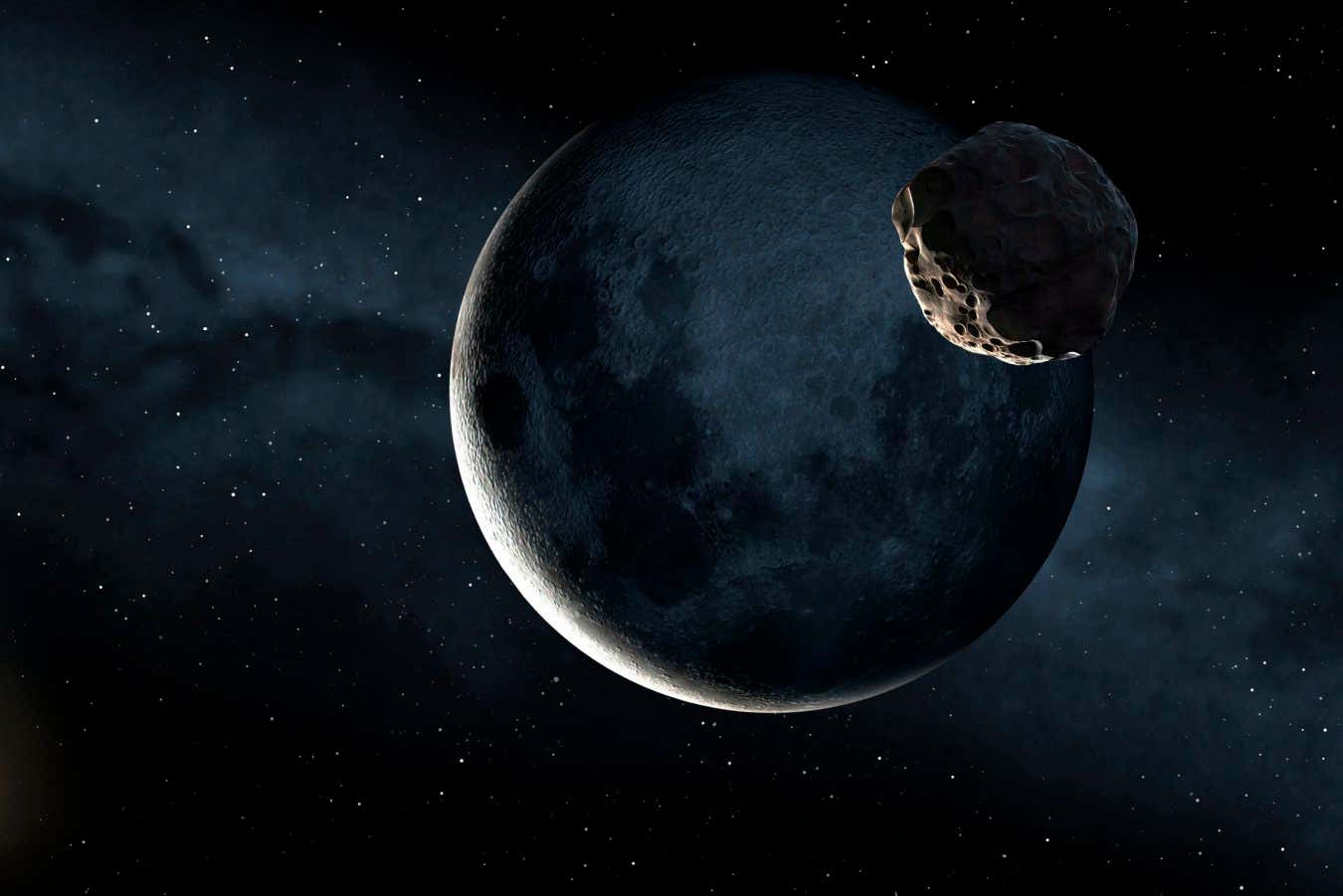
Illustration of an asteroid passing nearby the moon
MARK GARLICK/SCIENCE PHOTO LIBRARY
The chances of a devastating asteroid impact briefly spiked in 2025, after astronomers discovered a building-sized asteroid hurtling towards Earth.
The asteroid, named 2024 YR4, was first detected by astronomers in late December 2024 and was estimated to be between 40 and 90 metres wide. Its possible trajectories across our solar system passed through a narrow window that contained Earth, with astronomers calculating at the time that it had a 1-in-83 chance of striking the planet in 2032.
As they made more detailed observations of the asteroid’s trajectory during the first months of 2025, astronomers calculated increasingly likely chances of impact, reaching its most perilous level of a 1-in-32 chance at the beginning of February.
If the hypothetical impact had been near a city, the aftermath would have been devastating, releasing the equivalent of megatonnes of TNT. The asteroid was deemed dangerous enough that it was briefly designated as a 3 on the 10-point Torino rating system of likely impact consequences, in which 0 means there will be no consequences and 10 means it will cause a global catastrophe. It also triggered several United Nations-affiliated bodies to take further action, such as coordinating global telescope observation campaigns and meeting to decide whether an asteroid-deflection mission might be needed.
During this time, the world’s space agencies regularly met and coordinated to compare notes on their observations and to try to better understand the asteroid. “2024 YR4 was a great teacher to us,” says Richard Moissl at the European Space Agency (ESA). “This was great training that improved our [asteroid detection] methods and our understanding of the whole matter.”
By 20 February, astronomers had sufficiently honed 2024 YR4’s orbit to nearly entirely exclude Earth from the window the asteroid would pass through, and ESA swiftly downgraded the risk of an impact to a 1-in-625, or 0.16 per cent, chance. Some weeks later, both NASA and ESA announced there was no chance of an impact at all. “It’s not perceived as a threat for Earth,” says Moissl.
However, astronomers haven’t been able to rule out a possible impact on the moon, with the current risk sitting at around 4 per cent for 2032. “If it was to collide with the moon, it would be a wonderful opportunity to learn about the impact process and to witness it from a kind of safe distance,” says Gareth Collins at Imperial College London.
Scientists have begun calculating the possible consequences of a moon impact, such as the asteroid launching a shower of satellite-destroying shrapnel towards Earth, as well as whether a deflection mission might be possible and what might be the most effective strategy to employ, from firing small satellites into the asteroid to blowing it up with a nuclear bomb. “You would want to do that very, very carefully, so that you don’t turn a moon impact into an Earth impact,” says Moissl.
Our imprecise figure of a 4 per cent chance of a moon impact isn’t currently high enough to make the world’s space agencies seriously plan a mission. That figure is also unlikely to change soon, because 2024 YR4 is currently behind the sun and so isn’t visible to telescopes — and it won’t reappear until 2028. However, we will have one rare chance to view it in February 2026 with the James Webb Space Telescope, because of its unique vantage point in orbit around Earth. Data from these observations will be our final realistic chance to decide whether we want to launch some sort of mission to visit or deflect the asteroid, says Moissl, because designing an asteroid mission can take many years.
Total solar eclipse 2027 cruise: Spain and Morocco
Set sail on an extraordinary journey aboard the Douglas Mawson, a state-of-the-art expedition ship, to witness the longest total solar eclipse left this century, which takes place on 2 August 2027
Topics:
