

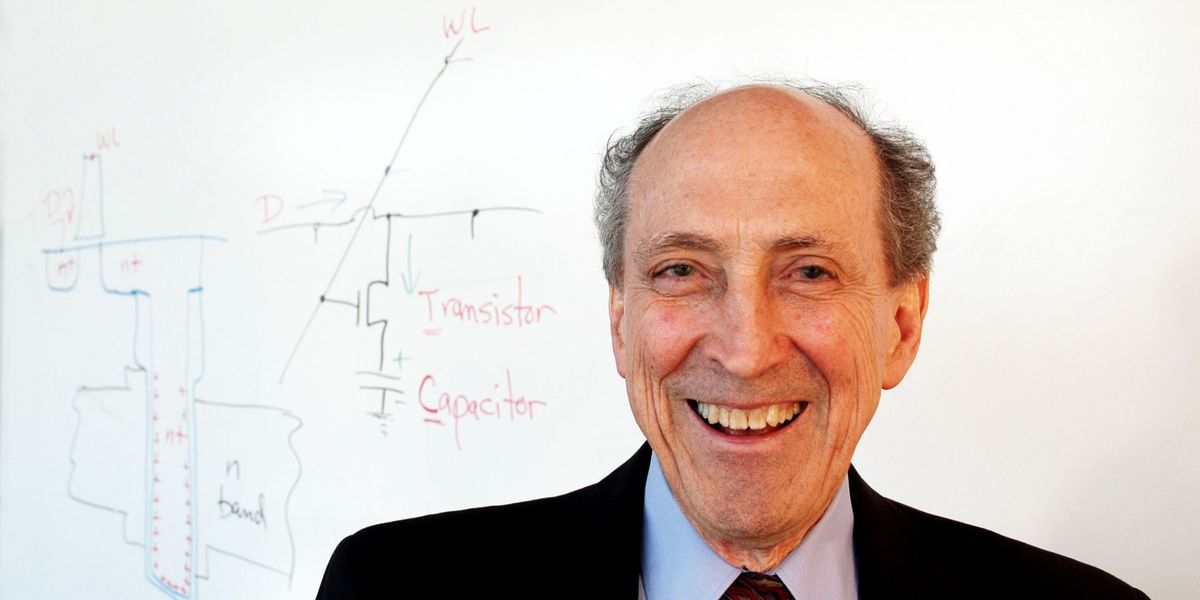
Robert Dennard
Inventor of Dynamic RAM
Fellow, 91; died 23 April
In 1967 Dennard invented what is known as DRAM—a type of random-access semiconductor memory that stores each bit of data in a memory cell consisting of a tiny capacitor and transistor.
Before his invention, RAM required bulky, power-hungry components that were expensive to produce. His breakthrough paved the way for inexpensive, high-density, and commercially available memory.
The computing pioneer received the 2009 IEEE Medal of Honor for his innovation.
Dennard began his career as a staff engineer at IBM’s New York City research lab. He worked on new devices and circuits for logic and memory applications and developed advanced data communication techniques.
He was transferred in 1961 to IBM’s newly opened Watson Research Center, in Yorktown Heights, N.Y., where he worked on field-effect transistors and integrated circuits, using a six-transistor memory cell for each bit of data, the standard at the time. In 1968 Dennard successfully reduced a RAM cell to a small capacitor and a single field-effect transistor—the device that became known as DRAM. He was granted a U.S. patent for his invention in 1968.
By the early 1970s, DRAM was standard in virtually all computers. A decade later, the device powered the first PCs—including the IBM 5150—allowing them to perform more complex operations.
After DRAM’s success, Dennard turned his attention to transistors. In 1972 he developed principles for scaling metal-oxide-semiconductor field-effect transistor (MOSFET) devices, the main building block in low-power and high-performance very-large-scale integration (VLSI) chips. IEEE Fellow Gordon Moore had predicted that the number of transistors on a chip would double every two years, but Dennard proposed that as transistors got smaller, their power consumption would remain nearly constant. He published his theory, now known as Dennard scaling, with a set of supporting principles in the 1974 paper “Design of Ion-Implanted MOSFETs With Very Small Physical Dimensions.”
Dennard was named an IBM Fellow in 1979. For the next several decades at the company, he worked on metal-oxide-semiconductor technology, refining RAM and developing low-voltage, high-performance circuits.
During his career, he was honored with dozens of awards including the 2019 IEEE Robert N. Noyce Medal and the 2001 IEEE Edison Medal. In 1997 Dennard was inducted into the National Inventors Hall of Fame.
He received bachelor’s and master’s degrees in electrical engineering in 1954 and 1956 from Southern Methodist University, in Dallas. Two years later he earned a Ph.D. in electrical engineering from the Carnegie Institute of Technology (now part of Carnegie Mellon).
Richard P. Schulz
Power systems engineer
Life Fellow, 87; died 29 May
Schulz began his career in 1959 as a power systems engineer at General Electric in Schenectady, N.Y. He worked there until 1987, when he joined American Electric Power in Columbus, Ohio. He retired in 2000 and became a consultant.
He specialized in power systems analysis.
Schulz, a member of the IEEE Power & Energy Society, authored or coauthored 32 papers on power grid testing reliability that were featured in IEEE publications.
He earned a bachelor’s degree in electrical and mechanical engineering in 1959 from Lehigh University, in Bethlehem, Pa., and a master’s degree in 1966 from Union College, in Schenectady.
C. Gordon Bell
Developer of early PCs
Fellow, 89; died 17 May
Bell helped develop early PCs at Digital Equipment Corp., a pioneering computer company in Maynard, Mass. He received the 1992 IEEE John Von Neumann Medal for “innovative contributions to computer architecture and design.”
He joined DEC in 1960 and spent his first few years there designing the firm’s minicomputers and time-sharing computers. Time-sharing was a technique that made computing faster and less expensive by allowing multiple users to operate a system concurrently without interfering with each other.
Bell left DEC in 1966 to join the Carnegie Institute of Technology (now part of Carnegie Mellon) as a professor of computer science and electrical engineering.
He returned to DEC in 1972 as vice president of R&D and led the development of the company’s VAX minicomputers. Introduced in 1977, the VAX line featured a 32-bit instruction set architecture and virtual memory. Its user-friendly operating system, known as VMS, enabled file sharing, networking, and other new features.
In 1979 Bell and Ken Olsen, the company’s CEO, founded the Digital Computer Museum in Marlborough, Mass. Its collection of artifacts is now part of the Computer History Museum in Mountain View, Calif.
Bell left DEC in 1983 to found Encore Computer Co., a manufacturer in Marlborough. While there, he helped develop one of the first multiple microprocessor computers. Three years later he was appointed the first assistant director of the U.S. National Science Foundation’s Directorate for Computer and Information Science and Engineering and served in that role until 1987.
After his one-year term with the NSF, Bell moved to California to join Ardent Computer Corp. in Sunnyvale as vice president of engineering. He led the development of the first graphics supercomputer there.
In 1995 he became a researcher at Microsoft, in Mountain View, where his work focused on telepresence technologies and multimedia. He retired in 2015.
Bell authored six books on computing and entrepreneurship. He was a Fellow of the Association for Computing Machinery and a member of the U.S. National Academy of Engineering.
He received several awards including the 1991 National Medal of Technology and Innovation for “his continuing intellectual and industrial achievements in the field of computer design; and for his leading role in establishing cost-effective, powerful computers which serve as a significant tool for engineering, science, and industry.”
He earned bachelor’s and master’s degrees in electrical engineering from MIT in 1956 and 1957.
Laveen Nanik Kanal
Founder and president of LNK
Life Fellow, 92; died 3 May
Kanal was a computer science professor for 26 years at the University of Maryland, in College Park.
He also founded LNK in Germantown, Md., and served as its president for 30 years. The R&D technology company specialized in pattern recognition, image processing, and artificial intelligence.
Kanal emigrated from India to the United States in 1948 to attend the University of Washington in Seattle, where he earned bachelor’s and master’s degrees in electrical engineering in 1951 and 1953.
After graduating, Kanal worked for two years as an electronics engineer at Canada General Electric in Toronto. He left in 1955 to join General Dynamics in Rochester, N.Y., as manager of its machine intelligence laboratory. After two years, Kanal decided to pursue a Ph.D. at the University of Pennsylvania, in Philadelphia. He earned his doctorate in electrical engineering in 1960, then joined Philco-Ford Corp., an electronics company in Willow Grove, Pa., as an engineering manager. He left in 1968 to found LNK.
In 1970 he changed career paths and became a professor at the University of Maryland, where he played a key role in establishing and expanding the school’s computer science department. He was director of the university’s Machine Intelligence and Pattern Analysis Laboratory (now the Center for Machine Learning) from 1974 to 1989. He was named professor emeritus in 1996.
Kanal was a Fellow of the Association for the Advancement of Artificial Intelligence, the American Association for the Advancement of Science, and the International Association for Pattern Recognition. In 1992 he received the IAPR’s King-Sun Fu Prize for contributions to the field of pattern recognition.
H. Joel Trussell
Former Proceedings of the IEEE editor in chief
Fellow, 79; died 9 April
Trussellwas a dedicated IEEE volunteer who served as Proceedings of the IEEE editor in chief from 2013 to 2018. He also was a former member of The Institute’s editorial advisory board.
A prominent researcher in the field of signal and image processing, Trussell spent the first 11 years of his career at Los Alamos National Laboratory, in Santa Fe, N.M.
He decided to pursue a career in academia and left Los Alamos to teach at Heriot-Watt University, in Edinburgh. In 1980 he became an electrical and computer and engineering professor at North Carolina State University, in Raleigh, where he taught for 40 years, retiring in 2020.
Trussell’s research interests included estimation theory, color imaging, and signal and image restoration and reconstruction. One of his most significant contributions was introducing new mathematical tools to model and incorporate a priori data—which relies on deductive reasoning to make predictions—to address signal recovery challenges. He also created a robust mathematical framework for the study of color imaging. His research led to partnerships with Color Savvy Systems, a startup that focused on image color measurement and control, as well as Eastman Kodak and Hewlett-Packard.
During his time at Proceedings of the IEEE, he edited more than 200 papers. He shared the 1986 IEEE Acoustics, Speech, and Signal Processing Society Senior Paper Award with M. Reha Civanlar for “The Feasible Solution in Signal Restoration,” and the 1993 IEEE Signal Processing Society Paper Award with Patrick L. Combettes for “The Use of Noise Properties in Set Theoretic Estimation.”
Trussell received a bachelor’s degree in applied mathematics in 1967 from Georgia Tech. He went on to earn a master’s degree in the same subject the next year from Florida State University, in Tallahassee. In 1976 he received a Ph.D. in electrical engineering and computer science from the University of New Mexico, in Albuquerque.
James Theodore Hardin
Vice president and chief engineer
Member, 89; died 18 January
Hardin was former vice president and chief engineer at Innovative Applications Corp. (IAC), in El Paso, Texas. It specialized in processing and recycling laser toner cartridges.
In the early 1950s Hardin was an engineer at Lockheed Corp., an aerospace manufacturer, in Calabasas, Calif., where he contributed to the design of Air Force One, the airplane used by U.S. presidents.
He enlisted in the U.S. Navy in 1957 and served on the USS Coral Sea as a nuclear weapons officer. When his active duty ended in 1963, he remained in the Navy Reserve until he retired in the 1980s as a captain.
In his civilian role, he worked as an engineer and manager at Prestolite Electric, a global manufacturer and supplier of alternators, starters, and electrical equipment, with headquarters in Novi, Mich. He left in the late 1980s to serve as director of engineering at Septor Electronics Corp., which developed manufacturing equipment in El Paso. In 1992 he left Septor to join IAC.
Hardin received bachelor’s and master’s degrees in mechanical engineering in 1956 and 1963 from Bradley University, in Peoria, Ill.
From Your Site Articles
Related Articles Around the Web
