

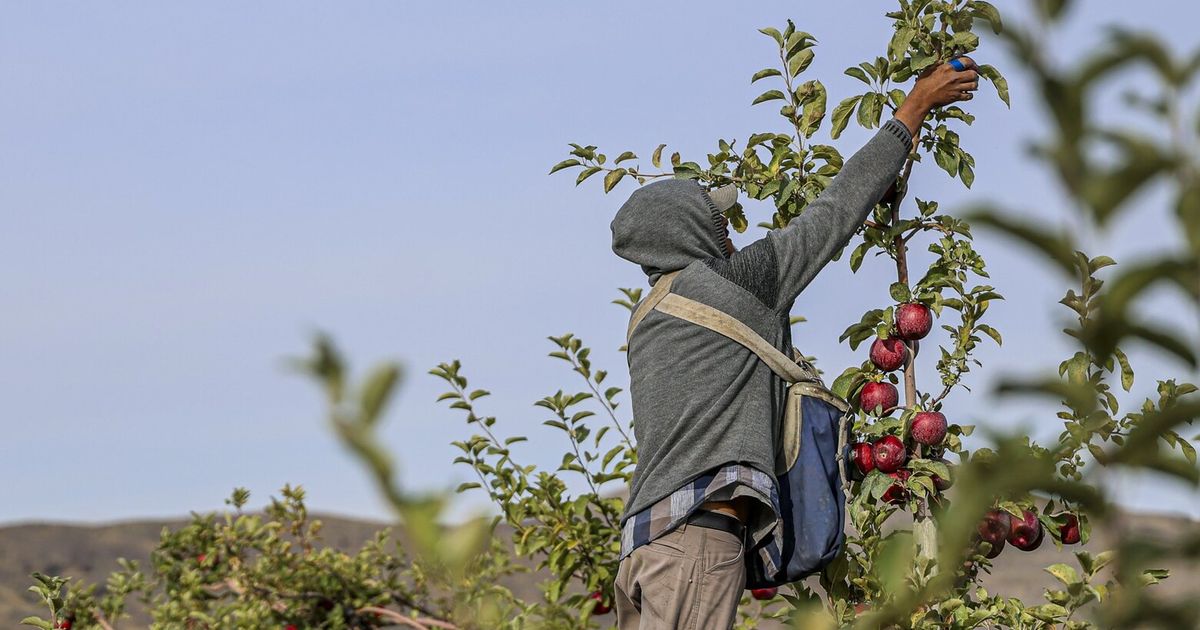
More and more of our Washington state apple, pear and cherry growers are being forced out of business by circumstances beyond their control. According to the U.S. Department of Agriculture’s Census of Agriculture, Washington state lost 3,700 farms between 2017 and 2022 — more than two farms per day. The number of tree fruit farms producing a crop went down by 15%. And we know those numbers are far worse today.
The shortage of seasonal labor and rising labor costs driven by flaws in the federal H-2A program have been the most significant contributing factors to this trend. Washington’s agricultural sector is largely based on high-value, labor-intensive specialty crops. For example, the cost of the labor to grow and harvest an acre of Washington apples has increased by 182% since 2013. The farmer’s income for that same acre of apples has increased by only 7%.
And these increases are directly affecting the viability of our tree fruit growers. In 2013, labor costs consumed an average of 37% of the check that growers received from the sale of their fruit. Once all the numbers were crunched for the 2023 crop, that number had risen to 108% — so growers paid 8% more in labor costs than they received for their fruit. Growers operated far in the red before they had even paid any other orchard costs, like fuel or fertilizer.
These labor cost increases can be directly attributed to flaws in the terms and conditions of the federal H-2A program, which was designed to supplement the domestic workforce with foreign workers on temporary visas when no U.S. workers can be found to do the job. In just eight years, from 2017 to 2025, the number of H-2A workers brought into Washington state more than doubled, from approximately 18,800 workers to more than 38,700.
Agriculture is seasonal, with total on-farm employment in Washington fluctuating between 65,000 in the winter months to nearly 145,000 during peak harvest in midsummer. Historically, Washington’s apples, cherries and pears were harvested by workers who lived in the state, along with workers who traveled from state to state following each crop in its season. They would arrive in Washington for the tree fruit harvest, which runs from June to November. But these sources of experienced labor have decreased steadily as current workers have retired and new U.S. workers are not entering the workforce to replace them.
The shortage of agricultural labor has been a recognized problem since the 1980s, and it led to the creation of the H-2A visa program in 1986. The program provides foreign nationals with temporary visas that allow them to do seasonal agricultural work in the United States and return home in the offseason. Built into the program are provisions to protect domestic workers.
Growers are required to advertise for domestic workers and hire those qualified before they can contract with H-2A workers. The H-2A program does not allow farmers to replace U.S. workers with those from other countries. Growers are only allowed to use this program if they can show that no domestic workers are willing to fill those jobs. In fact, growers are required to advertise the jobs with all H-2A wages and benefits and hire any qualified domestic worker who applies for the first half of the H-2A work contract.
Growers are also required to pay their H-2A and domestic workers a minimum of the Adverse Effect Wage Rate — or if higher, an H-2A prevailing wage in each state. This year, the AEWR is $19.82 per hour — nearly 19% higher than Washington’s minimum wage, which is the second-highest in the nation. In addition, growers are required to provide housing and transportation for H-2A workers and offer the same to the domestic workforce who can’t reasonably return to their permanent residence daily. These costs are significant, with non-payroll labor costs equating roughly $531 per acre last year for Washington state apple growers — an increase of nearly 500% since 2013.
Despite the requirement to pay these higher wages and continue recruiting domestic workers, very few apply for these jobs. In fiscal year 2025, only 32 domestic workers came forward for roughly 38,700 positions.
Considering its high costs and complex administrative requirements, the H-2A program is a last resort for growers. This is demonstrated by the skyrocketing usage of H-2A, while at the same time, the number of tree fruit farms has plummeted in the Pacific Northwest. Unsurprisingly, the expenses of this program are driving an increasing number of U.S. farms out of business every year. And it is going to get worse if the program is not changed.
Washington’s fruit growers have been advocating for changes to the program and for other labor law reforms that will ensure both orchards and farmworkers have a sustainable future. While there has been bipartisan acknowledgment within Congress for the need for broad agricultural workforce reform, no legislation achieving this objective has been able to pass both the House and Senate in the nearly four decades since this program was created.
Washington’s tree fruit producers cannot afford to wait any longer. Fortunately, the U.S. Department of Labor recently offered some much-needed relief to participants in the H-2A visa program and addressed one of its most significant flaws. In a new Interim Final Rule published in October, the agency has improved the calculation method and accuracy of the Adverse Effect Wage Rate.
Over the past decade, the system has allowed the Adverse Effect Wage Rate in Washington state to increase by 59%, when average employment costs as tracked by the Bureau of Labor Statistics’ Employment Cost Index have increased by 31%. The new rule realigns the AEWR with actual market conditions.
How does it do that? The rule ends the use of a USDA survey that was never intended to be used as a guide to set wages and replaces it with a Bureau of Labor Statistics survey that is more reflective of the wages farmers actually pay. For example, it will generate wage data that is more granular — generating results at a state level instead of a regional level.
The new rule also recognizes that some agricultural work requires advanced skills and should be compensated at a higher rate. It sets a different wage based on two skill levels, with considerations like job experience, certifications, level of oversight needed and degree of difficulty. Building a sustainable, fairly compensated workforce is vital to the tree fruit industry, and this new rule will help H-2A employers better achieve this.
The new rule also recognizes that domestic workers must pay for their housing out of their salaries, while H-2A workers receive free housing from their employer. To maintain parity, the wage rate for H-2A workers will be adjusted to reflect what domestic workers in their state pay out of their wages for housing based on fair market rents from the U.S. Department of Housing and Urban Development.
Without a dedicated, skilled domestic workforce and a reformed H-2A program, more of our family farms will fail. We must have a strong workforce that is well-compensated at wages that growers can afford. At stake is an industry important to the state economy and to its identity. Washington’s tree fruit is known around the world for its quality, flavor and contribution to our health.
If we can’t compete, Washington consumers would have to rely on food produced in other states or countries where workers are not paid as well and do not receive the worker protections offered in Washington state.
The recent changes are a good start, but further reforms and action by Congress are needed to ensure that our state’s growers have the seasonal help they need, and that those workers are paid properly for the important work they do. Only then can we continue to have orchards and farms that feed our neighbors and support our state’s economy.
