

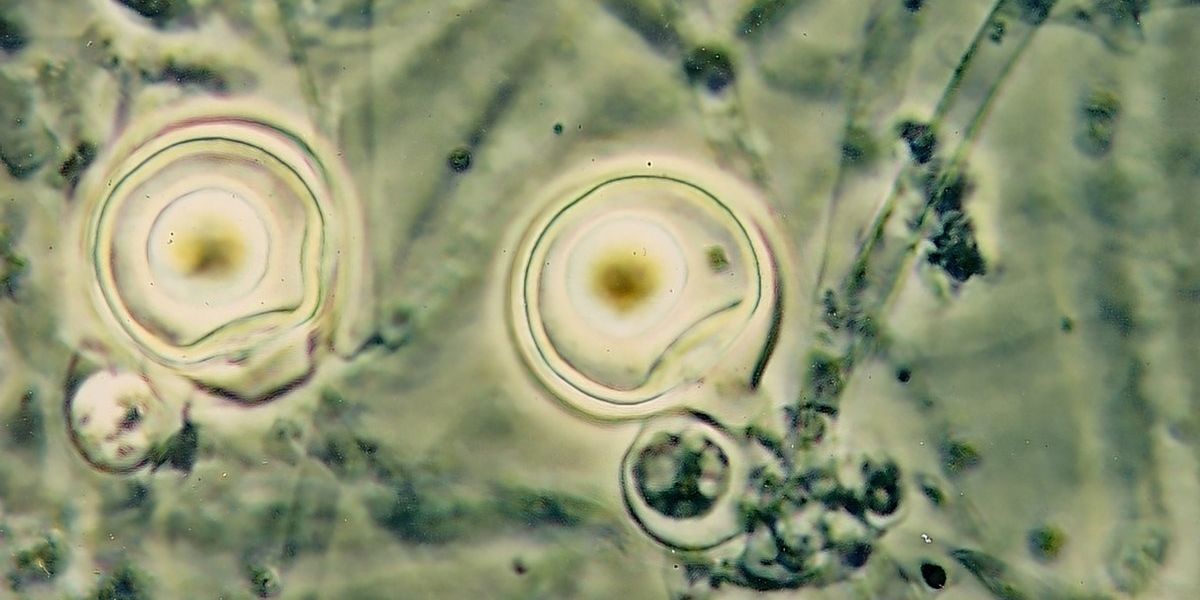
Imagine you’re a baby cocoa plant, just unfurling your first tentative roots into the fertile, welcoming soil.
Somewhere nearby, a predator stirs. It has no ears to hear you, no eyes to see you. But it knows where you are, thanks in part to the weak electric field emitted by your roots.
It is microscopic, but it’s not alone. By the thousands, the creatures converge, slithering through the waterlogged soil, propelled by their flagella. If they reach you, they will use fungal-like hyphae to penetrate and devour you from the inside. They’re getting closer. You’re a plant. You have no legs. There’s no escape.
But just before they fall upon you, they hesitate. They seem confused. Then, en masse, they swarm off in a different direction, lured by a more attractive electric field. You are safe. And they will soon be dead.
If Eleonora Moratto and Giovanni Sena get their way, this is the future of crop pathogen control.
Many variables are involved in the global food crisis, but among the worst are the pests that devastate food crops, ruining up to 40 percent of their yield before they can be harvested. One of these—the little protist in the example above, an oomycete formally known as Phytophthora palmivora—has a US $1 billion appetite for economic staples like cocoa, palm, and rubber.
There is currently no chemical defense that can vanquish these creatures without poisoning the rest of the (often beneficial) organisms living in the soil. So Moratto, Sena, and their colleagues at Sena’s group at Imperial College London settled on a non-traditional approach: They exploited P. palmivora’s electric sense, which can be spoofed.
All plant roots that have been measured to date generate external ion flux, which translates into a very weak electric field. Decades of evidence suggests that this signal is an important target for predators’ navigation systems. However, it remains a matter of some debate how much their predators rely on plants’ electrical signatures to locate them, as opposed to chemical or mechanical information. Last year, Moratto and Sena’s group found that P. palmivora spores are attracted to the positive electrode of a cell generating current densities of 1 ampere per square meter. “The spores followed the electric field,” says Sena, suggesting that a similar mechanism helps them find natural bioelectric fields emitted by roots in the soil.
That got the researchers wondering: Might such an artificial electric field override the protists’ other sensory inputs, and scramble their compasses as they tried to use plant roots’ much weaker electrical output?
To test the idea, the researchers developed two ways to protect plant roots using a constant vertical electric field. They cultivated two common snacks for P. palmivora—a flowering plant related to cabbage and mustard, and a legume often used as a livestock feed plant—in tubes in a hydroponic solution.
Two electric-field configurations were tested: A “global” vertical field [left] and a field generated by two small nearby electrodes. The global field proved to be slightly more effective.Eleonora Moratto
In the first assay, the researchers sandwiched the plant roots between rows of electrodes above and below, which completely engulfed them in a “global” vertical field. For the second set, the field was generated using two small electrodes a short distance away from the plant, creating current densities on the order of 10 A/m2. Then they unleashed the protists.
With respect to the control group, both methods successfully diverted a significant portion of the predators away from the plant roots. They swarmed the positive electrode, where—since zoospores can’t survive for longer than about 2 to 3 hours without a host—they presumably starved to death. Or worse. Neil Gow, whose research presented some of the first evidence for zoospore electrosensing, has other theories about their fate. “Applied electrical fields generate toxic products and steep pH gradients near and around the electrodes due to the electrolysis of water,” he says. “The tropism towards the electrode might be followed by killing or immobilization due to the induced pH gradients.”
Not only did the technique prevent infestation, but some evidence indicates that it may also mitigate existing infections. The researchers published their results in August in Scientific Reports.
The global electric field was marginally more successful than the local. However, it would be harder to translate from lab conditions into a (literal) field trial in soil. The local electric field setup would be easy to replicate: “All you have to do is stick the little plug into the soil next to the crop you want to protect,” says Sena.
Moratto and Sena say this is a proof of concept that demonstrates a basis for a new, pesticide-free way to protect food crops. (Sena likens the technique to the decoys used by fighter jets to draw away incoming missiles by mimicking the signals of the original target.) They are now looking for funding to expand the project. The first step is testing the local setup in soil; the next is to test the approach on Phytophthora infestans, a meaner, scarier cousin of P. palmivora.
P. infestans attacks a more varied diet of crops—you may be familiar with its work during the Irish potato famine. The close genetic similarities imply another promising candidate for electrical pest control. This investigation, however, may require more funding. P. infestans research can be undertaken only under more stringent laboratory security protocols.
The work at Imperial ties into the broader—and somewhat charged—debate around electrostatic ecology; that is, the extent to which creatures including ticks make use of heretofore poorly understood electrical mechanisms to orient themselves and in other ways enhance their survival. “Most people still aren’t aware that naturally occurring electricity can play an ecological role,” says Sam England, a behavioral ecologist with Berlin’s Natural History Museum. “So I suspect that once these electrical phenomena become more well known and understood, they will inspire a greater number of practical applications like this one.”
From Your Site Articles
Related Articles Around the Web
