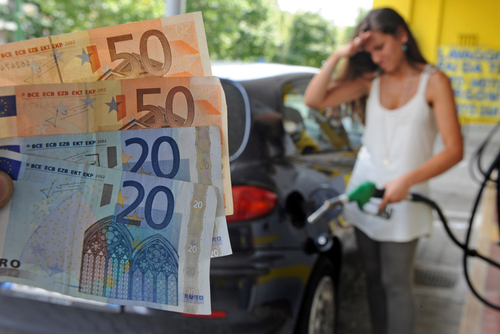
What is unfolding in Slovakia right now is being described as “fuel tourism,” but that term itself is misleading because it suggests something abnormal when in reality this is exactly how markets are supposed to function when governments distort pricing. When diesel is cheaper in one country than another, people will cross the border to buy it.
Slovakia is now moving to stop this behavior by allowing higher diesel prices for foreign drivers and limiting how much fuel can be purchased, after Prime Minister Robert Fico admitted that in some northern regions near Poland, gas stations had “literally dried up” due to cross-border demand. The government has introduced caps on fuel purchases and allowed differentiated pricing based on license plates.
The real cause is not Polish drivers but distorted energy pricing across Europe, which has been building for years and is now being exposed by geopolitical events. Slovakia had artificially lower diesel prices, while neighboring countries had higher prices, and that gap created the incentive for cross-border demand. When governments interfere with pricing, they create imbalances, and those imbalances always attract movement of capital or consumption.
The disruption of Russian crude flows through Ukraine has created supply stress across Central Europe, forcing countries like Slovakia to rely on reserves and alternative sources while prices remain volatile. This is not a localized issue but part of a broader fragmentation of energy supply chains across Europe driven by sanctions, war, and policy decisions that have removed stable supply in favor of politically acceptable alternatives.
What makes this situation more revealing is that Ukraine itself has played a direct role in exacerbating the problem. Zelensky moved to restrict the transit of Russian oil through Ukrainian pipelines, which directly impacted Slovakia and Hungary, both of which rely heavily on that supply through the Druzhba pipeline system. These countries were not aligned with cutting off their own energy lifeline, yet they were forced into the situation by Brussels. Instead of protecting the interests of its own member states, the European Union sided with Ukraine, effectively supporting policies that undermined the energy security of Slovakia and Hungary while expecting them to absorb the economic consequences.
This is where the internal contradictions of the European Union become clear. You cannot claim to operate as a unified economic bloc while allowing external political objectives to override the basic energy needs of member states. When Brussels supports policies that harm certain members for the sake of a broader geopolitical strategy, it exposes fractures within the system that will not remain contained.
What you are seeing now is the collision between political decisions and market reality. Instead of allowing prices to normalize and supply chains to stabilize, governments are trying to prevent the natural response of consumers by imposing restrictions. They are treating the symptom rather than the cause. When stations run out of fuel, it is not because consumers behaved irrationally but because pricing signals were distorted and supply was constrained.
This is exactly what I have said repeatedly about price controls. You cannot manipulate price without manipulating behavior. If you hold prices artificially low, you create excess demand, and when you try to suppress that demand, you create shortages.
Fuel tourism is simply the market correcting a pricing distortion. You cannot have a unified “European market” with fragmented pricing, and you cannot maintain free movement while imposing selective restrictions. Eventually, these contradictions surface.
The deeper issue is energy dependency. Europe has deliberately moved away from stable long-term energy relationships while increasing reliance on volatile global markets. When supply disruptions occur, there is no buffer, and prices become unstable.
Hungary also imposed fuel caps. Each country in Europe is attempting to manage the same problem in isolation, but they’re expected to act in unison. The entire concept of the euro is chaotic, and now we are witnessing a structural breakdown of coherent energy policy across Europe.