
Close Menu
    National News Brief
    Thursday, November 26
    • Home
    • Business
    • Lifestyle
    • Science
    • Technology
    • International
    • Arts & Entertainment
    • Sports
    National News Brief
    Home » Temperature gets a new definition using a quantum device

    Temperature gets a new definition using a quantum device

    Team_NationalNewsBriefBy Team_NationalNewsBriefMarch 26, 2026 Science No Comments3 Mins Read
    Share
    Facebook Twitter LinkedIn Pinterest Email


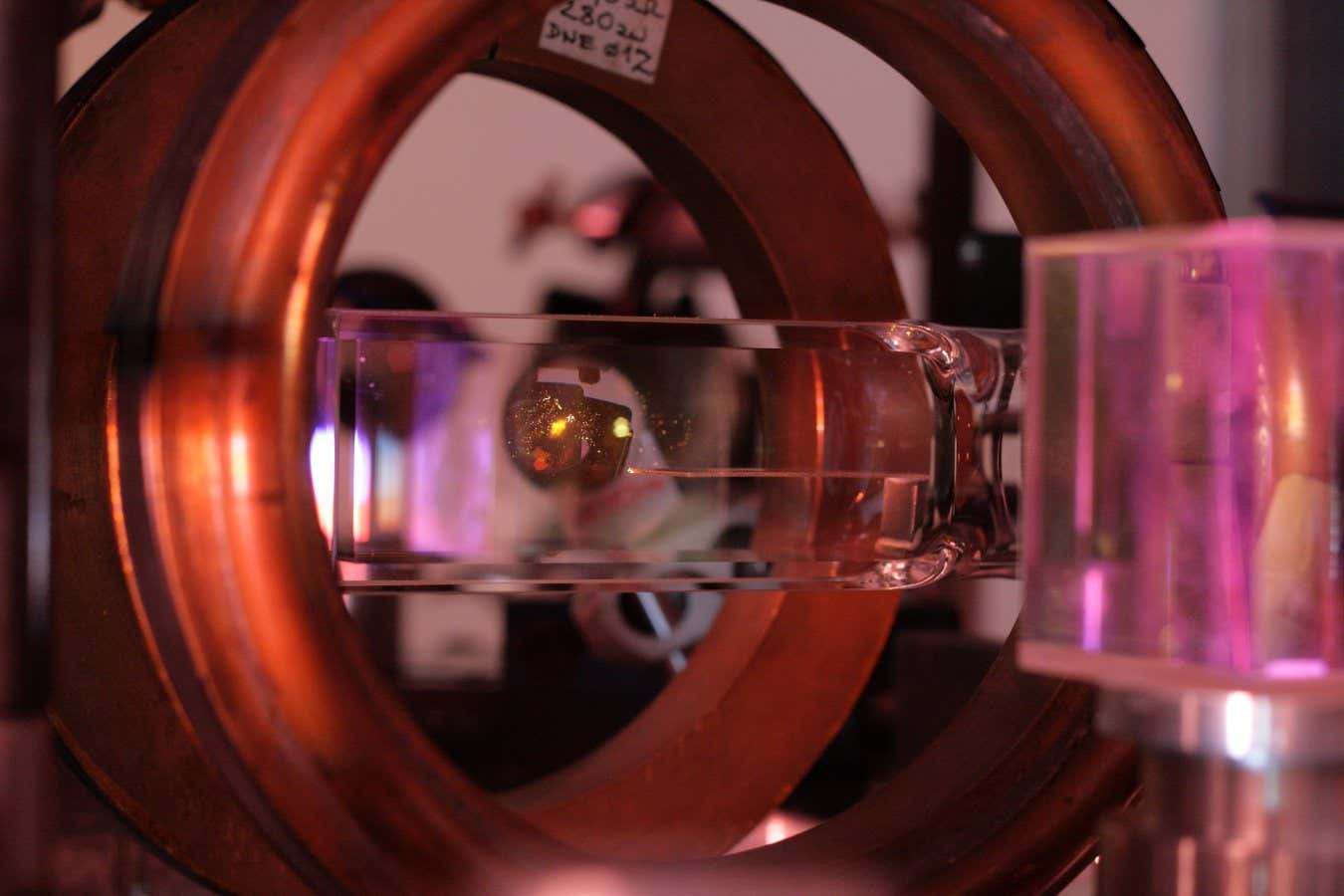
    The main part of the new set-up for cooling and trapping rubidium atoms

    Tomasz Kawalec CC BY-SA 4.0

    A better, more reliable definition of temperature could come from a quantum device full of giant atoms.

    While some countries measure temperatures in Celsius and others use Fahrenheit, physicists everywhere use a unit called kelvin. Zero kelvin denotes the absolute coldest temperature allowed by the known laws of physics, so kelvin is said to measure “absolute temperature”. In practice, however, making sure that when you measure a single kelvin, it really is a single kelvin is a laborious process.

    “If you want to make an absolute temperature measurement, you buy a commercial temperature sensor, which was calibrated by another commercial temperature sensor, which was calibrated by another commercial temperature sensor, and so on. And one of those sensors was, at some point, sent to the National Institute of Standards [and Technology],” says Noah Schlossberger at NIST in Colorado.

    He and his colleagues have now built a device that uses quantum effects to measure kelvin, which researchers could use instead of having to get someone else to calibrate their sensors.

    The device is a small box made from metal and glass containing trapped rubidium atoms. The researchers push these atoms to an extreme size, using lasers to move the outermost electrons unusually far from the nucleus, and to an extreme temperature by using both lasers and electromagnetic fields to grab onto and chill the atoms to about half a millikelvin, a temperature roughly a 600,00th that of room temperature.

    As a result, the outermost electrons in the rubidium atoms become extremely sensitive to even a small increase in temperature and “jump” into a different quantum state when exposed to one. These jumps are what makes the device a great temperature sensor, because there are well-established mathematical models that can determine the temperature differences needed to make them – effectively allowing for a redefinition of kelvin in these terms.

    The International Bureau of Weights and Measures defines the kelvin in a similar way – as a product of several quantum constants – but, in practice, even institutions like NIST use non-quantum devices for calibration. The hope is that the new device gives a quantum definition of kelvin where calibration wouldn’t be needed.

    “Every rubidium atom in the world is exactly the same, and they will behave in exactly the same way in the same environment. I can rebuild the device on the other side of the world, and it will be exactly the same,” says Schlossberger. He says this is especially important for keeping high-precision devices functioning correctly, such as atomic clocks, which can only work at very low-kelvin temperatures.

    But the new device is still a prototype and so it still has imperfections in how quantum states are detected, for example. It is also too bulky to leave the lab and took more than six months to build. The researchers are now working on optimising its design to make it more practical and to increase its accuracy.

    Schlossberger presented the work on 16 March at the American Physical Society Global Physics Summit in Colorado.

    Topics:


    Source link

    Team_NationalNewsBrief
    • Website

    Keep Reading

    The U.S. Army is blowing up five tons of toxic lead azide in Iowa

    In 2022 NASA struck an asteroid. Now we are finally seeing the massive impact up close

    Why AI’s proof of the Riemann hypothesis is so bittersweet

    A new biography reveals the private life of Stephen Hawking

    Slime molds beat mathematicians at complex problems

    Read The Age of Alchemy by Kit Chapman with Scientific American in December

    Add A Comment

    Comments are closed.

    Editors Picks

    Federal judge denies attempt to block commuted death row inmates’ transfer to ‘Supermax’ prison

    May 28, 2025

    Urine tests detect high-risk HPV as effectively as DIY vaginal swabs

    August 31, 2025

    Thousands of US flights cancelled, delayed as government shutdown continues | Travel News

    November 9, 2025

    Georgia rallies to beat Georgia Tech 44-42 in 8th OT

    November 30, 2024

    Bluesky is ushering in a pick-your-own algorithm era of social media

    November 19, 2024
    Categories
    • Arts & Entertainment
    • Business
    • International
    • Latest News
    • Lifestyle
    • Opinions
    • Politics
    • Science
    • Sports
    • Technology
    • Top Stories
    • Trending News
    • World Economy
    About us

    Welcome to National News Brief, your one-stop destination for staying informed on the latest developments from around the globe. Our mission is to provide readers with up-to-the-minute coverage across a wide range of topics, ensuring you never miss out on the stories that matter most.

    At National News Brief, we cover World News, delivering accurate and insightful reports on global events and issues shaping the future. Our Tech News section keeps you informed about cutting-edge technologies, trends in AI, and innovations transforming industries. Stay ahead of the curve with updates on the World Economy, including financial markets, economic policies, and international trade.

    Editors Picks

    Mitsubishi Electric CEO on How He Reached the C-Suite

    November 26, 2026

    Fibonacci A Window Into Universe

    November 26, 2026

    Zach Edey Throws Down a Monster Dunk

    November 26, 2026

    Brad Pitt & Angelina Jolie End Feud In Rare Joint Move

    November 26, 2026
    Categories
    • Arts & Entertainment
    • Business
    • International
    • Latest News
    • Lifestyle
    • Opinions
    • Politics
    • Science
    • Sports
    • Technology
    • Top Stories
    • Trending News
    • World Economy
    • Privacy Policy
    • Disclaimer
    • Terms and Conditions
    • About us
    • Contact us
    Copyright © 2024 Nationalnewsbrief.com All Rights Reserved.

    Type above and press Enter to search. Press Esc to cancel.