

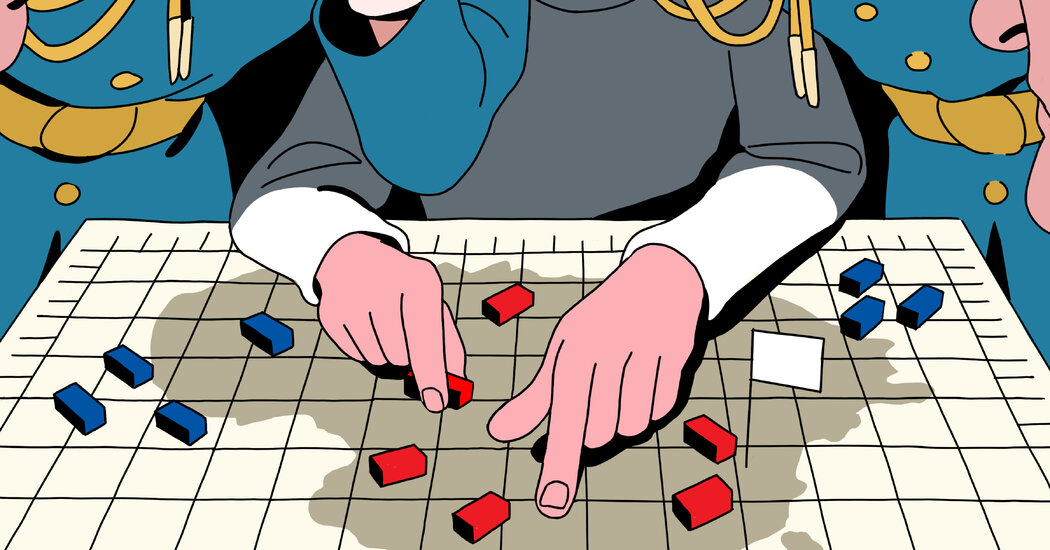
It was a bitter victory. After occupying a chunk of NATO territory in the Baltics, my team successfully converted the land grab into a diplomatic coup, winning major concessions from the United States that would refashion Europe’s security architecture in Russia’s favor. I was President Vladimir Putin, and I had just secured a big win for my project of Russian aggrandizement.
Thankfully, this was not reality. It was a war game organized by the German newspaper Die Welt and the German armed forces, designed to test Berlin’s readiness for a security crisis brought about by Russian aggression and American indifference. I’d been invited to represent my home country of Russia; there was a certain piquancy in playing the man whose invasion of Ukraine pushed me, as well as many of my friends and colleagues, into exile.
The results were chilling. The game, which took place last December, made plain how plausible a new Russian attack is — and how vulnerable NATO would be to one. The war in Iran, handing Russia a fresh advantage and fracturing the West further, has only worsened the situation. The exercise made me worry that unless NATO countries get their act together, another invasion could be coming.
The game was set up like this. In October 2026, Russia — deprived of its maximalist war aims in a May cease-fire with Ukraine that nonetheless left the leadership confident — is seeking retribution for Europe’s help to Kyiv. Under the cover of a large military exercise, the Kremlin places 15,000 elite troops in Belarus and the Russian exclave of Kaliningrad, separated by a mere 40-mile-long strip that runs through Lithuania.
My team seized this strip of land, under the guise of establishing a “humanitarian corridor” to supply food to Kaliningrad. We used drones to gain control of the area, remotely mined the border between Poland and Lithuania to make it harder for Warsaw to intervene and, finally, invaded with troops and tanks. We also brought in Russian doctors and journalists, to increase the number of civilian casualties if NATO hit back.
Then we opened a dialogue with the White House, insisting that Russian soldiers would be immediately withdrawn once the Europeans accommodated our demands. Chief among them were a rollback of NATO military infrastructure in Europe and nonexpansion of the alliance — pretty much what Mr. Putin demanded before invading Ukraine. Our position was simple: Give us what we want, or prepare for another war that could go nuclear.
With the midterms just a week away, the White House chose to engage in talks. They wanted to avoid American military involvement and instead present preventing World War III to the American people as Mr. Trump’s accomplishment. Without Captain America leading the way, Germany chose not to use the military tools at its disposal — like giving combat orders to a German brigade in Lithuania — to confront the aggressor.
Once the U.S. president stood down, NATO was effectively deactivated: Absent America’s buy-in, allies couldn’t use the organization’s collective defense plans or command-and-control system. They could do little other than watch as Mr. Trump agreed to high-level talks with the Kremlin. Through a combination of military boldness, diplomatic cunning and brinkmanship, we discredited Article 5, NATO’s founding principle of collective defense, and fortified Russia’s position as a key power in Europe.
Some policymakers in NATO capitals are skeptical that Russia could pull this off, and not without reason. In truth, the Russians are unlikely to have the element of surprise on their side. NATO intelligence agencies carefully monitor the movement of Russian troops: Any attempt to mass soldiers would be immediately known to Western generals. But there are reasons to believe that the Kremlin, under certain conditions, would contemplate an armed attack on NATO territory.
First, there is motive. Throughout his quarter-century in the Kremlin, Mr. Putin has spoken in blunt terms of NATO being a major threat to Russia’s security — and never more so than now. By invading Ukraine, ironically, Mr. Putin has turned NATO into a much bigger danger. The Kremlin ruler has repeatedly told Russians that the real war is not against Ukraine but against all of NATO. He has said it so often that he must believe it himself.
Then there is the strength of Russia’s military. Despite its failure to crush Ukraine, Russia now has a bigger land force and produces more tanks, shells and missiles than before the invasion. What’s more, in contrast to potential NATO adversaries, it knows how to fight modern drone warfare. In our game, the army’s ability to establish fire control over a strip of NATO land without leaving its position was a crucial element in our success.
There is also Mr. Putin’s information environment. Pandemic-induced isolation was one of the precursors to the invasion of Ukraine: Surrounded by a small circle of sycophants, the Russian president lost touch with reality. The war has made Mr. Putin only more isolated and people around him more afraid to speak the truth. With the elites and broader society cowed by repression, what is there to stop Mr. Putin from making another disastrous decision?
Mr. Putin’s perception of the adversary matters, too. Back in 2022, he clearly thought the West was weak and disunited. Now, he finds a Europe that is unsure of itself as it takes the first steps in a costly and politically controversial rearmament process. Until this effort is turned into equipment and capabilities sufficient to deter Russia, there is a window of opportunity in which Russia, though fundamentally weaker than NATO, may have an upper hand militarily.
Last but not least, there is Mr. Trump. No American president has put the credibility of NATO more in doubt or created more rifts with European allies. During the war in Iran, Mr. Trump’s disregard for the alliance has gone through the roof. Watching the trans-Atlantic bond implode, Mr. Putin may believe he can combine appeals to Mr. Trump’s vanity with nuclear intimidation to persuade America not to defend Europe — just as we did in the game.
The good news is that Europe can effectively deter the Kremlin, with or without America. In the scenario we played, for example, there were cheap and quick solutions that would make a Russian invasion far less likely, such as placing World War I-era minefields and fortifications along NATO’s border with Russia and Belarus. These could be combined with 21st-century instruments like the much-discussed drone wall on NATO’s eastern flank and perhaps the most potent weapon of all, resolve.
That is all feasible. But time is of the essence: The most dangerous period, as I vividly learned playing Mr. Putin, may soon be upon us.
