

Given how integral the Internet has become to everyday tasks such as shopping, paying bills, and holding virtual meetings, it’s interesting that nearly 30 percent of the global population still has no access to it. More than 2 billion people are still offline, according to a report released in November by the International Telecommunication Union.
More and more people are being connected, though, thanks to IEEE Future Networks’ Connecting the Unconnected (CTU) and similar programs. Since 2021, the technical community has been working to accelerate the development, standardization, and deployment of 5G, 6G, and future generations.
Every year, CTU holds a worldwide competition to seek out innovators who are in the early stages of developing technologies or applications to provide greater access. It also holds an annual summit that brings together experts, community leaders, and other interested parties to discuss strategies to expand access and foster digital inclusion.
CTU expanded in several ways last year. It launched regional summits to focus on local connectivity issues, organized community-focused events, and established an expanded mentorship program to further support contest winners and the next generation of technological innovators impacting humanity. The program also partners with the IEEE Standards Association (IEEE SA) to develop guidelines for some of the submitted innovations.
“IEEE Future Networks has created a community to bring all these initiatives working on digital connectivity together in a single platform and leverage the IEEE brand to help raise the visibility of their work,” says IEEE Life Fellow Sudhir Dixit, a CTU cochair and a Basic Internet Foundation cofounder, which also works to expand Internet access.
A contest for new connectivity methods
The CTU challenge, launched in 2021, typically receives 200 to 300 submissions each year, Dixit says. Last year 245 projects from 52 countries were submitted. Participants include academics, nonprofit organizations, startups, and students.
Projects can be entered into one of three categories. The Technology Applications category is for new connectivity methods or innovations that broaden broadband access. Those who improve the affordability of Internet services can enter the Business Model category. The Community Enablement category is for strategies that promote public broadband adoption.
After selecting a category, entrants choose between two tracks based on their project’s maturity. The proof-of-concept route is for early-stage but functional technology that has already produced results. The conceptual path is for projects in the theoretical phase that have not undergone full testing.
“IEEE Future Networks has created a community to bring all these initiatives working on digital connectivity together in a single platform and leverage the IEEE brand to help raise the visibility of their work.” —Sudhir Dixit, Connecting the Unconnected cochair
Last year’s challenge submission period was from March to June, with judging phases from June through November. The 20 winners presented their solutions in December at a virtual Winners Summit. Fourteen projects received prize money, ranging from US $500 to $2,500. Six finalists earned an honorable mention at the summit.
The awards amounts have varied over the years, based on the sponsorship.
Among the winners were a solar-powered community broadband network in Tanzania, a low-cost method for accessing the Internet that uses FM radio and a short message service (SMS), and a strategy for utilizing India’s rural broadband infrastructure to deliver medical services to people living in isolated, tribal, and other underserved regions.
“Our job is to help further develop the technology, look for gaps, and see if it is good enough to be applied to rural villages, like those in Africa and India,” says IEEE Fellow Ashutosh Dutta, who is a CTU cochair and a professor at Johns Hopkins University, in Baltimore. “The idea behind the contest is to make sure the technology actually gets implemented at the grassroots level and is being used by the local community.”
This year’s challenge submission period runs until 19 June, with judging phases from July through October.
The finalists of the 2025 IEEE Connect the Unconnected challenge describe their projects.IEEE Future Networks
Local connectivity discussions
The CTU program hosted three regional summits last year. The North American event was held in September in Washington, D.C. In November, the Global/Asia-Pacific meeting took place in Bangalore, India; it was co-located with the IEEE Future Networks World Forum. The Europe, Middle East, and Africa summit also was held in November, in Abuja, Nigeria.
Topics discussed at the summits included infrastructure solutions for universal connectivity; sustainable business models; scaling homegrown technologies; and policy, regulation, and financing issues.
As of press time, the dates for this year’s regional summits had not been announced.
Community-focused events
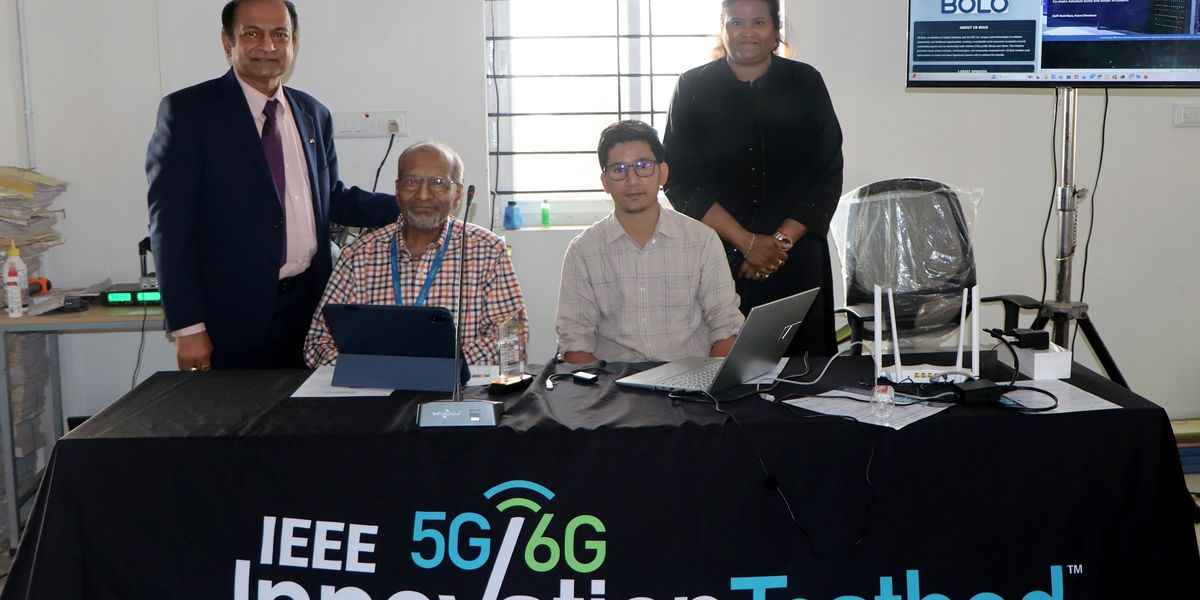
To help bridge the gap between ideas and their deployment, the Connect a Community event was established to demonstrate how some new technologies might benefit people. The inaugural event was held in November in Bengaluru, India. During the daylong program, 10 of the challenge winners demonstrated their connectivity solutions to villagers from seven rural communities.
Dutta credits IEEE Life Fellow Rakesh Kumar with devising the event. Kumar chairs IEEE Future Directions, which was where Future Networks got its start in 2017 as the 5G Initiative.
“Kumar wants to ensure the winning technologies are going to be useful for the community,” Dutta says.
Providing entrepreneurs with business skills
Dixit says the Future Networks team believed that simply conducting a competition and distributing prizes wasn’t enough.
“We wanted to follow up with the winners, monitor their progress, and help them turn their ideas into a business,” he says.
To accomplish that, IEEE launched the Empowerment Through Mentorship program, in which budding entrepreneurs are paired with industry leaders and experienced mentors who provide them with 1,000 days of guidance, coaching them on scaling up their business.
“We launched the mentorship program to further the cause,” Dixit says. “These people may be good at developing technology, but they don’t know the marketing challenges, how to raise money, and other factors.”
The Lemelson Foundation, an organization in Portland, Ore., that partners with IEEE, collaborated on the mentorship program. The foundation’s philanthropic strategy is to cultivate a robust ecosystem for entrepreneurs in East Africa, India, and the United States. It does so by providing the entrepreneurs with tools including financing options and access to communities that share their passion.
The foundation chose to partner with IEEE “because of its powerful international network and focus on electrical engineering, which is a critical element of communications and energy infrastructure globally,” says Kory Murphy, Lemelson’s program officer for U.S. invention and entrepreneurship.
“Other factors include IEEE’s focus on nontraditional or disadvantaged areas in India,” Murphy says, “and its recognition that mentorship is critical for the successful deployment of new technologies.”
IEEE began an early pilot project in 2023 with support of a grant from the Lemelson Foundation, to determine if a sustained entrepreneurship mentorship program was valuable and necessary, he says. It then conducted a survey through 2024 to collect information to better understand the needs of stakeholders, mentors, and entrepreneurs in hard-to-reach areas in India. While the early pilot program was restricted to that country, its intent was to learn from the experience and share the findings globally, he says.
“Our job is to help further develop the technology, look for gaps, and see if it is good enough to be applied to rural villages, like those in Africa and India.” —Ashutosh Dutta, Connecting the Unconnected cochair
“The foundation’s involvement was aimed at testing certain activities, partnership strategies, and understanding the budgetary requirements for a prepilot program,” he says. “The primary goal of the foundation is to enable conditions for innovation to occur within regional systems, especially addressing the opportunity for sustained, systematic, and relational mentorship in technology innovation.”
The Empowerment Through Mentorship program is structured into three tiers. One focuses on individuals and their needs, the program/technical level focuses on the invention, and the venture level guides participants from the initial concept through product testing and validation. Within each track, participants engage in activities such as networking, securing financial support, and pitching their innovations, Murphy says.
“The 1,000-day approach reflects the belief that it requires a long period of time to coach and support those who traditionally are excluded,” he says.
CTU mentors can be IEEE members or nonmembers who are successful entrepreneurs and own small or large companies, Dixit says. They also can work in academia.
“They need to be passionate about training and mentoring other people,” Dixit says. “We have created a curriculum that covers topics such as ways to get financing from investors and how to turn ideas into a profitable business. It’s not the technology that will make the product successful; it’s everything else that goes into it.”
To determine whether any of the challenge’s submitted projects have the potential to become a standard, the CTU working group collaborates with the IEEE SA Industry Connections program’s 6G Rural Connectivity and Intelligent Village activity. Projects considered for standards do not have to be winners. Any project that has successfully passed the first phase, completed the second-phase requirements, and requested a review may be considered.
Typically, about half of the submitted projects are reviewed for possible standard implications, Dutta says.
“We selected about 60 submissions that could be potentially standardized,” he says. “Out of those, we work with IEEE SA’s rapid reactive standards activity group to narrow them down to five or 10 that can be potentially standardized.
“The CTU program is not only about developing a technology or implementing it, but also standardizing it so that people around the world can use the standard.”
One such project led to the development of IEEE P1962, “Standard for Providing Broadband Connectivity to Rural Infrastructure by Utilizing Solar Panels as Optical Communication Receivers.” It specifies an architecture for an optical receiver that uses solar panels and associated circuitry to provide energy-efficient, affordable, and high-speed optical wireless communication.
“CTU has created a platform for the world to bring their ideas to one single place where people can talk to each other about them,” Dixit says. “We are a unifying force.
We bring these many dimensions together to connect the unconnected.”
From Your Site Articles
Related Articles Around the Web
