

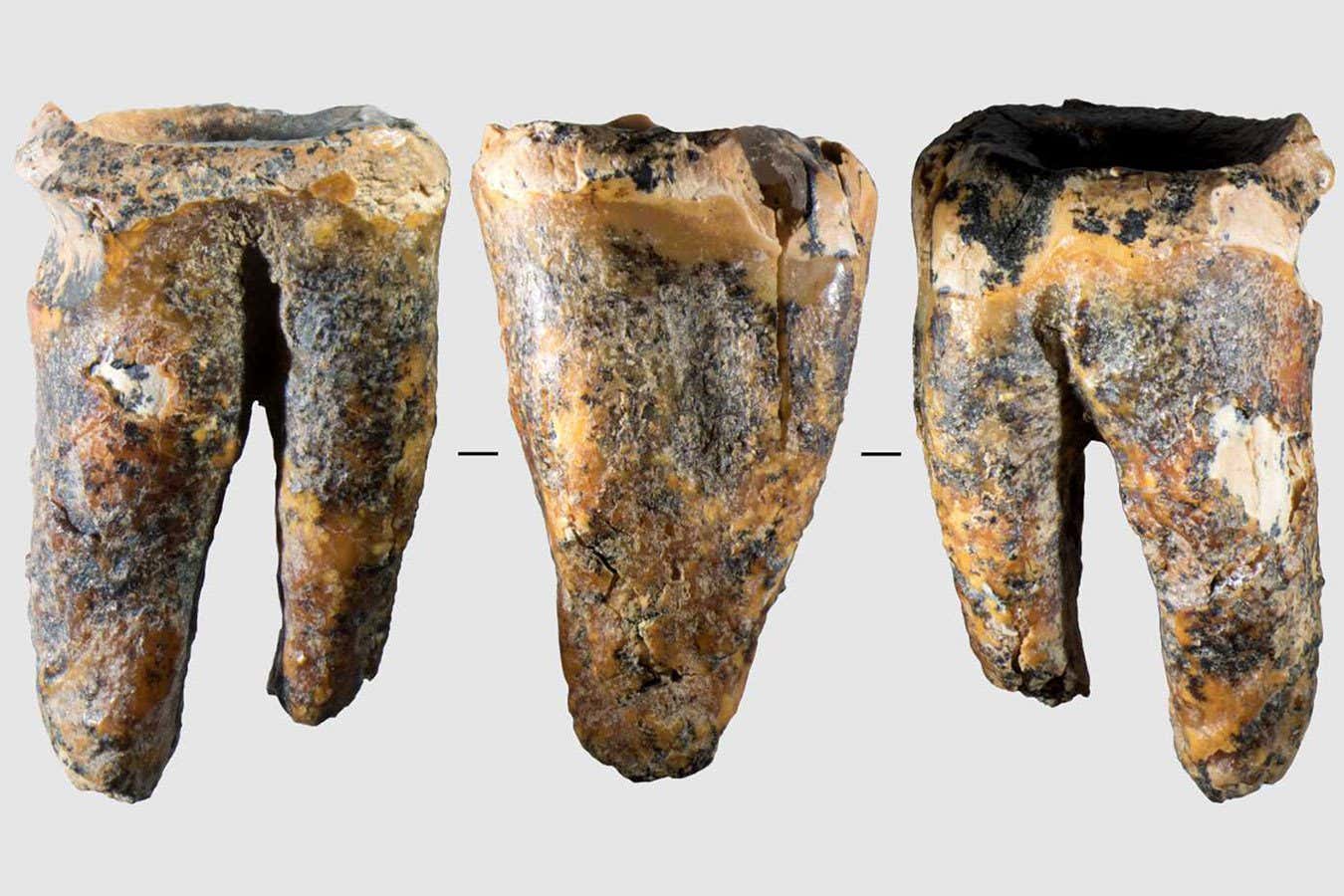
Three views of the Neanderthal tooth with evidence of dental treatment
Hexian Culture, Tourism and Sports Bureau, Ma’anshan
A 59,000-year-old Neanderthal tooth found in a Siberian cave shows signs of deliberate drilling to treat a deep cavity, pushing back the earliest evidence of dentistry by about 45,000 years.
The lower second molar – plagued by suspected bacterial decay – features tell-tale marks of experienced stone-tool boring, in three stages, down to the pulp. While the procedure would have been excruciating, it probably led to pain relief in the individual, who went on to chew with the tooth, possibly for years, says Kseniya Kolobova at the Russian Academy of Sciences.
“Our discovery challenges prejudices about Neanderthal cognition directly, showing that they were capable of causal reasoning about disease,” she says. “We trust the evidence from our microscopes.”
In the Altai mountains of south-western Siberia, Russia – where Neanderthals migrated from Europe about 70,000 years ago – researchers discovered a lower molar with a large, irregularly shaped concavity comprising three partially overlapping dips into the entire pulp chamber.
At first, the team thought it was just a tooth that got broken before or after death, says Andrey Krivoshapkin, also at the Russian Academy of Sciences. But as more scientists examined the tooth, more questions arose about how the tooth got deformed – and if it had been done on purpose. Thus far, the oldest evidence of purposeful dental work dates to 14,000 years ago in a Homo sapiens in Italy and involved scratching, not drilling.
The team asked Lydia Zotkina, also at the Russian Academy of Sciences, to perform in-depth mark analyses on the tooth, revealing clear signs of human intervention, Krivoshapkin says. That led to further investigations using advanced imaging, which showed two cavities and scrapes consistent with repetitive toothpick use. It also revealed traces of rotation by pointed stone tools – probably made of jasper like the tools found in the same cave – directly into the cavity.
The shape of the hole resembles cavity-repair attempts in much more recent humans, with the probable intention of accessing the pulp chamber and removing tissue. The tooth’s polished, rounded contours indicate that the individual continued to use the tooth well after the drilling procedure, Kolobova says.
“At first, we were sceptical,” she says. “But little by little, we realised we were looking at something truly unprecedented: we were about to rewrite a small but important chapter of Neanderthal history.”

The Chagyrskaya cave in south-western Siberia, Russia, where the tooth was found
Ksenia A. Kolobova
To confirm their hypothesis, the researchers tried various drilling and scraping techniques in their lab using replicated fine-pointed jasper stone tools and three Homo sapiens molars – two prehistoric specimens and one modern one with a cavity, which had been recently extracted from Zotkina’s mouth. Neanderthal teeth are too rare and old for such experiments, the researchers explain. The team succeeded in making similar holes in a 50-minute process that required precision and practice to prevent fracturing the tooth itself.
“This was not a fumbling first attempt,” Krivoshapkin says of the Neanderthal case. “The operator knew where to drill, how deep to go and when to stop. Regardless of who held the tool, the intervention demonstrates a remarkable level of cognitive and motor sophistication.”
The pain “would have been immense,” he adds – especially for a Neanderthal, as genetic evidence suggests they had greater pain sensitivity than Homo sapiens do. “Either the patient was extraordinarily stoic, or the person performing the treatment worked very quickly, or both.”
The treatment would probably have led to nerve death, leading to pain relief. “It was invasive, goal-directed and functionally successful,” Kolobova says.
Stefano Benazzi at the University of Bologna in Italy says he is convinced by the results – which are not surprising given the growing body of evidence pointing to Neanderthals’ sophistication. “These findings point to cognitive and behavioural capacities that were far more advanced than long assumed,” he says
Even so, that doesn’t mean Neanderthals had advanced dental skills in particular, he cautions. “My impression is that the pain was probably severe enough that they attempted to remove the affected area by scraping it,” Benazzi says. “It might be more appropriate to refer to this as ‘proto-dentistry’, or something along those lines.”
Embark on a captivating journey through time as you explore key Neanderthal and Upper Palaeolithic sites of southern France, from Bordeaux to Montpellier Topics:
Neanderthals, ancient humans and cave art: France
