

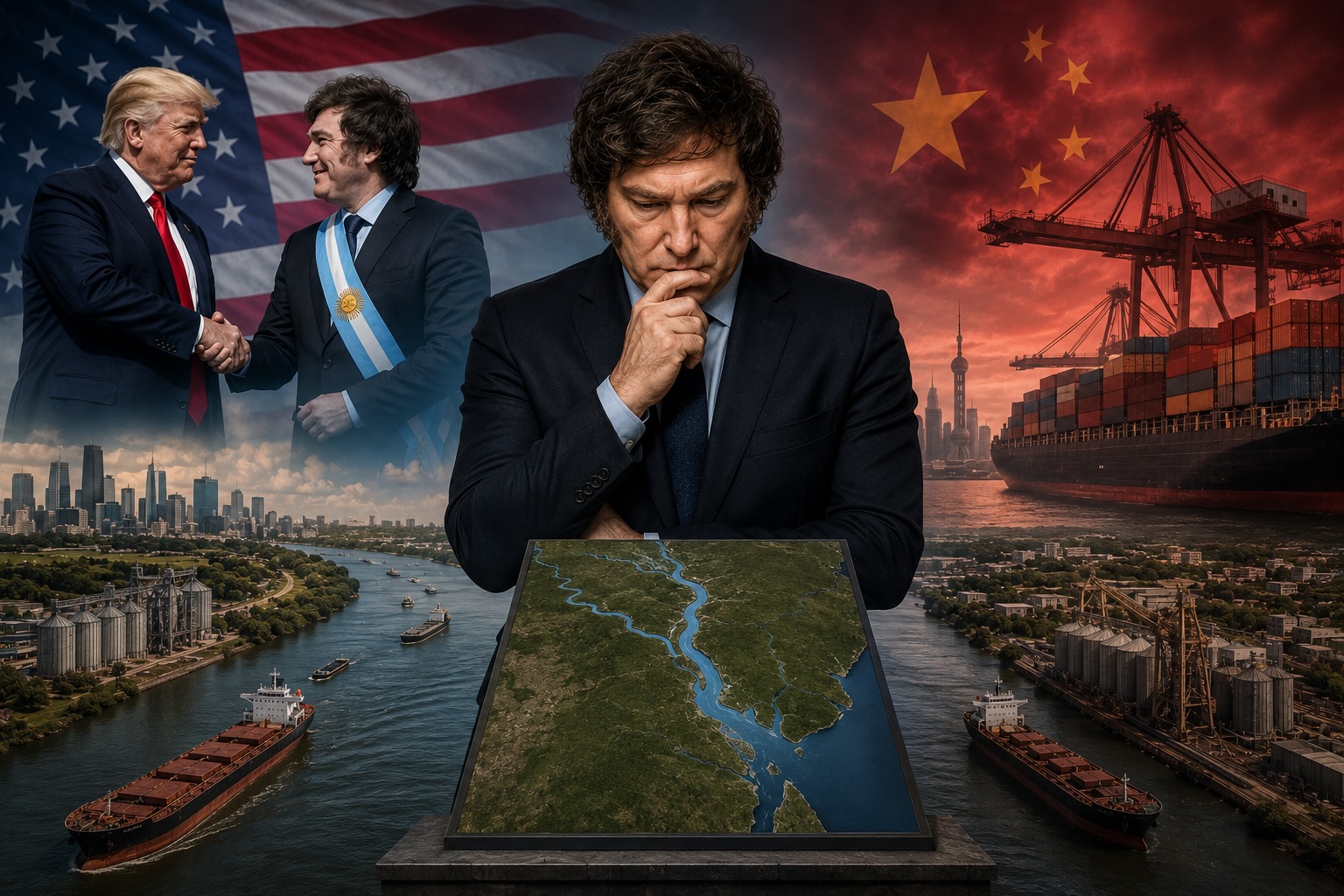
President Javier Milei, a staunch ally of President Trump and vocal opponent of Chinese influence, now confronts a high-stakes decision that could either strengthen or sabotage the budding U.S.-Argentina partnership. At the center of the challenge is the pending 25-year concession for the Hidrovía (Via Navegable Troncal), Argentina’s economic artery and the commercial backbone of the Southern Cone.
This vital inland waterway stretches more than 1,000 miles and carries roughly 80 percent of the country’s imports and exports. Grain, soybeans, minerals, energy products, industrial goods, and future critical minerals all depend on it—making the Hidrovía Argentina’s equivalent of America’s Mississippi River in its influence on competitiveness, food security, export capacity, and national sovereignty.
The Hidrovía tender represents an estimated $10 billion investment opportunity over 25 years, with the potential to deepen the navigation channel from the current 34 feet toward 40 feet. This upgrade would enable larger vessels to carry greater volumes of soybeans, grains, and critical minerals, significantly boosting Argentina’s export competitiveness across Mercosur countries. A U.S.-backed win could also generate up to $4 billion in direct contracting opportunities for American dredging and related firms, strengthening bilateral commercial ties.
While Milei’s government has sought to exclude Chinese state-owned companies from the tender, serious concerns persist that Beijing may secure indirect long-term access through the incumbent operator Jan De Nul’s partnership with the Argentine firm Servimagnus. Servimagnus maintains extensive ties to Chinese state-linked entities including CCCC, Shanghai Dredging, COSCO, and Huawei. U.S. intelligence and enforcement experts have noted more than 180 contacts between Servimagnus headquarters and the Chinese Embassy in Buenos Aires in the past year alone.
The situation is further complicated by Jan De Nul’s past entanglement in a bribery scandal. Three decades ago, its local partner Emepa allegedly paid $600,000 to the corrupt Fernández de Kirchner government to extend the concession. Although Jan De Nul denies knowledge and the partnership has since been restructured, the history raises serious red flags about the reputability of the firm and if they have indirectly benefitted from illicit payoffs..
Control of dredging operations is no routine matter. The winner will shape navigability, shipping costs, schedules, port efficiency, and overall export competitiveness for a generation. A China-connected operator would gain access to sensitive shipping data, vessel traffic, cargo flows, and commercial intelligence, while using Argentina as a regional base to expand into other Western Hemisphere infrastructure projects.
By contrast, a competing U.S.-backed consortium—including Great Lakes Dredge & Dock, KKR, Clear Street, and other American investors—offers transparent partnership, billions in contracting opportunities for U.S. firms, and a genuine strategic alliance that strengthens American dredging capabilities abroad. The tender process, relaunched in December 2025 after earlier failures, is now in its final evaluation stages. Recent scoring of technical envelopes has drawn sharp criticism, with the Jan De Nul-Servimagnus consortium receiving 66.2 points compared to just 42.14 for the U.S.-backed DEME group. Independent observers have alleged the criteria were structured to favor the incumbent, raising questions about transparency even as Milei’s administration pushes privatization reforms.
This tender arrives shortly after the signing of the U.S.-Argentina Reciprocal Trade and Investment Agreement and U.S. support in the form of loan guarantees that helped stabilize Milei’s hold on power in the lead-up to crucial elections that could have sunk his deregulation agenda for good. President Milei has cultivated an exceptionally close alignment with the West, particularly the United States, since taking office. He has visited the U.S. more than a dozen times, forged a personal rapport with President Trump—whom he has publicly called a key ally—and repositioned Argentine foreign policy to mirror Washington’s priorities on issues ranging from countering Chinese influence to supporting democratic values and free enterprise.
Jeopardizing this partnership through a Hidrovía decision that appears to favor China-linked interests would risk eroding the goodwill and concrete assistance that have become lifelines for Milei’s free market economic overhaul, undermining investor confidence and Argentina’s broader economic recovery. For Washington, the outcome tests whether alignment with Argentina delivers reciprocal benefits—keeping critical infrastructure free of adversarial influence and opening markets for American companies. How Milei resolves the Hidrovía concession will send a clear signal about Argentina’s long-term strategic direction and the depth of its partnership with the United States. A 25-year commitment will shape the country’s economy for decades to come and ultimately define Milei’s legacy.
