

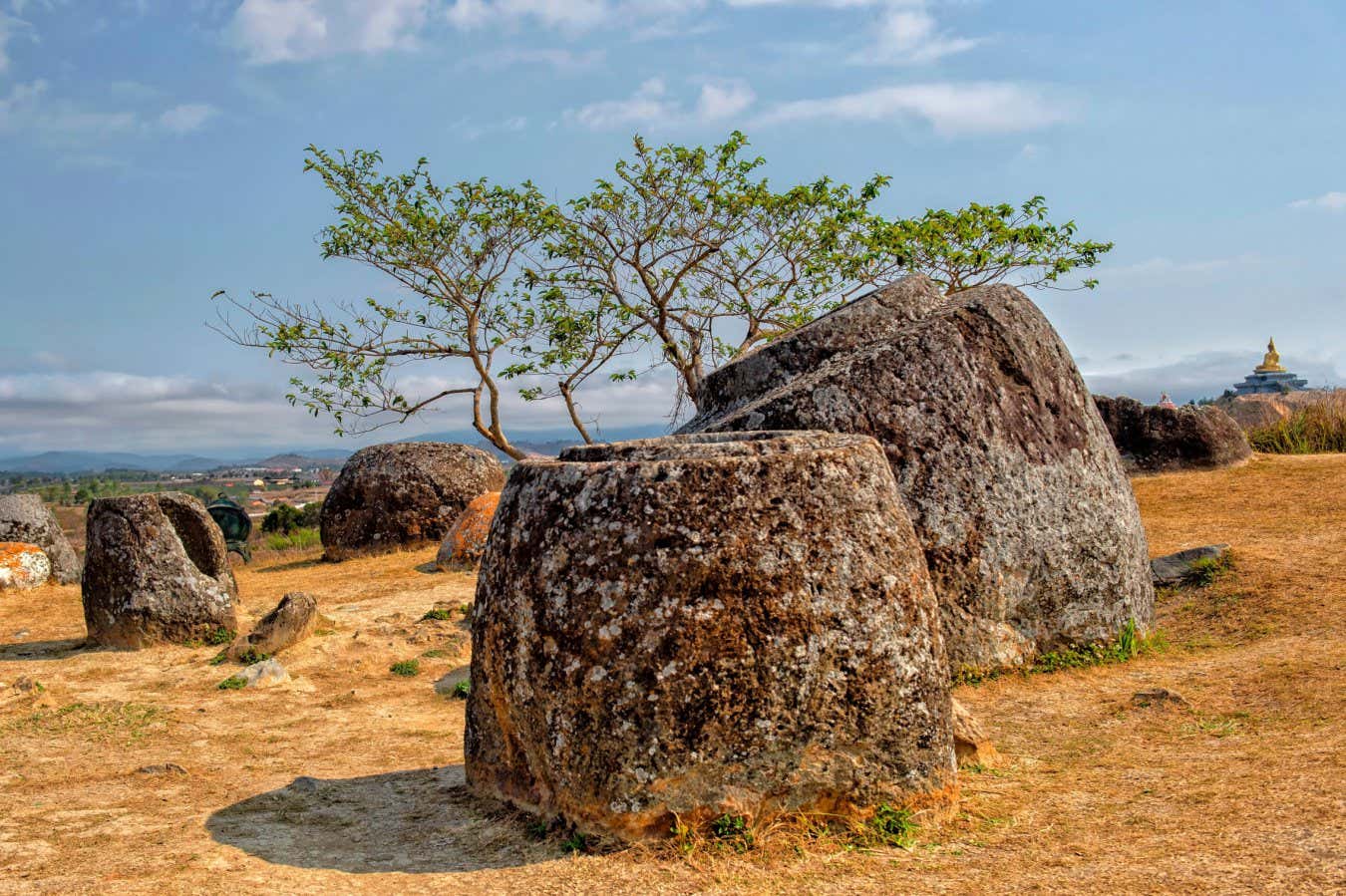
The plain of jars in Laos
Alvov/Shutterstock
The remains of at least 37 people have been found interred in a giant stone jar in Laos, reshaping our understanding of one of South-East Asia’s most puzzling ancient landscapes.
Around the remote Xieng Khouang plateau in central Laos sit thousands of giant stone jars, some 3 metres high and weighing several tonnes. The Plain of Jars has long been thought to be an ancient megalithic site, but who made the jars and what they were used for have remained mysterious.
“There are all these old stories associated with them, that they were made for giants who used them for brewing rice wine,” says Nick Skopal at James Cook University in Australia.
Investigations in the 1930s led to suggestions that the jars were associated with the South-East Asian Iron Age between about 500 BC and AD 500 and were used to cremate or decompose bodies. More recent studies have found glass beads, jewellery and a few cremated remains, as well as burials near the jars but not within them.
Now, Skopal and his colleagues have found the densely packed remains of many people in their excavation of a jar measuring 1.3 metres high and more than 2 metres wide near the Laotian town of Phonsavan. The jar contained the right femurs and skulls from 19 individuals, but teeth from 37 people.
Radiocarbon dating of samples showed that the remains were deposited in multiple phases over up to 270 years, between the 9th and 12th centuries AD.
The remains were neatly packed in, potentially after an initial period of decomposition elsewhere, with the longer bones laid out towards the edges, and many smaller, more fragile bones missing.
“This is an incredibly consequential discovery,” says Nigel Chang, also at James Cook University, who wasn’t involved in the research. “After almost 100 years of speculation, this is the first of these stone jars to be investigated with irrefutable association with mortuary behaviour.”
About 500 metres from the big, primary jar was a group of smaller stone jars, some of which contained glass beads. Skopal suggests that people put dead bodies inside the smaller jars until the flesh deteriorated, then moved the bones to the larger jar.
“Were the stone jars some way for the soul to be released and be prepared for the afterlife as part of ancestor worship?” he says. “We are doing some DNA testing on these remains inside the jar. That will give us an idea of who these people were and how they were related to each other.”
The dating of the samples reveals when this stone jar was being used, but doesn’t show when it was made.
“It seems to be becoming clear that there was a lot of activity around the jar sites in the second half of the first millennium AD or so,” says Chang. “However, my personal opinion is that the jars themselves are older than that: from 2000 or more years ago.”
Unfortunately, you can’t date the jars themselves, says Skopal, but he adds that his team’s dating of artefacts excavated outside the jar matches what’s inside it, which suggests the jar was placed there when the first bodies were put inside. “It’s starting to suggest that it’s more of a medieval culture, and not an Iron Age thing,” he says.

A newly excavated stone jar containing human remains
Dr Nicholas Skopal
Skopal thinks that practice was part of ancestral funerary rites that spanned generations. But there is great variance in the stone jars in Laos, he adds, so there were probably different ways of using them within the wider tradition. At some sites, jars are generally upright, and many are empty – perhaps because of looting – while at other sites, there are many jars with shallower or narrower internal cavities that are lying flat. That implies differences in rites between regions or over time, he says.
“It is very likely that numerous cultural groups could have utilised the jars, or the same cultural group used the same jar as a mortuary facility over an extended period of time,” says Tiatoshi Jamir at Nagaland University in India.
Skopal’s team also found iron tools, earthenware, a copper-based bell and glass beads inside the jar. Chemical analysis revealed the beads were produced in South India and Mesopotamia, indicating long-distance travel and trade.
This isn’t unexpected, he says, given that around AD 1000 was a flourishing period in East and South-East Asia, which included the Song Dynasty and Dali Kingdom in China, Cambodia’s Khmer Empire and the Pagan kingdom in what is now Myanmar.
Marco Mitri at North Eastern Hill University in India, who has worked on similar stone jars in north-east India, more than 1000 kilometres away, says archaeology is revealing an extensive cultural tradition.
He suggests a widespread Austroasiatic population engaged in these funerary traditions for hundreds of years, with similar rites still carried on today in India by an Austroasiatic group called the Khasi, who, after cremation, deposit bones in stone boxes called cists.
New Scientist regularly reports on the many amazing sites worldwide, that have changed the way we think about the dawn of species and civilisations. Why not visit them yourself? Topics:
Discovery Tours: Archaeology and palaeontology
