

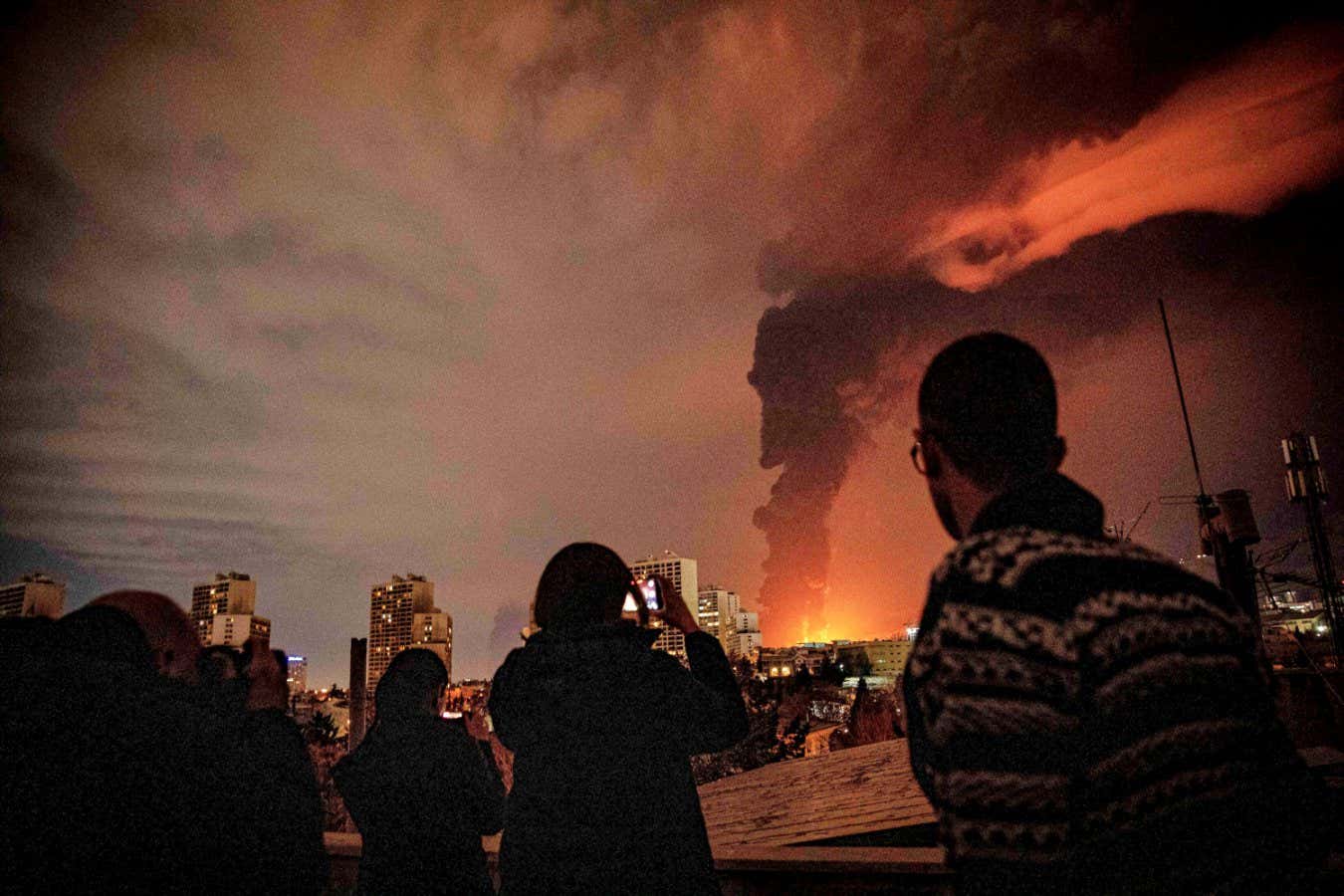
Flames and smoke rise from an oil storage facility struck during attacks on Iran on 7 March
Alireza Sotakbar/ISNA/AP/Alamy
Israeli airstrikes on oil facilities in Tehran on 7 March led to sulphur dioxide emissions equivalent to a small volcanic eruption, potentially exposing people as far away as China to acid rain and toxic air pollution.
As part of the US and Israeli campaign against Iran, warplanes struck several oil depots and a refinery that night, sparking massive fires that lit up the sky and spewed smoke for days. Black rain containing soot and hydrocarbons fell on the Iranian capital, and residents reported eye and skin irritation and difficulty breathing.
Now, data from a new generation of Chinese satellites has shown that the plume of sulphur dioxide released by these explosions and fires covered 300,000 square kilometres, passing over Turkmenistan, Uzbekistan, Kyrgyzstan, Kazakhstan and China.
The brief attack prompted a days-long spike in emissions, injecting a total of 29,800 tonnes of sulphur dioxide, according to Zhenping Yin at Wuhan University in China and his colleagues. For comparison, Iceland’s Eyjafjallajökull volcano was emitting about 20,000 tonnes of sulphur dioxide per day when its ash cloud shut down air travel in Europe in 2010.
The concentrations of sulphur dioxide measured by the satellites reached levels that could impair lung function, irritate the eyes and throat, and exacerbate asthma or bronchitis, especially among children and older people, says Yin.
“Although the major emission event lasted only one to two days, the research notes that the potential impact on the regional atmosphere should not be neglected,” he says. Pollutants may have been rained out over water sources and agricultural land, potentially contaminating drinking water and food, he adds.
Sulphur dioxide reacts with different compounds of hydrogen and oxygen in the air to form sulphuric acid, leading to smog and acid rain. During the Great Smog of 1952, sulphuric acid and other pollution from burning coal killed an estimated 12,000 people in London.
The attack on Tehran released about 20 times more sulphur dioxide than some coal-fired power plants in high-income countries emit in a year, although a coal plant in a nation that doesn’t require scrubbers on smokestacks can emit far more of it.
Besides sulphur dioxide, the burning oil facilities emitted soot and heavy metals. According to Lucy Carpenter at the University of York, UK, the massive quantity of sulphur dioxide emitted suggests the plume held harmful quantities of even more dangerous pollution. This might include nitrogen oxides and polycyclic aromatic hydrocarbons, as well as unburned hydrocarbons like benzene, all of which have been linked to cancer.
“[Sulphur dioxide] would be emitted with a whole range of other things,” says Carpenter. “That amount in one single fire has huge implications for people’s health… over thousands of kilometres.”
These fine particles can stay aloft for days, travelling with the wind. It was impressive that the study was able to trace the evolution of the plume over such a wide area, she says.
The plume only lasted for about three days, which probably isn’t enough time to cause cancer. And the satellites measure sulphur-dioxide concentrations through the entire atmosphere, so the toxin concentration at ground level is unclear. But the pollution could potentially have triggered asthma attacks, strokes or even heart attacks in especially vulnerable people, according to Carpenter.
The Fengyun 3 satellite constellation that the study drew upon provides atmospheric concentrations of sulphur dioxide and other major pollutants to the public within three hours, which could improve disaster response, says Yin. “Satellite data are useful for pollution assessment and early warning for downstream areas.”
Topics:
